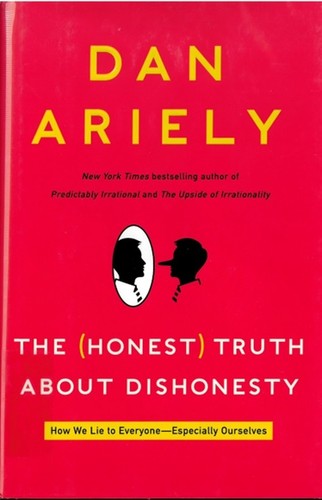
Talk to The (Honest) Truth About Dishonesty like its author wrote you back.
Get the ideas that fit your life — not generic summaries.
- Chat with the book
- Audiobook-style main ideas
- Adapts to your life and goals
- Helps you take action
What it argues
Dan Ariely is a behavioral economist at Duke who studies irrational behavior, and this book applies that framework to a question most people prefer not to examine too closely: why do people cheat? The expected finding — that cheating is driven by rational cost-benefit analysis of getting caught versus the reward — turns out to be largely wrong. People cheat a little, not a lot, even when the probability of detection is zero. What drives cheating is something more like the need to maintain a positive self-image as honest while getting away with something.
The book documents this through clever experiments. Participants who shredded their test answers before reporting their score cheated more than those who handed in their answers, but the increase was modest. Essentially no one cheated the maximum amount, even when they could have claimed any score with no risk of detection. The amount of cheating was more closely related to factors that influence the internal dialogue: whether people had recently recalled the Ten Commandments, whether they saw a peer cheating first, whether they were depleted from prior effort, whether the reward was in cash or tokens.
What it gets right
- 1.
Most dishonesty is not driven by rational calculation of getting caught. People cheat a little even when detection is impossible, and do not maximize cheating even when maximizing is safe.
- 2.
The fudge factor is the psychological range within which people can bend rules while maintaining a positive self-image as basically honest. Dishonesty stays within that range.
- 3.
Factors that make dishonesty feel less like dishonesty — tokens instead of cash, distance from harm, seeing peers cheat — expand the fudge factor and increase cheating.
What it covers
Who wrote it
Dan Ariely is James B. Duke Professor of Psychology and Behavioral Economics at Duke University and a founding member of the Center for Advanced Hindsight. Born in Israel, he suffered severe burns as a teenager and became interested in pain, decision-making, and how physical and emotional states affect judgment. He is the author of Predictably Irrational, The Upside of Irrationality, and several other popular books on behavioral economics. His TED talks have been widely viewed and he has been an influential voice in applying behavioral economics to policy design.
