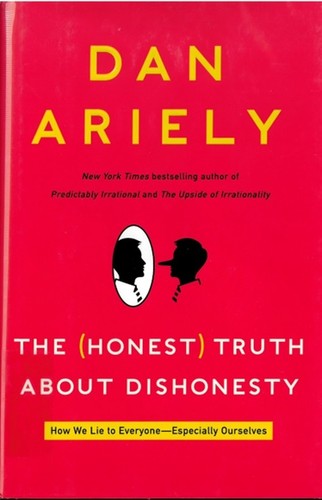
The (Honest) Truth About Dishonesty by Dan Ariely is a 2012 psychology book about dishonesty, behavioral economics, ethics. Most dishonesty is not driven by rational calculation of getting caught. People cheat a little even when detection is impossible, and do not maximize cheating even when maximizing is safe.
Summary
Dan Ariely is a behavioral economist at Duke who studies irrational behavior, and this book applies that framework to a question most people prefer not to examine too closely: why do people cheat? The expected finding — that cheating is driven by rational cost-benefit analysis of getting caught versus the reward — turns out to be largely wrong. People cheat a little, not a lot, even when the probability of detection is zero. What drives cheating is something more like the need to maintain a positive self-image as honest while getting away with something.
The book documents this through clever experiments. Participants who shredded their test answers before reporting their score cheated more than those who handed in their answers, but the increase was modest. Essentially no one cheated the maximum amount, even when they could have claimed any score with no risk of detection. The amount of cheating was more closely related to factors that influence the internal dialogue: whether people had recently recalled the Ten Commandments, whether they saw a peer cheating first, whether they were depleted from prior effort, whether the reward was in cash or tokens.
Ariely argues that most dishonesty is driven by what he calls the fudge factor — the range within which people can bend the rules while still telling themselves they are basically honest. Factors that make dishonesty feel less like dishonesty — tokens instead of money, distance from direct harm, seeing peers cheat — expand the fudge factor. Factors that trigger moral identity — reminders of ethical codes, pledges, moral salient cues — contract it.
The practical implications are direct: if you want to reduce dishonesty in a system, don't focus primarily on detection and punishment. Focus on the factors that allow people to maintain a positive self-image while cheating, and remove or shrink them. Ariely applies this to insurance fraud, academic cheating, financial sector misconduct, and tax compliance.
Talk to The (Honest) Truth About Dishonesty like its author wrote you back.
Get the ideas that fit your life — not generic summaries.
- Chat with the book
- Audiobook-style main ideas
- Adapts to your life and goals
- Helps you take action
Key takeaways
- 1.
Most dishonesty is not driven by rational calculation of getting caught. People cheat a little even when detection is impossible, and do not maximize cheating even when maximizing is safe.
- 2.
The fudge factor is the psychological range within which people can bend rules while maintaining a positive self-image as basically honest. Dishonesty stays within that range.
- 3.
Factors that make dishonesty feel less like dishonesty — tokens instead of cash, distance from harm, seeing peers cheat — expand the fudge factor and increase cheating.
- 4.
Moral reminders work. Signing an honor code at the top of a form rather than the bottom, or recalling a moral code before a task, reduces dishonesty — but only when the reminder comes before the opportunity, not after.
- 5.
Social contagion affects dishonesty. Seeing a peer cheat in plain view increases cheating. Social norms around honesty are actively maintained by the community's visible behavior.
- 6.
Conflicts of interest bias professional judgment even when experts believe they are being objective. The bias is real and operates below conscious awareness.
- 7.
Depletion increases dishonesty. People who have exerted self-control earlier are more likely to cheat later — consistent with ego depletion research, though that research has had replication challenges.
Discussion questions
Use these on your own, with a book club, or as chat starters in Superbook. Book club version, ready to copy or print →
- 1.
Ariely argues that most people cheat within their fudge factor — a little, not a lot. Does that match your observation of behavior in organizations you have been part of?
- 2.
The moral reminder experiments suggest that cuing moral identity before an opportunity reduces cheating. What structures in your own environment already function this way, and what structures are conspicuously absent?
- 3.
He shows that seeing a peer cheat — especially one who is clearly part of your in-group — increases your own cheating. What does that suggest about moral climate in teams and organizations?
- 4.
Ariely discusses conflict of interest in professional settings. Can you identify a case in your own professional life where you believe your judgment was unintentionally biased by incentive?
- 5.
The experiment with tokens instead of cash showed that psychological distance from money increases dishonesty. How does the abstraction of financial instruments in modern economies interact with this finding?
- 6.
Signing an honor code at the top of a form works; signing at the bottom does not. What design changes in forms or processes would make the most difference in real systems?
- 7.
He distinguishes between external deterrence (surveillance, punishment) and identity-based deterrence (making dishonesty inconsistent with self-image). Which do you think is more scalable?
- 8.
Think of an organization you know well. What features of its culture expand or contract the fudge factor for its members?
- 9.
Ariely discusses his own experience with self-deception. What do you think is the category of thing you most regularly tell yourself is okay when it isn't?
- 10.
The book suggests that many people who behave dishonestly at the margins are not primarily motivated by greed. What are the implications for how we design incentives and accountability?
- 11.
If you were redesigning an institution — a university, a company, a government agency — to minimize dishonesty, what three changes would you make based on this research?
Themes
Frequently asked questions
-
Is Dan Ariely's research reliable?
Some of his work has been subject to replication challenges and, in a high-profile case, an investigation found data manipulation in at least one paper he co-authored. This casts some shadow over his work, though the core behavioral economics findings underlying this book come from the broader literature, not only from his lab.
-
What is the fudge factor?
The psychological space within which people can cheat while still considering themselves honest. It is not a fixed amount but depends on context: how much psychological distance exists from the dishonesty, how vivid the moral frame is, and what peers are doing.
-
Does this book apply to major fraud or just small cheating?
Ariely focuses primarily on small cheating — the everyday dishonesty that accumulates across millions of people. He argues this aggregate is economically larger than dramatic fraud, and that understanding small cheating reveals something fundamental about the psychology of dishonesty.
-
What is the most useful design implication from the book?
Move moral commitments to before the opportunity rather than after. Signing forms at the top rather than the bottom, taking oaths before professional actions rather than embedding them in fine print, and making ethical identity salient at the moment of decision rather than after the fact.
-
How does this book relate to Predictably Irrational?
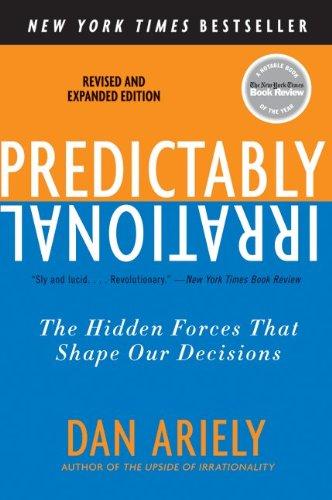
Same author, same behavioral economics framework, narrower focus. Predictably Irrational is a broader survey of irrational behavior; this one focuses specifically on dishonesty. They can be read independently.