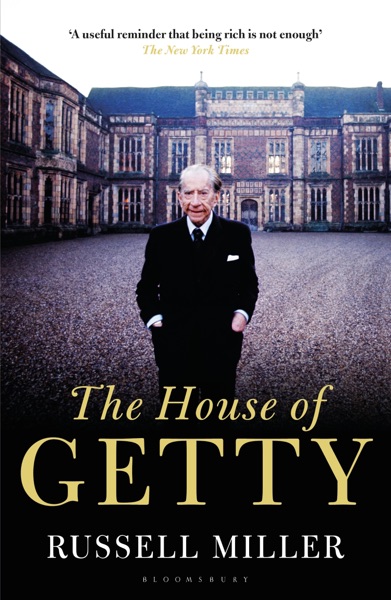
Talk to The House of Getty like its author wrote you back.
Get the ideas that fit your life — not generic summaries.
- Chat with the book
- Audiobook-style main ideas
- Adapts to your life and goals
- Helps you take action
The House of Getty, in detail
The House of Getty is Russell Miller's investigative biography of J. Paul Getty and the dynasty he created. Miller traces the Getty story from J. Paul's early oil ventures in the 1910s through his death in 1976 as arguably the richest private individual in the world, and then follows the family into the subsequent generation — the kidnapping of J. Paul Getty III, the legal battles over the estate, and the ways in which extreme wealth distorted every relationship and institution it touched.
J. Paul Getty himself is the book's central fascination. He was spectacularly rich and spectacularly miserly — a man who installed a pay phone at his English estate, Sutton Place, to prevent guests from running up his phone bill, while simultaneously bidding against the Italian government for Raphael paintings. He married and divorced five times, fathered children with an indifference to their welfare that bordered on cruelty, and spent his later decades as a recluse in England who conducted most of his business by telex. Miller draws on interviews, correspondence, and company documents to build a portrait that is more dimensional than the cartoon miser of popular imagination, but not much more sympathetic.
The kidnapping of Getty's grandson in 1973 — the young man held for five months until his severed ear was sent to a newspaper — is the book's dramatic centerpiece. J. Paul Getty's initial refusal to pay the ransom, and the eventual negotiation that freed his grandson after a reduced payment, became one of the defining stories about how extreme wealth can deform a person's moral reasoning. Miller treats the episode carefully, neither sensationalizing it nor allowing the old man to escape its implications.
The later sections cover the heirs and the institutions — the Getty Oil Company, the Getty Museum, the trust that managed the family wealth. These sections are less gripping than the J. Paul material but important for understanding how a dynasty founded on a single person's will and obsession struggles to survive the founder's death. Miller published the book in 1985, before the subsequent generation's troubles had fully played out, but the pattern he identifies — wealth transmitted, values not — holds through everything that came after.
The big ideas
- 1.
J. Paul Getty accumulated extraordinary wealth through a combination of shrewd oil acquisition, extreme frugality, and a willingness to operate without partners who could constrain him.
- 2.
Miserliness at the scale Getty practiced it was not thrift but a form of control — every transaction was a power relationship, and paying was experienced as surrender.
- 3.
The kidnapping of J. Paul Getty III in 1973 revealed the extent to which the family's patriarch could not separate financial calculation from human obligation, even toward his own grandchildren.
