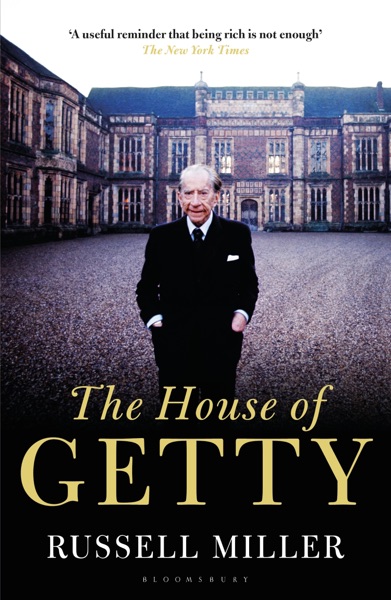
The House of Getty by Russell Miller is a 1985 biography book about wealth, dynasty, dysfunction. J. Paul Getty accumulated extraordinary wealth through a combination of shrewd oil acquisition, extreme frugality, and a willingness to operate without partners who could constrain him.
Summary
The House of Getty is Russell Miller's investigative biography of J. Paul Getty and the dynasty he created. Miller traces the Getty story from J. Paul's early oil ventures in the 1910s through his death in 1976 as arguably the richest private individual in the world, and then follows the family into the subsequent generation — the kidnapping of J. Paul Getty III, the legal battles over the estate, and the ways in which extreme wealth distorted every relationship and institution it touched.
J. Paul Getty himself is the book's central fascination. He was spectacularly rich and spectacularly miserly — a man who installed a pay phone at his English estate, Sutton Place, to prevent guests from running up his phone bill, while simultaneously bidding against the Italian government for Raphael paintings. He married and divorced five times, fathered children with an indifference to their welfare that bordered on cruelty, and spent his later decades as a recluse in England who conducted most of his business by telex. Miller draws on interviews, correspondence, and company documents to build a portrait that is more dimensional than the cartoon miser of popular imagination, but not much more sympathetic.
The kidnapping of Getty's grandson in 1973 — the young man held for five months until his severed ear was sent to a newspaper — is the book's dramatic centerpiece. J. Paul Getty's initial refusal to pay the ransom, and the eventual negotiation that freed his grandson after a reduced payment, became one of the defining stories about how extreme wealth can deform a person's moral reasoning. Miller treats the episode carefully, neither sensationalizing it nor allowing the old man to escape its implications.
The later sections cover the heirs and the institutions — the Getty Oil Company, the Getty Museum, the trust that managed the family wealth. These sections are less gripping than the J. Paul material but important for understanding how a dynasty founded on a single person's will and obsession struggles to survive the founder's death. Miller published the book in 1985, before the subsequent generation's troubles had fully played out, but the pattern he identifies — wealth transmitted, values not — holds through everything that came after.
Talk to The House of Getty like its author wrote you back.
Get the ideas that fit your life — not generic summaries.
- Chat with the book
- Audiobook-style main ideas
- Adapts to your life and goals
- Helps you take action
Key takeaways
- 1.
J. Paul Getty accumulated extraordinary wealth through a combination of shrewd oil acquisition, extreme frugality, and a willingness to operate without partners who could constrain him.
- 2.
Miserliness at the scale Getty practiced it was not thrift but a form of control — every transaction was a power relationship, and paying was experienced as surrender.
- 3.
The kidnapping of J. Paul Getty III in 1973 revealed the extent to which the family's patriarch could not separate financial calculation from human obligation, even toward his own grandchildren.
- 4.
Inherited wealth creates specific psychological pressures on children and grandchildren who did not earn it — a combination of entitlement, resentment, and difficulty finding purpose that Miller traces across two generations.
- 5.
Sutton Place, Getty's English estate, became a stage for a particular kind of reclusive power — surrounded by yes-men, sycophants, and women who depended on his favor while he remained inaccessible to actual intimacy.
- 6.
The Getty Museum was founded with a genuine interest in art but also served as a tax and estate planning vehicle. The line between passion and strategic philanthropy is blurred throughout the family's history.
- 7.
The story of Getty Oil after J. Paul's death illustrates how a company built around one founder's personality and judgment struggles to maintain coherence once that person is gone.
- 8.
Extreme wealth amplifies character flaws rather than creating them. The traits that made Getty successful — obsessive control, distrust, calculation — became more damaging as wealth removed all natural constraints on them.
Discussion questions
Use these on your own, with a book club, or as chat starters in Superbook. Book club version, ready to copy or print →
- 1.
J. Paul Getty was famously frugal despite being the world's richest man. Miller suggests this wasn't hypocrisy but a form of control. Do you find that explanation convincing?
- 2.
How do you read the pay-phone story? Is it a revealing detail about character, or is it the kind of anecdote that gets attached to any rich eccentric because it confirms what we already believe?
- 3.
The kidnapping chapter raises the question of what obligations money creates. Did Getty have a duty to pay the ransom immediately, or does the book's account make his hesitation understandable in any way?
- 4.
Miller traces the damage that J. Paul Getty's emotional unavailability did to his children. How much of what the next generation suffered was caused by money, and how much would have happened in any family with this patriarch?
- 5.
The Getty Museum became one of the world's great art institutions, largely because of the trust structure that controlled its endowment. What does that say about the relationship between the intentions of a founder and the outcomes an institution produces?
- 6.
Miller had limited cooperation from the family while writing this book. How does that affect your reading of it — does the distance from the subjects make it more objective, or less complete?
- 7.
J. Paul Getty spent his final decades isolated in England, running a global oil company by telex, rarely seeing his family. What was he protecting himself from, and at what cost?
- 8.
The book was written in 1985. The subsequent decades brought further Getty family tragedies — drug addiction, accidents, more legal battles. Does the pattern Miller identifies feel like prophecy in retrospect?
- 9.
Miller argues that the wealth distorted every relationship it touched. Can you think of counterexamples — wealthy dynasties or individuals where inherited wealth didn't produce these pathologies? What was different?
- 10.
The Getty story is often told as a cautionary tale. What is the actual lesson — don't be rich, don't be miserly, don't have children, don't neglect your estate planning?
- 11.
How does the Getty family story compare to other great American dynasties — the Rockefellers, the Kennedys, the Mellons? Is there something specifically distorting about oil money versus other kinds of inherited wealth?
Themes
Frequently asked questions
-
Is The House of Getty a reliable biography?
Miller is a credible journalist, but the Getty family was not cooperative with the project, and much of the book relies on secondhand accounts and public records. It should be read as serious investigative biography — rigorous but necessarily incomplete on the family's interior life.
-
Does the book cover the Getty Museum?
Yes, but briefly. The museum is treated as a chapter in the Getty estate history rather than an institution in its own right. For a deeper look at the museum, other sources are more useful.
-
How does this compare to more recent accounts of the Getty family?
More recent coverage — including John Pearson's Painfully Rich — covers the 1990s and 2000s material that Miller couldn't have. But Miller's portrait of J. Paul Getty himself remains one of the most thoroughly researched available.
-
Who should read this book?
People interested in the Gilded Age dynasties and how extreme wealth transmits across generations. Also useful for readers interested in the oil industry's early history or in the psychology of miserliness at an extreme scale.
-
Is the kidnapping section accurate?
The broad facts are well-documented. Miller's interpretation of J. Paul Getty's motivations for initially refusing to pay is partly speculative, which he acknowledges. The episode has been covered in multiple other sources that largely confirm Miller's account.
Similar books
Bad Blood: Secrets and Lies in a Silicon Valley Startup
John Carreyrou
Empire of Pain: The Secret History of the Sackler Dynasty
Patrick Radden Keefe
Shoe Dog: A Memoir by the Creator of Nike
Phil Knight
Liar's Poker
Michael Lewis
