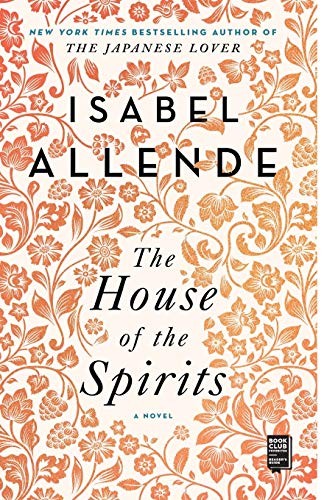
Talk to The House of the Spirits like its author wrote you back.
Get the ideas that fit your life — not generic summaries.
- Chat with the book
- Audiobook-style main ideas
- Adapts to your life and goals
- Helps you take action
What it argues
The House of the Spirits begins with Clara del Valle, a clairvoyant child who stops speaking for nine years after a family tragedy and grows up to become the center of a sprawling Chilean family chronicle. The novel follows four generations of the Trueba and del Valle women from the early twentieth century through the military coup that echoes Pinochet's 1973 takeover of Chile — narrated jointly by Clara's granddaughter Alba, writing from detention, and Esteban Trueba, the patriarch whose violence shapes everything around him.
Allende is working in the tradition of Latin American magical realism — spirits are real, clairvoyance is mundane, roses bloom out of season at will — but she is also writing directly about political history, and the magic gets thinner as the coup approaches, as if the novel's enchantment cannot survive the specific horror it is building toward. The book is partly a love letter to the women of Allende's own family (she wrote it as a letter to her dying grandfather), and partly a reckoning with the political conditions that made violence of the novel's final section possible.
What it gets right
- 1.
Clara's magic is not escapism but a survival strategy — the capacity to inhabit a plane of experience beyond the reach of Esteban's control is how the women of the family persist.
- 2.
Esteban Trueba is a portrait of a contradiction the novel takes seriously: a man capable of genuine love who is also capable of systematic brutality, and who cannot see the connection between the two.
- 3.
The magical realism gradually thins as the coup approaches — Allende is showing that the magic of this world cannot survive the specific historical horror that is coming.
What it covers
Who wrote it
Isabel Allende was born in Peru in 1942 and grew up in Chile, where her cousin Salvador Allende was president until the 1973 coup. She went into exile in Venezuela and later settled in the United States. The House of the Spirits (1982) was her first novel, written initially as a letter to her dying grandfather and published to international acclaim. She has since written more than twenty novels, including Of Love and Shadows, Eva Luna, and The Infinite Plan. She is one of the most widely read Spanish-language novelists in the world. The Isabel Allende Foundation supports the rights of women and girls.
