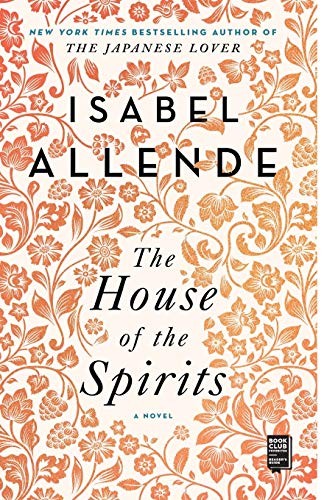
The House of the Spirits by Isabel Allende is a 1982 literary fiction book about political violence and memory, female resilience, magical realism. Clara's magic is not escapism but a survival strategy — the capacity to inhabit a plane of experience beyond the reach of Esteban's control is how the women of the family persist.
Summary
The House of the Spirits begins with Clara del Valle, a clairvoyant child who stops speaking for nine years after a family tragedy and grows up to become the center of a sprawling Chilean family chronicle. The novel follows four generations of the Trueba and del Valle women from the early twentieth century through the military coup that echoes Pinochet's 1973 takeover of Chile — narrated jointly by Clara's granddaughter Alba, writing from detention, and Esteban Trueba, the patriarch whose violence shapes everything around him.
Allende is working in the tradition of Latin American magical realism — spirits are real, clairvoyance is mundane, roses bloom out of season at will — but she is also writing directly about political history, and the magic gets thinner as the coup approaches, as if the novel's enchantment cannot survive the specific horror it is building toward. The book is partly a love letter to the women of Allende's own family (she wrote it as a letter to her dying grandfather), and partly a reckoning with the political conditions that made violence of the novel's final section possible.
The dual narration is one of the novel's cleverest structural choices. Esteban Trueba — landowner, senator, reactionary, wife-beater, rapist — is also one of the novel's most vivid presences, and his genuine love for Clara alongside his capacity for brutality gives the novel a moral complexity that a simpler political novel would sacrifice. Allende's position is not that the right-wing patriarch is understandable and therefore excused, but that the catastrophe the family suffers was made by people who were capable of love.
This is Allende's first novel and her most celebrated. Readers who love Garcia Márquez's One Hundred Years of Solitude will find obvious similarities, and the comparison is fair — but Allende's women are more central and more fully rendered, and the political violence at the novel's end is more direct. A generous, large-hearted, politically serious book that earns its emotions.
Talk to The House of the Spirits like its author wrote you back.
Get the ideas that fit your life — not generic summaries.
- Chat with the book
- Audiobook-style main ideas
- Adapts to your life and goals
- Helps you take action
Key takeaways
- 1.
Clara's magic is not escapism but a survival strategy — the capacity to inhabit a plane of experience beyond the reach of Esteban's control is how the women of the family persist.
- 2.
Esteban Trueba is a portrait of a contradiction the novel takes seriously: a man capable of genuine love who is also capable of systematic brutality, and who cannot see the connection between the two.
- 3.
The magical realism gradually thins as the coup approaches — Allende is showing that the magic of this world cannot survive the specific historical horror that is coming.
- 4.
The novel is structured around women passing knowledge, memory, and resistance forward across generations — the house and its notebooks are the archive of what official history will try to erase.
- 5.
Allende wrote the book as a letter to her dying grandfather, which gives the political chronicle an intimate scale: the coup is not an abstraction but something that happened to specific people in specific rooms.
- 6.
The violence of the final section — torture, disappearance, rape as a political instrument — is rendered without softening. The magic has no power here, which is the point.
- 7.
The dual narration forces the reader to hold two contradictory accounts simultaneously: Esteban's self-justifying version and the women's more honest one. Neither is fully reliable.
- 8.
Clara's notebooks, which she fills obsessively throughout her life, become the basis of Alba's narration — the novel argues that female record-keeping is itself an act of political resistance.
Discussion questions
Use these on your own, with a book club, or as chat starters in Superbook. Book club version, ready to copy or print →
- 1.
Esteban Trueba commits rape and other brutalities but is also rendered with enough sympathy that readers often find him compelling. Is this a failure on Allende's part or the novel's central argument about how political violence is actually produced?
- 2.
The magical elements — Clara's clairvoyance, the moving furniture, the spirits — feel natural in the early sections and fade as the coup approaches. What is Allende saying by making magic incompatible with military dictatorship?
- 3.
The women of the family are more interesting than the men in almost every case. Is this a deliberate structural choice or a consequence of autobiographical material?
- 4.
How does the dual narration — Esteban and Alba — shape what you believe? Are there moments where you find yourself trusting Esteban's version over Alba's?
- 5.
Clara stops speaking for nine years as a child. When she starts again it is to announce her engagement, on her own terms. Is her silence a form of power or a form of damage?
- 6.
Compare The House of the Spirits to One Hundred Years of Solitude as uses of magical realism. What does Allende do differently, and does the comparison illuminate or diminish her novel?
- 7.
The torture scenes in the final section are detailed and disturbing. Some readers find this necessary and honest; others find it exploitative. Where do you land?
- 8.
Alba, writing from detention, is the frame narrator. How does knowing she survived change how you read the novel's political violence? Does the survival feel earned or convenient?
- 9.
Esteban supports the coup that ultimately destroys his own granddaughter. Does his eventual regret change the moral weight of his choices, or does the novel make clear that regret is insufficient?
- 10.
The women in the novel are consistently the ones who preserve memory, nurture community, and resist. Is this a feminist political argument or a kind of essentialism that the novel can't quite escape?
- 11.
Allende published this novel in exile, unable to return to Chile. How does that biographical context change how you read the political content?
- 12.
The house itself — its physical space, its spirits, its eventual transformation — is as much a character as any of the people. What does it represent by the end?
Themes
Frequently asked questions
-
Is The House of the Spirits worth reading?
Yes. It is a generous, emotionally full novel that earns its scope and its politics. The magical realism is handled with a lighter touch than Garcia Márquez, and the historical violence of the final third gives the novel a moral gravity that stays with you.
-
Do I need to know Chilean history to understand the novel?
No, but it helps. The coup at the novel's end clearly echoes Pinochet's 1973 overthrow of Salvador Allende's government. Readers with some background in Latin American political history will catch the specificity; readers without it will still understand the novel's argument about political violence.
-
How does The House of the Spirits compare to One Hundred Years of Solitude?
They share the magical realism register and the multigenerational family chronicle structure. Allende's women are more fully central, the political content is more direct, and the emotional scale is somewhat more intimate. Garcia Márquez is more technically dazzling; Allende is more immediately legible.
-
Is the magical realism distracting or integral?
Integral. The magic is not decoration but a statement about what these women have access to that official reality denies. When it fades, the reader feels the loss — which is the point.
-
Who shouldn't read The House of the Spirits?
Readers sensitive to sexual violence — Esteban commits rape and it is treated with full weight. The final sections depicting political torture are also detailed and disturbing. The novel does not flinch from the violence it describes.