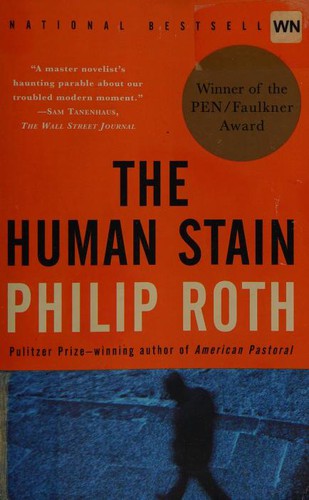
Talk to The Human Stain like its author wrote you back.
Get the ideas that fit your life — not generic summaries.
- Chat with the book
- Audiobook-style main ideas
- Adapts to your life and goals
- Helps you take action
What it argues
Coleman Silk is a seventy-one-year-old classics professor and former dean at Athena College in western Massachusetts who has been driven from his position by a racially charged accusation. In 1998, referring to two students who have never appeared in his class, Silk asks, "Do they exist or are they spooks?" The students are Black; spooks is taken as a racial slur; Silk's career of thirty years is over. The irony, which Roth discloses early: Silk himself is Black, a light-skinned man who passed for Jewish for his entire adult life, reinventing himself so completely that his own children do not know their grandfather was a Black man from East Orange, New Jersey.
The Human Stain is the final volume of Roth's American Trilogy and its most politically direct. Nathan Zuckerman, the novelist narrator who runs through so much of Roth's work, pieces together Silk's story alongside Silk's late-life affair with Faunia Farley, a much younger janitor who may or may not be illiterate, and the shadow of Faunia's violent ex-husband, a Vietnam veteran named Lester Farley. The political year is 1998, and the Clinton-Lewinsky scandal runs as background radiation — a country convulsing in public moral judgment while its own hypocrisies operate everywhere.
What it gets right
- 1.
Coleman Silk's passing as Jewish when he is Black is rendered as a quintessentially American act of self-invention — the freedom to become whoever you choose, and the cost of that freedom.
- 2.
The 1998 Clinton-Lewinsky backdrop is not decoration: Roth is arguing that a society conducting a public moral spectacle about sexual transgression is also conducting one about its own racial history.
- 3.
The accusation that destroys Silk is technically unjust — he was not using a racial slur — but Roth doesn't let that injustice become the simple point; the irony is more layered than righteous indignation.
What it covers
Who wrote it
Philip Roth (1933–2018) was an American novelist and one of the dominant literary figures of the postwar era. His major works include Portnoy's Complaint (1969), the Zuckerman Bound tetralogy, and the American Trilogy — American Pastoral (1997), I Married a Communist (1998), and The Human Stain (2000). He won the Pulitzer Prize for American Pastoral, two National Book Awards, three PEN/Faulkner Awards, and the Man Booker International Prize. He announced his retirement from fiction writing in 2012 and died in 2018.
