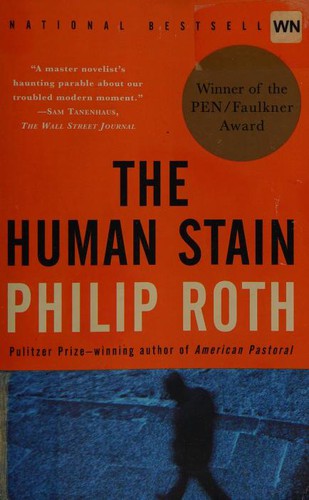
The Human Stain by Philip Roth is a 2000 literary fiction book about race and passing, political correctness and accusation, identity and reinvention. Coleman Silk's passing as Jewish when he is Black is rendered as a quintessentially American act of self-invention — the freedom to become whoever you choose, and the cost of that freedom.
Summary
Coleman Silk is a seventy-one-year-old classics professor and former dean at Athena College in western Massachusetts who has been driven from his position by a racially charged accusation. In 1998, referring to two students who have never appeared in his class, Silk asks, "Do they exist or are they spooks?" The students are Black; spooks is taken as a racial slur; Silk's career of thirty years is over. The irony, which Roth discloses early: Silk himself is Black, a light-skinned man who passed for Jewish for his entire adult life, reinventing himself so completely that his own children do not know their grandfather was a Black man from East Orange, New Jersey.
The Human Stain is the final volume of Roth's American Trilogy and its most politically direct. Nathan Zuckerman, the novelist narrator who runs through so much of Roth's work, pieces together Silk's story alongside Silk's late-life affair with Faunia Farley, a much younger janitor who may or may not be illiterate, and the shadow of Faunia's violent ex-husband, a Vietnam veteran named Lester Farley. The political year is 1998, and the Clinton-Lewinsky scandal runs as background radiation — a country convulsing in public moral judgment while its own hypocrisies operate everywhere.
The book is about what Roth calls the human stain — the ineradicable mark of being human, the impossibility of self-invention that is completely clean, the way desire and history and biology compromise whatever story we want to tell about ourselves. Silk's passing is presented not as racial betrayal but as American act — the most American possible expression of self-creation — and the novel is deeply ambivalent about whether to condemn or admire it. Faunia's story adds a parallel meditation on what happens to women who refuse the roles offered to them.
This is Roth at his most politically engaged and also his most willing to write characters who are morally complicated beyond resolution. Zuckerman is an unreliable narrator by construction — he is inventing significant portions of Silk's inner life — which gives the novel an epistemological uncertainty that its themes demand. Readers who find Roth's treatment of women too objectifying will find evidence for that reading here; readers who find him the sharpest anatomist of American self-deception will find it as well. Both readings are sustainable.
Talk to The Human Stain like its author wrote you back.
Get the ideas that fit your life — not generic summaries.
- Chat with the book
- Audiobook-style main ideas
- Adapts to your life and goals
- Helps you take action
Key takeaways
- 1.
Coleman Silk's passing as Jewish when he is Black is rendered as a quintessentially American act of self-invention — the freedom to become whoever you choose, and the cost of that freedom.
- 2.
The 1998 Clinton-Lewinsky backdrop is not decoration: Roth is arguing that a society conducting a public moral spectacle about sexual transgression is also conducting one about its own racial history.
- 3.
The accusation that destroys Silk is technically unjust — he was not using a racial slur — but Roth doesn't let that injustice become the simple point; the irony is more layered than righteous indignation.
- 4.
Zuckerman's narration acknowledges its own unreliability — he is partly inventing what he tells us, which means the novel is also about how we construct other people's stories to serve our own needs.
- 5.
Faunia Farley is one of Roth's most carefully constructed female characters: her apparent passivity is a form of agency, and her relationship with Silk is not simply a late-life male fantasy.
- 6.
Lester Farley — the Vietnam veteran, the violent ex-husband — is given enough interiority that his menace comes with context, which is more disturbing than if he were simply a monster.
- 7.
The human stain of the title refers to the inescapability of being human — the way desire, history, and the body contaminate whatever self-presentation we attempt.
- 8.
The novel argues that the progressive impulse toward purity — the moral policing of the late 1990s campus — is itself a form of American Puritanism, continuous with the traditions it claims to oppose.
Discussion questions
Use these on your own, with a book club, or as chat starters in Superbook. Book club version, ready to copy or print →
- 1.
Coleman Silk chose to pass as white/Jewish rather than live as Black in postwar America. The novel presents this as an exercise of freedom rather than betrayal. Do you agree with that framing? What does it cost him that he perhaps didn't fully reckon with?
- 2.
The accusation against Silk is technically wrong — 'spooks' was not used racially — but he can't defend himself without revealing his secret. Does the irony make the injustice worse, or does it complicate any simple outrage?
- 3.
Zuckerman openly acknowledges that he is inventing significant portions of Silk's interior life. How does that admission change your relationship with the narrative?
- 4.
The Clinton-Lewinsky scandal runs through the novel as a kind of moral atmosphere. How does Roth use it? Is the parallel he draws between public moral spectacle and private hypocrisy convincing?
- 5.
Faunia may or may not be genuinely illiterate — her literacy might be a performance of its own. What does that ambiguity add to the novel's argument about identity?
- 6.
Silk's family doesn't know his secret. His Black relatives are given a brief, moving scene in the novel. How does the novel handle the loss and damage of his passing on the people he left behind?
- 7.
Lester Farley's chapters give him interiority and a kind of sympathy — his damage is real and has a history. Does that complexity make him more or less frightening?
- 8.
Roth has been accused of writing women primarily as they are perceived by his male characters. Does Faunia feel like a full character or a projection? Does it matter for the novel's arguments?
- 9.
The title, the human stain, refers to the impossibility of purity. Is Roth arguing for a kind of moral realism — accept your stain — or for something more specific about the American racial situation?
- 10.
The novel ends with an image of Lester Farley on the ice. What is Roth doing with that image? Is it a resolution or a threat?
- 11.
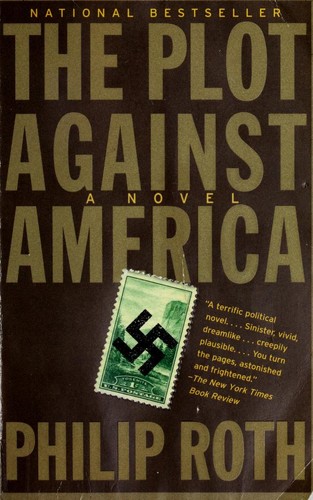
Compare The Human Stain to The Plot Against America as Roth novels about race in America. Which argument feels more urgent?
- 12.
Silk reinvents himself completely and succeeds for decades. Is his life story a tragedy, a success, or both?
Themes
Frequently asked questions
-
What is The Human Stain about, without spoilers?
A classics professor is accused of racism based on a misunderstanding and loses his career. The novel then reveals a secret about the professor's identity that makes the situation more ironic than it first appears. It's also about his late-life relationship with a much younger woman and the dangerous man in her past.
-
Is The Human Stain hard to read?
It's dense and intellectually demanding — Roth is making arguments through character and situation, and the arguments reward slow reading. It is not structurally experimental; the prose is clear and driving. The emotional difficulty is in sitting with characters who are all compromised in different ways.
-
Do I need to read the other American Trilogy novels first?
No, but reading American Pastoral first is worthwhile — it's the most celebrated of the three and sets up Zuckerman as narrator. The Human Stain works independently, and many readers consider it the trilogy's strongest volume.
-
Is there an adaptation?
Yes. A film adaptation was released in 2003 with Anthony Hopkins as Coleman Silk and Nicole Kidman as Faunia. It was not well-received — casting Hopkins in a role where Silk's racial passing is central created obvious problems — and is generally considered inferior to the novel.
-
Who shouldn't read The Human Stain?
Readers who are very sensitive to Roth's representation of women will find material here that supports the critique. Those who want narrative momentum over argument will find the pace contemplative. And if you're looking for a more direct engagement with American racial history, non-fiction accounts of passing will give you things this novel doesn't.