Business · Book club
The Innovator's Dilemma book club questions
Here are 12 book club questions for The Innovator's Dilemma by Clayton M. Christensen, ordered to open easily and end somewhere worth arguing about. Copy them, print them, or bring them up one at a time.
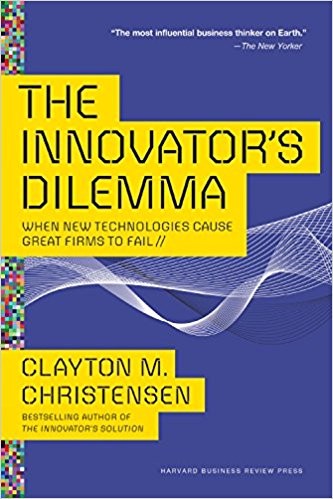
Christensen's argument, published in 1997, is deceptively simple: the very practices that make companies excellent at serving their current customers — listening carefully, investing in proven technologies, targeting the most profitable segments — are precisely what causes them to miss disruptive innovations.
Clayton M. Christensen · 1997 · 4h 15m
Full summary and key takeaways →The 12 questions
- 1.
Christensen argues that successful management practices are what cause companies to fail. Where in your industry or organization do you see this pattern?
- 2.
Think of a product or company that disrupted an industry you know. Did the disruptor start by targeting customers the incumbents ignored?
- 3.
What would it actually take for a large company to spin out a genuinely autonomous unit to chase a disruptive opportunity? What organizational forces would resist?
- 4.
The integrated steelmills could see the minimills taking rebar and still made rational decisions to cede the segment. Would you have made the same decision in their position?
- 5.
Christensen says you cannot rely on customer feedback to detect disruptive threats, because the relevant customers don't exist yet. How would you build a threat-sensing practice without that input?
- 6.
If you run a business or team, identify one low-margin, low-status segment of your market that you currently ignore. Is there a disruptor moving upmarket from there?
- 7.
The book distinguishes sustaining innovations from disruptive ones. Which of the improvements your organization is working on right now are sustaining, and which might be disruptive?
- 8.
Christensen published this in 1997 using disk drives as his primary case study. How well does the framework apply to a disruption you have personally lived through?
- 9.
The prescribed solution — spin out an autonomous organization — sounds clean in theory. What makes it so difficult in practice, and have you seen it work?
- 10.
What industry do you think is currently in the early stages of being disrupted from below? Who is the minimill in that story?
- 11.
Christensen's concept of disruption has been widely misused to describe almost any competitive threat. What gets lost when the word is stretched that far?
- 12.
If you were advising the CEO of a company that had just identified a potential disruptive threat to its core business, what would you tell them to do in the next twelve months?
How to run the discussion
- Pick six to eight, not all of them. An hour of real discussion covers fewer questions than anyone expects, and racing the list is what makes a book club feel like homework.
- Open with what people noticed, not what they concluded. Asking for a verdict first hardens opinions before anyone has heard each other.
- Let the disagreement run. The questions below that split a room are the ones worth the time; the ones everyone answers the same way can be skipped.
- Ask the quiet person a specific question. A direct, narrow question is far easier to answer than an open invitation to contribute.
Themes worth steering toward
If the conversation stalls, these are the threads that usually restart it.
Common questions
What are good book club questions for The Innovator's Dilemma?
Here are 12 book club questions for The Innovator's Dilemma by Clayton M. Christensen, ordered to open easily and end somewhere worth arguing about. The strongest openers ask what each reader noticed rather than what they concluded, and the discussion usually turns on disruption, innovation, business strategy.
How long should a book club discussion of The Innovator's Dilemma last?
Most groups run 60 to 90 minutes of actual discussion. That is roughly six to eight questions, not all of them, so pick the ones that suit your group rather than working down the list in order.
What are the main themes in The Innovator's Dilemma?
Disruption, Innovation, Business strategy, Technology management, Incumbent failure. Those are the threads most likely to divide a room, which makes them the useful places to steer a discussion that has gone quiet.
Picking the next one? See books like The Innovator's Dilemma or questions for other book club picks.
