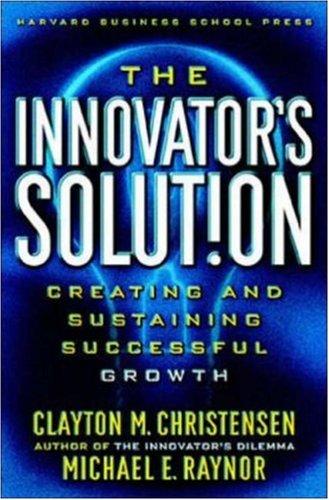
Talk to The Innovator's Solution like its author wrote you back.
Get the ideas that fit your life — not generic summaries.
- Chat with the book
- Audiobook-style main ideas
- Adapts to your life and goals
- Helps you take action
The Innovator's Solution, in detail
The Innovator's Solution is Christensen and Raynor's follow-up to The Innovator's Dilemma, which explained why great companies fail in the face of disruptive innovation. This book addresses the natural next question: if you understand the dilemma, how do you either become the disruptor or avoid being disrupted? It is more prescriptive than the first book, and it provides a more developed framework for thinking about where to play and how to win in disruptive innovation.
The book's central refinement is the distinction between sustaining innovation — making better products for existing customers — and disruptive innovation — introducing a simpler, cheaper solution that initially appeals to non-consumers or underserved customers before eventually improving to take over the mainstream. The Innovator's Dilemma showed why disruption happens; The Innovator's Solution addresses how to create and sustain disruptive growth deliberately.
One of the most useful contributions is the Jobs to Be Done framework, introduced here and later developed further by Christensen. The argument is that customers don't buy products; they hire them to do a job. Understanding the job — what the customer is trying to accomplish, what the circumstances are, what the constraints are — is more predictive of what a product needs to be than demographic segmentation or feature analysis. Two seemingly similar customers may have very different jobs; two demographically different customers may have the same job.
The book also addresses the organizational challenge: large companies typically cannot innovate disruptively within their existing structures because the processes, values, and resource allocation mechanisms that make them successful at sustaining innovation systematically prevent disruptive work. Christensen and Raynor advocate spinning out separate units with different cost structures, profit formulas, and management processes when disruptive innovation is the goal. The honest caveat: the spin-out prescription is harder to execute than to prescribe, and many attempts to implement it fail for political and organizational reasons.
The big ideas
- 1.
Sustaining innovation improves existing products for existing customers. Disruptive innovation initially serves non-consumers or underserved customers before improving to capture the mainstream.
- 2.
Jobs to Be Done: customers don't buy products — they hire them to accomplish something in their lives. Understanding the job drives better product design than demographic or psychographic segmentation.
- 3.
Non-consumption is the most reliable target for disruption. Finding people who aren't served by existing solutions — because they're too expensive, complicated, or inaccessible — identifies where disruption can enter.
