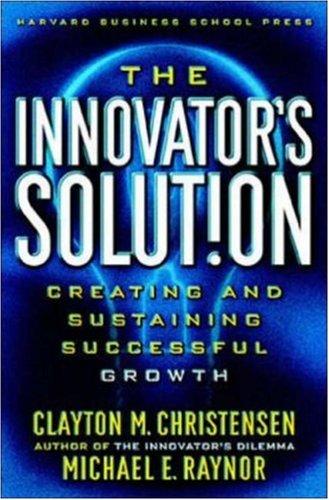
The Innovator's Solution by Clayton M. Christensen and Michael E. Raynor is a 2003 business book about innovation, strategy, startups. Sustaining innovation improves existing products for existing customers. Disruptive innovation initially serves non-consumers or underserved customers before improving to capture the mainstream.
Summary
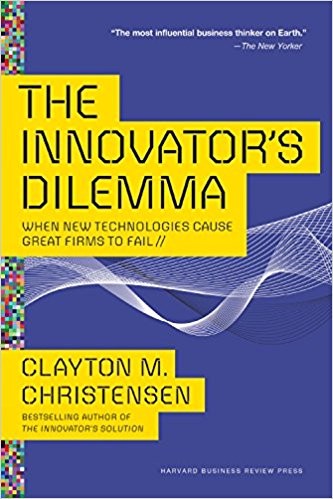
The Innovator's Solution is Christensen and Raynor's follow-up to The Innovator's Dilemma, which explained why great companies fail in the face of disruptive innovation. This book addresses the natural next question: if you understand the dilemma, how do you either become the disruptor or avoid being disrupted? It is more prescriptive than the first book, and it provides a more developed framework for thinking about where to play and how to win in disruptive innovation.
The book's central refinement is the distinction between sustaining innovation — making better products for existing customers — and disruptive innovation — introducing a simpler, cheaper solution that initially appeals to non-consumers or underserved customers before eventually improving to take over the mainstream. The Innovator's Dilemma showed why disruption happens; The Innovator's Solution addresses how to create and sustain disruptive growth deliberately.
One of the most useful contributions is the Jobs to Be Done framework, introduced here and later developed further by Christensen. The argument is that customers don't buy products; they hire them to do a job. Understanding the job — what the customer is trying to accomplish, what the circumstances are, what the constraints are — is more predictive of what a product needs to be than demographic segmentation or feature analysis. Two seemingly similar customers may have very different jobs; two demographically different customers may have the same job.
The book also addresses the organizational challenge: large companies typically cannot innovate disruptively within their existing structures because the processes, values, and resource allocation mechanisms that make them successful at sustaining innovation systematically prevent disruptive work. Christensen and Raynor advocate spinning out separate units with different cost structures, profit formulas, and management processes when disruptive innovation is the goal. The honest caveat: the spin-out prescription is harder to execute than to prescribe, and many attempts to implement it fail for political and organizational reasons.
Talk to The Innovator's Solution like its author wrote you back.
Get the ideas that fit your life — not generic summaries.
- Chat with the book
- Audiobook-style main ideas
- Adapts to your life and goals
- Helps you take action
Key takeaways
- 1.
Sustaining innovation improves existing products for existing customers. Disruptive innovation initially serves non-consumers or underserved customers before improving to capture the mainstream.
- 2.
Jobs to Be Done: customers don't buy products — they hire them to accomplish something in their lives. Understanding the job drives better product design than demographic or psychographic segmentation.
- 3.
Non-consumption is the most reliable target for disruption. Finding people who aren't served by existing solutions — because they're too expensive, complicated, or inaccessible — identifies where disruption can enter.
- 4.
New-market disruption creates new categories by bringing functionality to non-consumers. Low-end disruption attacks the least profitable customers of an incumbent with a lower-cost model.
- 5.
The resources, processes, and values (RPV) framework: a company's capabilities are defined by these three factors, and what makes a company capable in one context makes it incapable in another.
- 6.
Disruptive business units cannot be managed within the existing organizational structure. They require separate cost structures, profit formulas, and measurement systems that would be rejected as inadequate by the mainstream business.
- 7.
Predictable innovation is possible. The trajectory of improvement in any category follows a pattern — performance that initially undershoots what the market needs eventually overshoots it, creating vulnerability.
- 8.
The company that defines what the customer needs to hire their product to do — the job definition — creates the most defensible position against disruption.
Discussion questions
Use these on your own, with a book club, or as chat starters in Superbook. Book club version, ready to copy or print →
- 1.
Apply the Jobs to Be Done lens to a product you use regularly. What job are you hiring it for? Is the product designed around that job, or around a different one?
- 2.
Where do you see non-consumption in a market you know? Who is not being served by existing solutions, and why? What would it take to serve them profitably?
- 3.
The RPV framework says a company's capabilities are defined by its resources, processes, and values. Which of the three is most resistant to change when a company tries to pursue disruptive innovation?
- 4.
Christensen says large companies should spin out disruptive units rather than pursuing disruption within the existing structure. What makes that prescription so difficult to execute?
- 5.
What is the difference between new-market disruption and low-end disruption? Can you find an example of each in a market you follow?
- 6.
The overshooting thesis: performance eventually exceeds what most customers need, creating vulnerability. Where do you see current market leaders that may be overshooting their mainstream customers?
- 7.
How does the Jobs to Be Done framework change how you would conduct customer research? What questions would you ask that you wouldn't otherwise?
- 8.
Christensen argues that most diversification moves fail because companies don't understand which capabilities they actually have that are valuable in new contexts. How do you audit your organization's real capabilities versus its self-described ones?
- 9.
The Innovator's Dilemma described the problem; The Innovator's Solution describes the prescription. Is the prescription sufficient, or are there elements of the dilemma that Christensen hasn't fully solved?
- 10.
What industry are you most familiar with that is currently being disrupted? Identify the disruptors: are they low-end, new-market, or some combination?
- 11.
How does Competing Against Luck differ from The Innovator's Solution in how it uses the Jobs to Be Done concept?
Themes
Frequently asked questions
-
Should I read The Innovator's Dilemma before The Innovator's Solution?
The Solution assumes familiarity with The Dilemma but is readable on its own. Reading them in order gives the fullest picture of the theory and its application. The Solution adds the Jobs to Be Done framework and the prescriptive organizational advice that The Dilemma left largely unaddressed.
-
What is the Jobs to Be Done framework?
The insight that customers hire products to accomplish specific jobs in their lives. Understanding the job — the circumstances, the constraints, the outcome sought — is more predictive of what a product needs to be than any demographic or psychographic segmentation. Products designed around the right job outperform those designed around customer profiles.
-
What is the difference between sustaining and disruptive innovation?
Sustaining innovation improves existing products for existing customers on dimensions they already value. Disruptive innovation initially underperforms sustaining innovation on mainstream metrics but excels on different dimensions — price, accessibility, simplicity — that appeal to non-consumers or underserved customers.
-
Can large companies disrupt themselves?
Rarely, within their existing structure. Christensen argues they must spin out separate units with different cost structures, profit formulas, and measurement systems. The existing organization's resource allocation and values systematically prevent disruptive work from being funded or prioritized.
-
Is the disruption theory still predictive?
The core mechanism — non-consumption as a beachhead, performance trajectory overshoot — has explained many major market shifts since 1997. Critics argue it has been applied too broadly and retroactively to cases that don't fit the theory. The theory is most reliable when the specific conditions — non-consumption, overshoot, new entrant with different cost structure — are present.