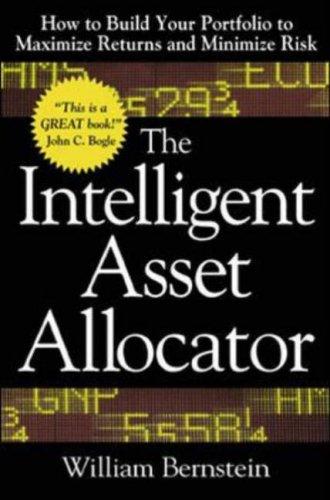
Talk to The Intelligent Asset Allocator like its author wrote you back.
Get the ideas that fit your life — not generic summaries.
- Chat with the book
- Audiobook-style main ideas
- Adapts to your life and goals
- Helps you take action
What it argues
The Intelligent Asset Allocator is William Bernstein's argument that the most important decision an investor makes is not which stock to buy but how to divide a portfolio across different asset classes. Bernstein, a neurologist who became an investment theorist, wrote the book as a quantitative primer for individual investors — one that takes the mathematics of portfolio theory seriously without requiring a finance degree. The central thesis is that diversification across low-correlating asset classes is the only free lunch in investing: it reduces risk without proportionally reducing returns.
The first part of the book introduces the foundational concepts of risk and return at the asset class level. Bernstein shows historical return and volatility data for stocks, bonds, small-cap stocks, international equities, and real assets, and explains why combining asset classes with low correlation produces better risk-adjusted outcomes than concentrating in the best-performing single class. He walks through the mechanics of mean-variance optimization — the mathematical framework for identifying efficient portfolio combinations — in language that is rigorous but readable.
What it gets right
- 1.
Asset allocation — how you divide a portfolio among different asset classes — explains the majority of long-term portfolio returns, not individual security selection.
- 2.
Diversifying across low-correlating assets reduces portfolio volatility without proportionally reducing expected returns. This is the core principle of modern portfolio theory.
- 3.
Historical return data shows that small-cap and value stocks have produced higher long-term returns than large-cap growth stocks, though with higher volatility.
What it covers
Who wrote it
William J. Bernstein is a retired neurologist and self-taught investment theorist who became one of the most respected independent voices in personal finance. He is the founder of Efficient Frontier Advisors and the author of several books including The Four Pillars of Investing, The Birth of Plenty, and A Splendid Exchange. His work is grounded in empirical finance and portfolio theory, and he writes for individual investors rather than professionals. He is known for combining intellectual rigor with skepticism about the financial industry.
