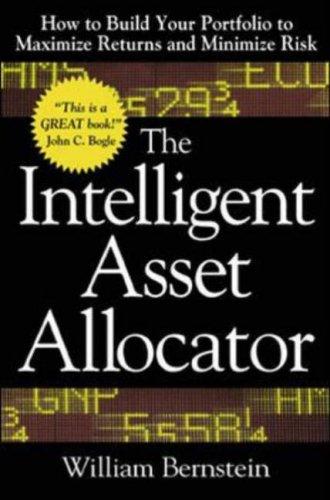
Talk to The Intelligent Asset Allocator like its author wrote you back.
Get the ideas that fit your life — not generic summaries.
- Chat with the book
- Audiobook-style main ideas
- Adapts to your life and goals
- Helps you take action
The Intelligent Asset Allocator, in detail
The Intelligent Asset Allocator is William Bernstein's argument that the most important decision an investor makes is not which stock to buy but how to divide a portfolio across different asset classes. Bernstein, a neurologist who became an investment theorist, wrote the book as a quantitative primer for individual investors — one that takes the mathematics of portfolio theory seriously without requiring a finance degree. The central thesis is that diversification across low-correlating asset classes is the only free lunch in investing: it reduces risk without proportionally reducing returns.
The first part of the book introduces the foundational concepts of risk and return at the asset class level. Bernstein shows historical return and volatility data for stocks, bonds, small-cap stocks, international equities, and real assets, and explains why combining asset classes with low correlation produces better risk-adjusted outcomes than concentrating in the best-performing single class. He walks through the mechanics of mean-variance optimization — the mathematical framework for identifying efficient portfolio combinations — in language that is rigorous but readable.
The second part moves to practical portfolio construction. Bernstein critiques active management and market timing with data, concludes that the average investor is better served by low-cost index funds, and gives specific model portfolios for investors at different stages of life and risk tolerance. He covers the mechanics of rebalancing — how selling winners and buying laggards systematically enforces buy-low-sell-high discipline — and explains why most investors resist it for psychological reasons.
The book's intellectual honesty is its distinguishing trait. Bernstein does not promise market-beating returns; he argues that most investors will underperform a simple index portfolio because of costs, taxes, and behavioral errors. The goal is to capture market returns reliably rather than chase exceptional ones. For readers who want to understand why passive diversification works at a deeper level than most personal finance books provide, this remains one of the clearest explanations available.
The big ideas
- 1.
Asset allocation — how you divide a portfolio among different asset classes — explains the majority of long-term portfolio returns, not individual security selection.
- 2.
Diversifying across low-correlating assets reduces portfolio volatility without proportionally reducing expected returns. This is the core principle of modern portfolio theory.
- 3.
Historical return data shows that small-cap and value stocks have produced higher long-term returns than large-cap growth stocks, though with higher volatility.
