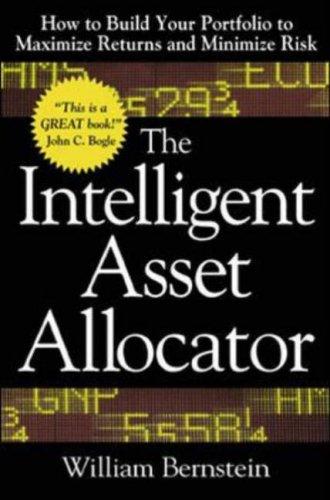
The Intelligent Asset Allocator by William J. Bernstein is a 2000 economics book about asset allocation, portfolio construction, risk and return. Asset allocation — how you divide a portfolio among different asset classes — explains the majority of long-term portfolio returns, not individual security selection.
Summary
The Intelligent Asset Allocator is William Bernstein's argument that the most important decision an investor makes is not which stock to buy but how to divide a portfolio across different asset classes. Bernstein, a neurologist who became an investment theorist, wrote the book as a quantitative primer for individual investors — one that takes the mathematics of portfolio theory seriously without requiring a finance degree. The central thesis is that diversification across low-correlating asset classes is the only free lunch in investing: it reduces risk without proportionally reducing returns.
The first part of the book introduces the foundational concepts of risk and return at the asset class level. Bernstein shows historical return and volatility data for stocks, bonds, small-cap stocks, international equities, and real assets, and explains why combining asset classes with low correlation produces better risk-adjusted outcomes than concentrating in the best-performing single class. He walks through the mechanics of mean-variance optimization — the mathematical framework for identifying efficient portfolio combinations — in language that is rigorous but readable.
The second part moves to practical portfolio construction. Bernstein critiques active management and market timing with data, concludes that the average investor is better served by low-cost index funds, and gives specific model portfolios for investors at different stages of life and risk tolerance. He covers the mechanics of rebalancing — how selling winners and buying laggards systematically enforces buy-low-sell-high discipline — and explains why most investors resist it for psychological reasons.
The book's intellectual honesty is its distinguishing trait. Bernstein does not promise market-beating returns; he argues that most investors will underperform a simple index portfolio because of costs, taxes, and behavioral errors. The goal is to capture market returns reliably rather than chase exceptional ones. For readers who want to understand why passive diversification works at a deeper level than most personal finance books provide, this remains one of the clearest explanations available.
Talk to The Intelligent Asset Allocator like its author wrote you back.
Get the ideas that fit your life — not generic summaries.
- Chat with the book
- Audiobook-style main ideas
- Adapts to your life and goals
- Helps you take action
Key takeaways
- 1.
Asset allocation — how you divide a portfolio among different asset classes — explains the majority of long-term portfolio returns, not individual security selection.
- 2.
Diversifying across low-correlating assets reduces portfolio volatility without proportionally reducing expected returns. This is the core principle of modern portfolio theory.
- 3.
Historical return data shows that small-cap and value stocks have produced higher long-term returns than large-cap growth stocks, though with higher volatility.
- 4.
International diversification is valuable because equity markets in different countries do not always move together, reducing overall portfolio risk.
- 5.
Rebalancing — periodically selling overweighted assets and buying underweighted ones — enforces a systematic buy-low-sell-high discipline that most investors cannot maintain emotionally.
- 6.
Active management underperforms passive index investing over long periods, primarily due to costs and taxes rather than manager incompetence.
- 7.
Investor behavior — panic selling in downturns, chasing past winners — accounts for the gap between fund returns and investor returns in those same funds.
- 8.
Risk tolerance is both psychological and financial. An investor who cannot hold equities through a 50% decline should not hold a portfolio that makes that experience possible.
Discussion questions
Use these on your own, with a book club, or as chat starters in Superbook. Book club version, ready to copy or print →
- 1.
Bernstein argues asset allocation matters more than stock selection. Does that conclusion match how most investors, financial media, and advisors actually spend their time and attention?
- 2.
The book is built on historical return data. How much weight should historical patterns carry when constructing a portfolio for the next 30 years?
- 3.
What is correlation in the context of asset allocation, and why does Bernstein argue that a lower-returning asset can still improve a portfolio?
- 4.
Bernstein shows that most investors underperform the funds they invest in due to poor timing. Have you observed this pattern in your own investment behavior?
- 5.
Rebalancing requires selling assets that have done well and buying ones that have done poorly. What makes this psychologically difficult, and how does systematic rebalancing overcome it?
- 6.
The book was written in 2000. Which of Bernstein's core arguments do you think have held up in the 25 years since, and which look most vulnerable?
- 7.
Bernstein is skeptical of international diversification's benefits in more recent decades. What changed, and does his original argument still hold?
- 8.
How should a younger investor with a long time horizon think differently about portfolio construction than someone nearing retirement?
- 9.
Bernstein critiques actively managed funds largely on cost grounds. Has the rise of low-cost active ETFs changed that calculation?
- 10.
What does Bernstein mean by risk tolerance being both financial and psychological, and why does the difference matter when building a portfolio?
- 11.
If a simple three-fund portfolio captures most of the benefits Bernstein describes, what is the cost of using a more complex approach with many asset classes?
- 12.
The book argues that most investors are better off knowing less and following a simple plan. Is that a satisfying conclusion, or does it feel like a concession to human limitation?
Themes
Frequently asked questions
-
Is The Intelligent Asset Allocator worth reading?
Yes, for investors who want to understand portfolio theory at a deeper level than most personal finance books offer. It is more quantitative than typical investment books but not inaccessible. The frameworks for thinking about correlation and rebalancing remain highly relevant.
-
How difficult is this book to read?
More demanding than popular personal finance titles. Bernstein includes charts, tables, and mathematical reasoning. Readers comfortable with basic statistics will find it clear; those looking for rule-of-thumb simplicity may prefer his later Four Pillars of Investing.
-
What is the main message of The Intelligent Asset Allocator?
That asset allocation is the primary driver of long-term investment outcomes, that diversification across low-correlating asset classes is the most reliable risk-reduction tool, and that most investors are better served by low-cost index funds than by trying to beat the market.
-
Who should read this book?
DIY investors who want to build a serious conceptual foundation for portfolio decisions rather than follow simplified rules. It is particularly valuable for people in the accumulation phase of investing who have decades to apply what they learn.
-
What is the most important concept in the book?
Correlation and its role in portfolio construction. Understanding that combining assets that do not move together reduces risk without proportionally reducing return is the intellectual key to why diversification works, and Bernstein explains it more clearly than almost any comparable book.