Talk to The Kiss Quotient like its author wrote you back.
Get the ideas that fit your life — not generic summaries.
- Chat with the book
- Audiobook-style main ideas
- Adapts to your life and goals
- Helps you take action
The Kiss Quotient, in detail
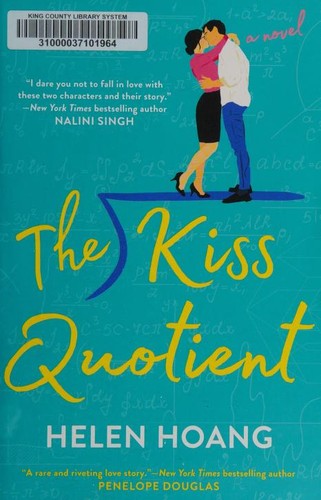
Stella Lane is a thirty-year-old econometrician with autism who is very good at her job, slightly alarmed by her mother's escalating desire for grandchildren, and reasonably certain she's bad at relationships. Her solution to the latter problem is characteristically direct: hire a professional to teach her. Michael Phan, who escorts to fund his family's medical bills, agrees. What begins as a transactional arrangement becomes something significantly messier for both of them.
What distinguishes The Kiss Quotient from the typical romance is Stella herself. Helen Hoang wrote the book while being diagnosed with autism in her late thirties, and the interiority Stella brings to every interaction — the discomfort with unexpected sensory input, the preference for explicit rather than implicit communication, the deep logic applied to social situations most people navigate on autopilot — feels genuinely observed rather than performed. Stella is not coded as tragic or specially gifted; she is a competent adult who finds certain kinds of human intimacy harder than most, and the novel treats her perspective with respect.
The romance mechanics are arranged to put Stella in a position where what she is worst at — uncertainty, indirect communication, reading emotional subtext — becomes unavoidable. Michael has his own complications: a Vietnamese-American family to whom he is fiercely loyal, a background he's ashamed of in ways that mirror Stella's shame about her neurodivergence, and feelings that accelerate past the scope of the original arrangement. The parallel structures of their self-doubt give the relationship more genuine texture than the usual setup of confident hero meets uncertain heroine.
This is a fast, warm, warm-hearted romance that does something the genre rarely attempts: it puts a neurodiverse woman at the center and refuses to treat her difference as either a quirk or a handicap. Readers who want a slow literary burn will be under-served; readers who want smart, direct romantic comedy with genuine emotional stakes will find a lot to love here. It launched a wave of more neurodiversity-conscious romance writing and holds up well as the original.
The big ideas
- 1.
Stella's autism is rendered from the inside — specific, unglamourized, and treated as part of her perspective rather than a plot device.
- 2.
The transactional setup is an unusually honest vehicle for exploring intimacy: both characters know exactly what they've agreed to, which makes the emotional complication harder to deny.
- 3.
Michael's class and family obligations give him a pressure that mirrors Stella's social anxiety — the parallel structures of shame and obligation hold the romance together.
