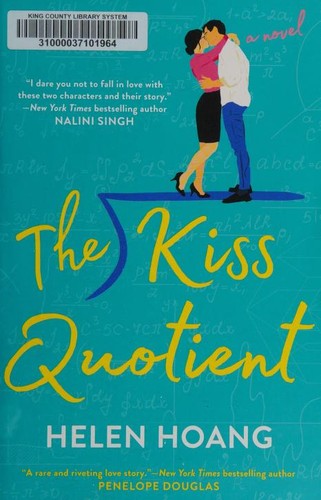
The Kiss Quotient by Helen Hoang is a 2018 romance book about autism and intimacy, shame and self-acceptance, class and family obligation. Stella's autism is rendered from the inside — specific, unglamourized, and treated as part of her perspective rather than a plot device.
Summary
Stella Lane is a thirty-year-old econometrician with autism who is very good at her job, slightly alarmed by her mother's escalating desire for grandchildren, and reasonably certain she's bad at relationships. Her solution to the latter problem is characteristically direct: hire a professional to teach her. Michael Phan, who escorts to fund his family's medical bills, agrees. What begins as a transactional arrangement becomes something significantly messier for both of them.
What distinguishes The Kiss Quotient from the typical romance is Stella herself. Helen Hoang wrote the book while being diagnosed with autism in her late thirties, and the interiority Stella brings to every interaction — the discomfort with unexpected sensory input, the preference for explicit rather than implicit communication, the deep logic applied to social situations most people navigate on autopilot — feels genuinely observed rather than performed. Stella is not coded as tragic or specially gifted; she is a competent adult who finds certain kinds of human intimacy harder than most, and the novel treats her perspective with respect.
The romance mechanics are arranged to put Stella in a position where what she is worst at — uncertainty, indirect communication, reading emotional subtext — becomes unavoidable. Michael has his own complications: a Vietnamese-American family to whom he is fiercely loyal, a background he's ashamed of in ways that mirror Stella's shame about her neurodivergence, and feelings that accelerate past the scope of the original arrangement. The parallel structures of their self-doubt give the relationship more genuine texture than the usual setup of confident hero meets uncertain heroine.
This is a fast, warm, warm-hearted romance that does something the genre rarely attempts: it puts a neurodiverse woman at the center and refuses to treat her difference as either a quirk or a handicap. Readers who want a slow literary burn will be under-served; readers who want smart, direct romantic comedy with genuine emotional stakes will find a lot to love here. It launched a wave of more neurodiversity-conscious romance writing and holds up well as the original.
Talk to The Kiss Quotient like its author wrote you back.
Get the ideas that fit your life — not generic summaries.
- Chat with the book
- Audiobook-style main ideas
- Adapts to your life and goals
- Helps you take action
Key takeaways
- 1.
Stella's autism is rendered from the inside — specific, unglamourized, and treated as part of her perspective rather than a plot device.
- 2.
The transactional setup is an unusually honest vehicle for exploring intimacy: both characters know exactly what they've agreed to, which makes the emotional complication harder to deny.
- 3.
Michael's class and family obligations give him a pressure that mirrors Stella's social anxiety — the parallel structures of shame and obligation hold the romance together.
- 4.
Hoang's prose is clear and fast-moving; she doesn't use literary style to signal depth, she earns depth through character specificity.
- 5.
The book sparked a meaningful conversation in romance about representation of neurodiverse protagonists, published at a moment when the genre was beginning to seriously examine whose experience it centered.
- 6.
Stella's approach to problems — quantify, experiment, analyze — is both genuinely funny and a lens through which the novel examines how intimacy resists optimization.
- 7.
The physical tension is significant and deliberately foregrounded, which is consistent with the premise but also gives the emotional development a parallel track.
- 8.
The secondary characters — particularly Michael's grandmother — are drawn with affection and cultural specificity that makes the world feel real.
Discussion questions
Use these on your own, with a book club, or as chat starters in Superbook. Book club version, ready to copy or print →
- 1.
Stella's plan to hire Michael is, by her logic, entirely rational. Does the novel agree with her reasoning, or does it gently show her she's missed something?
- 2.
Hoang was diagnosed with autism while writing this book. How do you think that influenced the intimacy of Stella's interior monologue?
- 3.
Michael is ashamed of his escorting work in a way that mirrors Stella's shame about her social difficulties. Does the parallel feel constructed or organic?
- 4.
Stella is often the most direct person in any scene — she says what she means and expects others to do the same. How does the novel use that directness comedically versus emotionally?
- 5.
The romance requires Michael to eventually reckon with whether he's been honest with Stella about his feelings. Given Stella's need for explicit communication, what are the stakes of his evasiveness?
- 6.
The Vietnamese-American family scenes give Michael's character cultural grounding beyond his individual psychology. Does the novel succeed in making those feel integral rather than decorative?
- 7.
Stella's mother wants grandchildren; Michael's family has specific expectations too. How do the family pressures in this book compare to how family usually functions in romance?
- 8.
The Kiss Quotient was credited with changing the romance landscape around neurodiverse representation. What responsibility do authors have when they write protagonists with identities they share, and what when they don't?
- 9.
Is the book's HEA (happily ever after) satisfying precisely because Stella has changed, or because the world around her has accommodated her?
- 10.
The escorting setup is uncommon in mainstream romance. How does the novel navigate the power and vulnerability dynamics it introduces?
- 11.
Would this book read differently if Stella were neurotypical? What would be lost?
Themes
Frequently asked questions
-
Is The Kiss Quotient worth reading?
Yes, particularly if you're interested in romance that puts an autistic woman's perspective genuinely at the center. The romance mechanics are solid, the steam is real, and Stella is one of the most distinctive protagonists the genre has produced in recent years.
-
Is The Kiss Quotient a good introduction to romance?
It's a reasonable entry point — accessible, fast-paced, emotionally satisfying, with enough warmth that genre newcomers won't feel lost. The neurodiverse framing gives it more distinctiveness than a typical starting point.
-
How explicit is The Kiss Quotient?
Fairly explicit by mainstream romance standards — the physical relationship is central to the premise and detailed accordingly. Readers who prefer closed-door romance should note this upfront.
-
Who shouldn't read this book?
Readers who are uncomfortable with explicit sexual content, or who want a slow-burn with minimal physical tension in the early chapters. The intimacy here is foregrounded from early on as part of the premise.
-
Is there a sequel?
The Bride Test (2019) follows Michael's cousin Khai and is set in the same world. The Heart Principle (2021) features an autistic protagonist named Anna. Both are companion novels rather than direct continuations.