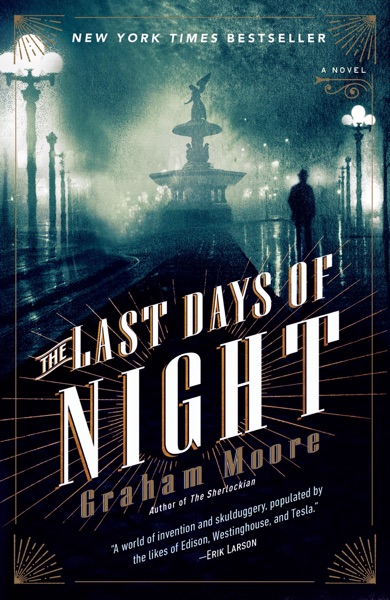
Talk to The Last Days of Night like its author wrote you back.
Get the ideas that fit your life — not generic summaries.
- Chat with the book
- Audiobook-style main ideas
- Adapts to your life and goals
- Helps you take action
The Last Days of Night, in detail
The Last Days of Night is Graham Moore's historical novel about the legal and commercial war between Thomas Edison and George Westinghouse over the electrification of America. The central figure is Paul Cravath, a 26-year-old lawyer fresh out of Columbia who is hired by Westinghouse to handle patent litigation against Edison. Moore uses Cravath's real-life trajectory — he would eventually found one of the most powerful law firms in New York — as the spine of a story about ambition, innovation, and the brutal economics of invention.
The novel covers the years 1888 to 1892, the peak of the so-called War of Currents. Edison's direct current system was losing ground to Westinghouse's alternating current, which could travel farther and power entire cities. Edison fought back through patents, public demonstrations of AC's dangers, and a lobbying campaign to have it used in the electric chair — the logic being that if AC killed criminals, consumers would fear it in their homes. Moore renders the technical dispute with enough clarity that the reader grasps the stakes without needing an engineering background.
Nikola Tesla appears as a major character — solitary, brilliant, and increasingly erratic — and his relationship with both Westinghouse and the broader electrical industry becomes one of the book's most interesting threads. Moore is honest about the gap between Tesla's mythologized status today and the more complicated figure who sold his patents under financial pressure and ended up largely forgotten by the men who profited from his work.
The historical fiction genre allows Moore to fill gaps with invention. Some dialogue and scenes are extrapolated, and the romantic subplot with Agnes Huntington is substantially fictionalized. Moore acknowledges this in an author's note. Readers interested in the strict history will want to supplement with primary sources. But as an introduction to the period — the gilded age of invention, the birth of corporate law, the transformation of American cities by electricity — the book is an unusually readable entry point. It moves quickly, the characters are sharply drawn, and the central argument that legal strategy shapes technology as much as engineering does is worth sitting with long after the last page.
The big ideas
- 1.
The War of Currents was decided as much in courtrooms as in laboratories. Edison's patent strategy was as central to his dominance as his inventions.
- 2.
Nikola Tesla's genius did not protect him from being outmaneuvered commercially. He sold his AC patents to Westinghouse under financial pressure and received little of the wealth they generated.
- 3.
Paul Cravath's approach to building a law firm — hire the best recent graduates, train them rigorously, promote from within — became a template that reshaped American legal practice for the next century.
