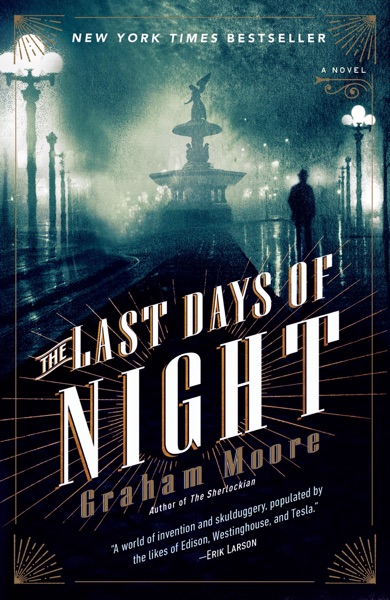
The Last Days of Night by Graham Moore is a 2016 history book about invention, patent law, ambition. The War of Currents was decided as much in courtrooms as in laboratories. Edison's patent strategy was as central to his dominance as his inventions.
Summary
The Last Days of Night is Graham Moore's historical novel about the legal and commercial war between Thomas Edison and George Westinghouse over the electrification of America. The central figure is Paul Cravath, a 26-year-old lawyer fresh out of Columbia who is hired by Westinghouse to handle patent litigation against Edison. Moore uses Cravath's real-life trajectory — he would eventually found one of the most powerful law firms in New York — as the spine of a story about ambition, innovation, and the brutal economics of invention.
The novel covers the years 1888 to 1892, the peak of the so-called War of Currents. Edison's direct current system was losing ground to Westinghouse's alternating current, which could travel farther and power entire cities. Edison fought back through patents, public demonstrations of AC's dangers, and a lobbying campaign to have it used in the electric chair — the logic being that if AC killed criminals, consumers would fear it in their homes. Moore renders the technical dispute with enough clarity that the reader grasps the stakes without needing an engineering background.
Nikola Tesla appears as a major character — solitary, brilliant, and increasingly erratic — and his relationship with both Westinghouse and the broader electrical industry becomes one of the book's most interesting threads. Moore is honest about the gap between Tesla's mythologized status today and the more complicated figure who sold his patents under financial pressure and ended up largely forgotten by the men who profited from his work.
The historical fiction genre allows Moore to fill gaps with invention. Some dialogue and scenes are extrapolated, and the romantic subplot with Agnes Huntington is substantially fictionalized. Moore acknowledges this in an author's note. Readers interested in the strict history will want to supplement with primary sources. But as an introduction to the period — the gilded age of invention, the birth of corporate law, the transformation of American cities by electricity — the book is an unusually readable entry point. It moves quickly, the characters are sharply drawn, and the central argument that legal strategy shapes technology as much as engineering does is worth sitting with long after the last page.
Talk to The Last Days of Night like its author wrote you back.
Get the ideas that fit your life — not generic summaries.
- Chat with the book
- Audiobook-style main ideas
- Adapts to your life and goals
- Helps you take action
Key takeaways
- 1.
The War of Currents was decided as much in courtrooms as in laboratories. Edison's patent strategy was as central to his dominance as his inventions.
- 2.
Nikola Tesla's genius did not protect him from being outmaneuvered commercially. He sold his AC patents to Westinghouse under financial pressure and received little of the wealth they generated.
- 3.
Paul Cravath's approach to building a law firm — hire the best recent graduates, train them rigorously, promote from within — became a template that reshaped American legal practice for the next century.
- 4.
Edison's campaign to associate alternating current with death was a deliberate disinformation effort, not simply scientific caution. The electric chair was introduced partly as a reputational weapon.
- 5.
The inventor who files the patent rarely determines how a technology gets used. The lawyers, financiers, and strategists who follow often matter more to the outcome.
- 6.
Large corporations can use patent litigation as a tool to exhaust smaller competitors financially, even when the legal merits are weak.
- 7.
Historical figures are more complicated than their legends. Both Edison and Tesla were simultaneously visionary and ruthless, and the clean narratives that schools teach about them are mostly myth.
- 8.
First-mover advantage in technology is fragile. Edison dominated electrical lighting but lost the current war because he backed the wrong technical standard.
Discussion questions
Use these on your own, with a book club, or as chat starters in Superbook. Book club version, ready to copy or print →
- 1.
Moore argues that legal strategy shaped the electrification of America as much as engineering did. Does that framing change how you think about technological change today?
- 2.
Paul Cravath is young, inexperienced, and hired partly because senior lawyers refused the case. What does the novel suggest about how outsiders make moves that insiders won't?
- 3.
Edison uses fear — specifically, public demonstrations of electrocution — to damage Westinghouse's business. How does this tactic compare to competitive strategies you've seen in contemporary industries?
- 4.
Tesla is portrayed as someone whose technical brilliance was consistently undermined by his inability to manage relationships and money. Is that a fair reading of the historical record, or does the novel oversimplify him?
- 5.
Westinghouse is presented as the more principled of the two main antagonists — he treats workers better, he's more honest about his patents. Does he come across as genuinely ethical, or just strategically decent?
- 6.
Moore fictionalized several elements, including the romance with Agnes Huntington. Does the license historical fiction takes bother you, or do you accept it as the price of narrative engagement?
- 7.
The novel is told from Paul Cravath's point of view rather than Edison's or Tesla's. What does that choice give you that a more famous narrator wouldn't?
- 8.
The electric chair appears as a direct product of the War of Currents — a technology invented as a competitive weapon. What does that suggest about how we should evaluate the social effects of technological competition?
- 9.
What does the book say about intellectual property law? Is the patent system as Moore depicts it in the 1880s a reasonable way to reward invention, or is it better understood as a barrier to progress?
- 10.
Cravath's success comes partly from his willingness to work in ways his senior colleagues considered beneath them. What does the novel say about the relationship between pride and effectiveness?
- 11.
By the end of the book, who do you think actually won the War of Currents? Edison lost the technical battle, but how does Moore evaluate his legacy?
- 12.
If you were advising Nikola Tesla at the moment he sold his patents, what would you have told him? Was there a better path?
Themes
Frequently asked questions
-
Is The Last Days of Night a true story?
Mostly. The major figures — Edison, Westinghouse, Tesla, Cravath — are real, and the broad outlines of the War of Currents are historically accurate. Moore invents dialogue and some scenes, and the romantic subplot with Agnes Huntington is substantially fictionalized. His author's note is transparent about where he departed from the record.
-
Do I need to know anything about electricity to enjoy this book?
No. Moore explains direct vs. alternating current clearly enough for non-technical readers in a few early scenes, and from there treats the electrical details as background rather than foreground. The book is really about law, money, and ambition.
-
How does The Last Days of Night compare to The Devil in the White City?
Both are narrative histories of the Gilded Age that blend documented events with novelistic reconstruction. Devil in the White City stays closer to the historical record; Moore takes more liberty but writes faster-moving fiction. If you liked one, you'll likely enjoy the other.
-
Is Nikola Tesla accurately portrayed?
Moore draws on documented accounts of Tesla's personality and circumstances, but the novel takes liberties with his internal life. Tesla historians debate how isolated and unstable he actually was; Moore leans into the tortured-genius reading. Worth supplementing with W. Bernard Carlson's biography for a more scholarly view.
-
Who should read this book?
Anyone interested in the history of technology, the Gilded Age, or the origins of American corporate law. It also works well for readers who want historical fiction that isn't set in a war or a royal court — the drama here is commercial and legal rather than military.
Similar books
The Innovator's Dilemma
Clayton M. Christensen
Bad Blood: Secrets and Lies in a Silicon Valley Startup
John Carreyrou
The Devil in the White City
Erik Larson
American Prometheus
Kai Bird and Martin J. Sherwin
