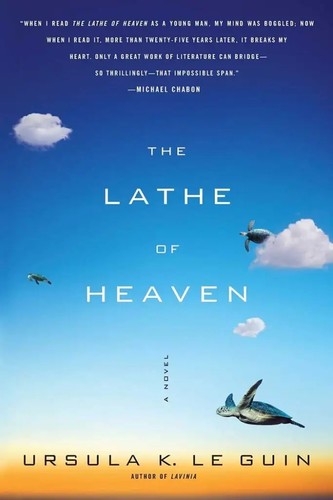
Talk to The Lathe of Heaven like its author wrote you back.
Get the ideas that fit your life — not generic summaries.
- Chat with the book
- Audiobook-style main ideas
- Adapts to your life and goals
- Helps you take action
The Lathe of Heaven, in detail
George Orr has a problem: his dreams come true. Not symbolically — when he sleeps, the world reshapes itself retroactively to match what he dreamed, and only Orr knows the difference. In an overcrowded, damaged future Portland, he is referred to psychiatrist Dr. William Haber, who sees in Orr's ability not a disorder to be cured but a tool to be directed. Haber begins using hypnosis to guide Orr's dreams toward his own vision of a better world. The Lathe of Heaven is a short, devastating novel about what happens next.
The book is an extended argument against the Platonic philosopher-king — against the idea that someone sufficiently wise and well-intentioned could improve the world by imposing their vision on it. Haber is not a villain in the straightforward sense; he genuinely believes in his goals. But his belief in his own goodness is exactly the problem. Each attempt to fix the world creates new catastrophes, which Haber rationalizes as acceptable costs on the way to something better. Le Guin is unsparing about the logic: the desire to make things right, stripped of humility and consent, is indistinguishable from tyranny.
Le Guin's prose here is quieter and stranger than in her Earthsea books — more Philip K. Dick than heroic fantasy. The reality-shifting means the reader, like Orr, can never be quite sure of the ground underfoot, and the novel uses that instability for psychological as much as plot purposes. The love interest, Heather Lelache, is positioned as an anchor to a reality that keeps disappearing — an interesting choice that the book's short length doesn't fully develop.
The Lathe of Heaven is barely 200 pages and is one of the most efficient novels in the science fiction canon. It does in a novella's space what many longer books can't manage at all: build a fully realized world, develop two characters in serious depth, and make a philosophical argument that arrives with emotional force. It rewards Le Guin's readers who know her Taoist preoccupations; it also works as a standalone for anyone interested in power, dreams, and the cost of good intentions.
The big ideas
- 1.
The novel's central argument is Taoist: forcing the world toward an ideal outcome is worse than working with what exists. Haber's failures are not accidents; they are inherent to his approach.
- 2.
Consent runs through the book as a moral constant. Orr never consents to being used as a tool, and every violation of that consent compounds the damage.
- 3.
Haber is a fascinating villain-without-malice. His belief in his own wisdom is complete and sincere, and Le Guin treats that as more dangerous than straightforward greed.
