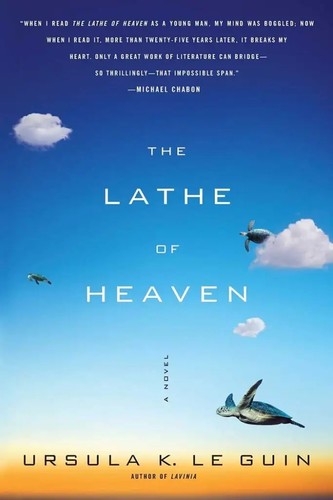
The Lathe of Heaven by Ursula K. Le Guin is a 1971 science fiction book about power and unintended consequences, hubris, consent and autonomy. The novel's central argument is Taoist: forcing the world toward an ideal outcome is worse than working with what exists. Haber's failures are not accidents; they are inherent to his approach.
Summary
George Orr has a problem: his dreams come true. Not symbolically — when he sleeps, the world reshapes itself retroactively to match what he dreamed, and only Orr knows the difference. In an overcrowded, damaged future Portland, he is referred to psychiatrist Dr. William Haber, who sees in Orr's ability not a disorder to be cured but a tool to be directed. Haber begins using hypnosis to guide Orr's dreams toward his own vision of a better world. The Lathe of Heaven is a short, devastating novel about what happens next.
The book is an extended argument against the Platonic philosopher-king — against the idea that someone sufficiently wise and well-intentioned could improve the world by imposing their vision on it. Haber is not a villain in the straightforward sense; he genuinely believes in his goals. But his belief in his own goodness is exactly the problem. Each attempt to fix the world creates new catastrophes, which Haber rationalizes as acceptable costs on the way to something better. Le Guin is unsparing about the logic: the desire to make things right, stripped of humility and consent, is indistinguishable from tyranny.
Le Guin's prose here is quieter and stranger than in her Earthsea books — more Philip K. Dick than heroic fantasy. The reality-shifting means the reader, like Orr, can never be quite sure of the ground underfoot, and the novel uses that instability for psychological as much as plot purposes. The love interest, Heather Lelache, is positioned as an anchor to a reality that keeps disappearing — an interesting choice that the book's short length doesn't fully develop.
The Lathe of Heaven is barely 200 pages and is one of the most efficient novels in the science fiction canon. It does in a novella's space what many longer books can't manage at all: build a fully realized world, develop two characters in serious depth, and make a philosophical argument that arrives with emotional force. It rewards Le Guin's readers who know her Taoist preoccupations; it also works as a standalone for anyone interested in power, dreams, and the cost of good intentions.
Talk to The Lathe of Heaven like its author wrote you back.
Get the ideas that fit your life — not generic summaries.
- Chat with the book
- Audiobook-style main ideas
- Adapts to your life and goals
- Helps you take action
Key takeaways
- 1.
The novel's central argument is Taoist: forcing the world toward an ideal outcome is worse than working with what exists. Haber's failures are not accidents; they are inherent to his approach.
- 2.
Consent runs through the book as a moral constant. Orr never consents to being used as a tool, and every violation of that consent compounds the damage.
- 3.
Haber is a fascinating villain-without-malice. His belief in his own wisdom is complete and sincere, and Le Guin treats that as more dangerous than straightforward greed.
- 4.
The instability of reality in the novel is not just a plot device — it's a phenomenological argument that consensus reality is more fragile than we assume.
- 5.
Le Guin draws on Taoist philosophy explicitly: the title comes from Zhuangzi, and the idea that the better you grasp for outcomes, the more they slip away is the spine of the book.
- 6.
Orr's passivity is a feature, not a flaw. His refusal to use his own power — to let things be — is the ethical position the novel endorses, and it's a harder position to inhabit than Haber's activism.
- 7.
The alien Aldebaranian subplot — beings without a fixed concept of reality — introduces a non-Western phenomenological perspective that broadens the book's argument beyond just Haber and Orr.
- 8.
At 58,000 words, The Lathe of Heaven makes an argument that many 400-page novels fail to make. Le Guin's compression is a lesson in itself.
Discussion questions
Use these on your own, with a book club, or as chat starters in Superbook. Book club version, ready to copy or print →
- 1.
Haber's intentions are good throughout. Does the novel argue that good intentions are insufficient, or that they are actually part of the problem?
- 2.
Orr refuses to use his own dreaming purposefully. Is that refusal ethical passivity or ethical wisdom? Does Le Guin think there's a difference?
- 3.
Each of Haber's corrections creates new disasters. Is that a comment on the particular kind of correction (utopian thinking), or a broader claim about changing the world at all?
- 4.
The book's Taoist framework says: stop forcing outcomes, work with what is. Applied to real-world politics, is that position defensible or is it a counsel of complacency?
- 5.
Heather's role is partly to provide an emotional anchor to a disappearing world. Does her character carry the weight that function requires, or is she underserved by the book's length?
- 6.
The alien Aldebaranians experience time and reality differently. What does their presence add to the argument about power and consent that the Haber-Orr dynamic alone doesn't provide?
- 7.
Compared to other SF novels about reality manipulation (Dick's The Man in the High Castle, say), where does Le Guin's philosophical position land differently?
- 8.
The climax involves Orr finally dreaming without Haber's direction. What does the result suggest about what the novel thinks 'natural' outcomes look like — and is that vision satisfying?
- 9.
This is a 1971 novel set in an ecologically damaged near-future city. Did it feel dated, prescient, or both?
- 10.
Le Guin almost never writes heroes — she writes people navigating power structures. How does that authorial stance shape who you end up sympathizing with here?
- 11.
Orr is a passive protagonist in a story about power. Is that a risk that the novel manages well, or does his passivity make him hard to inhabit?
- 12.
The book endorses humility in the face of complex systems. What are the limits of that position?
Themes
Frequently asked questions
-
Is The Lathe of Heaven hard to read?
No — it's among Le Guin's most accessible novels. At under 200 pages, it reads quickly. The reality shifts can be slightly disorienting by design, but the prose is clear and the emotional situation stays legible throughout.
-
Do I need to know Le Guin's other work first?
No. The Lathe of Heaven is a standalone novel with no connections to the Hainish Cycle or Earthsea. Familiarity with Le Guin's Taoist philosophy enriches it, but nothing is required beforehand.
-
Is there a film adaptation?
Two. A 1980 PBS production (widely considered excellent and faithful) and a 2002 A&E adaptation (less well-regarded). The 1980 version was long out of print but has become available again.
-
What is the title from?
From Zhuangzi: 'To let understanding stop at what cannot be understood is a high attainment. Those who cannot do it will be destroyed on the lathe of heaven.' Le Guin uses it as a frame for the novel's Taoist argument.
-
Who shouldn't read this?
Readers who need a propulsive plot and prefer adventure over philosophical argument. The novel's pleasures are intellectual and psychological, not action-based. Also, Orr's passivity frustrates some readers who want a protagonist who fights back.