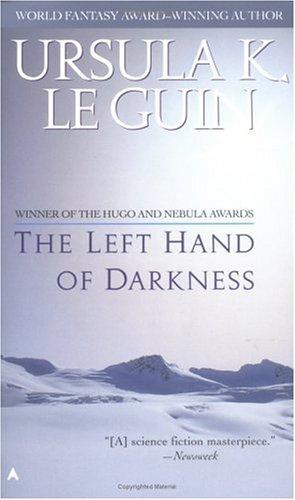
Talk to The Left Hand of Darkness like its author wrote you back.
Get the ideas that fit your life — not generic summaries.
- Chat with the book
- Audiobook-style main ideas
- Adapts to your life and goals
- Helps you take action
What it argues
The Left Hand of Darkness follows Genly Ai, an envoy from a loose interstellar federation called the Ekumen, who has been sent alone to the planet Gethen — also called Winter — to persuade its nations to join. Gethen's inhabitants are biologically ambisexual, becoming sexually active only during periodic cycles and capable of being either parent to a child. Genly arrives with a human mind shaped entirely by gender categories and spends most of the novel failing to understand what he is actually seeing.
The book is about the difficulty of perceiving across radical difference, and what loyalty looks like when neither party fully understands the other. The central relationship, between Genly and a Gethenian politician named Estraven, develops slowly over the first two-thirds of the novel and then becomes the entire moral weight of the story during a harrowing winter crossing on foot. Le Guin's point is not that gender is trivial but that its absence — and Genly's persistent attempt to read gender into Estraven anyway — reveals how much human perception is structured by categories we mistake for facts.
What it gets right
- 1.
Genly's persistent gendering of Estraven — reading feminine softness or masculine strength into a being without fixed gender — is the novel's central diagnosis: we see what our categories allow.
- 2.
Estraven is a more reliable reader of the situation than Genly for most of the novel, yet the book is told from Genly's point of view — the reader's own understanding has to run ahead of the narrator's.
- 3.
The winter crossing sequence works because Le Guin earns it through two hundred pages of mutual misreading; the intimacy isn't announced, it accumulates.
What it covers
Who wrote it
Ursula K. Le Guin (1929–2018) was an American novelist and essayist whose work across science fiction, fantasy, and literary fiction redefined what speculative fiction could be. She is best known for the Hainish Cycle — which includes The Left Hand of Darkness and The Dispossessed — and the Earthsea series. She won six Hugo Awards, six Nebula Awards, and the National Book Foundation's Medal for Distinguished Contribution to American Letters. Le Guin studied at Radcliffe and Columbia and was the daughter of anthropologist Alfred Kroeber, whose influence on her anthropological approach to world-building is pervasive.
