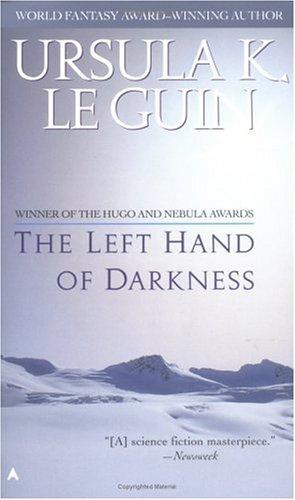
The Left Hand of Darkness by Ursula K. Le Guin is a 1969 science fiction book about gender and identity, loyalty and betrayal, alienation and belonging. Genly's persistent gendering of Estraven — reading feminine softness or masculine strength into a being without fixed gender — is the novel's central diagnosis: we see what our categories allow.
Summary
The Left Hand of Darkness follows Genly Ai, an envoy from a loose interstellar federation called the Ekumen, who has been sent alone to the planet Gethen — also called Winter — to persuade its nations to join. Gethen's inhabitants are biologically ambisexual, becoming sexually active only during periodic cycles and capable of being either parent to a child. Genly arrives with a human mind shaped entirely by gender categories and spends most of the novel failing to understand what he is actually seeing.
The book is about the difficulty of perceiving across radical difference, and what loyalty looks like when neither party fully understands the other. The central relationship, between Genly and a Gethenian politician named Estraven, develops slowly over the first two-thirds of the novel and then becomes the entire moral weight of the story during a harrowing winter crossing on foot. Le Guin's point is not that gender is trivial but that its absence — and Genly's persistent attempt to read gender into Estraven anyway — reveals how much human perception is structured by categories we mistake for facts.
Le Guin writes with anthropological precision and mythic cadence. The novel includes interpolated chapters: Gethenian folktales, excerpts from previous explorers' reports, ceremonial texts. This documentary apparatus makes the world feel thick without requiring pages of exposition. The prose is measured and cool, which is exactly right for a book set mostly in extreme cold and focused on the slow, difficult business of building trust.
Not everyone responds to this novel. The pacing is deliberate and the early chapters are largely political, tracking Genly's frustrating encounters with Gethenian power struggles he can't decode. Readers who need narrative momentum through the first half will find it slow. Those willing to stay with it encounter one of the genuinely moving relationships in twentieth-century science fiction — a novel that earns its conclusion rather than handing it to you.
Talk to The Left Hand of Darkness like its author wrote you back.
Get the ideas that fit your life — not generic summaries.
- Chat with the book
- Audiobook-style main ideas
- Adapts to your life and goals
- Helps you take action
Key takeaways
- 1.
Genly's persistent gendering of Estraven — reading feminine softness or masculine strength into a being without fixed gender — is the novel's central diagnosis: we see what our categories allow.
- 2.
Estraven is a more reliable reader of the situation than Genly for most of the novel, yet the book is told from Genly's point of view — the reader's own understanding has to run ahead of the narrator's.
- 3.
The winter crossing sequence works because Le Guin earns it through two hundred pages of mutual misreading; the intimacy isn't announced, it accumulates.
- 4.
Gethen's ambisexuality is less a utopian proposal than a thought experiment: if no one is always the dominant sex, what changes structurally in how power operates?
- 5.
Shifgrethor — a Gethenian concept roughly analogous to honor but tied to self-regard rather than reputation — shapes every political interaction in ways Genly keeps misinterpreting as evasiveness.
- 6.
The folktale chapters function as a chorus, offering cultural context that Genly doesn't have access to and the reader slowly accumulates alongside the main narrative.
- 7.
Le Guin is skeptical of large political structures throughout — the Ekumen itself is deliberately non-coercive, and Genly's failure is partly the failure of good-faith diplomacy conducted without adequate cultural humility.
- 8.
The title comes from a Gethenian poem about light and darkness needing each other — a recurring motif that earns its resonance only at the end.
Discussion questions
Use these on your own, with a book club, or as chat starters in Superbook. Book club version, ready to copy or print →
- 1.
Genly repeatedly describes Estraven in gendered terms despite knowing Estraven has no fixed gender. Do you think Le Guin is criticizing Genly, or depicting a limitation that's genuinely hard to escape?
- 2.
The book was written in 1969 and used 'he' as the default pronoun for Gethenians. Le Guin later said she would have chosen differently. Does that choice affect how you read the novel?
- 3.
Estraven acts to help Genly in ways that look like betrayal by Gethenian political standards. Was that the right choice?
- 4.
The winter crossing is the emotional center of the novel, but it comes very late. Did the pacing work for you, or did the early political chapters feel like a tax?
- 5.
Le Guin's Ekumen is a federation that never forces membership. Is that a plausible political structure, or an idealist fantasy?
- 6.
Shifgrethor is never fully translated for the reader — we understand it roughly but always from outside. Is that a limitation of the novel or its point?
- 7.
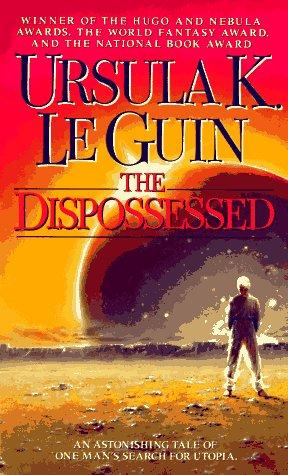
Compared to Le Guin's The Dispossessed, which is more optimistic about the possibility of cross-cultural understanding?
- 8.
The novel ends with a loss. Does that ending feel earned, or does it feel like Le Guin pulling the rug?
- 9.
What would the story look like from Estraven's point of view? What would we see about Genly that we currently miss?
- 10.
The Gethenians have no war, Le Guin speculates, partly because they have no permanent sexual hierarchy. How much does that argument convince you?
- 11.
Is this a novel about gender, or a novel about trust — and does it matter which frame you bring?
- 12.
Le Guin is considered one of science fiction's greatest prose stylists. Did her writing style work for you, or did the measured, cool voice create distance?
Themes
Frequently asked questions
-
Is The Left Hand of Darkness hard to read?
The first third is dense — there are political intrigues among Gethenian nations that are hard to track, and the cultural context accumulates slowly. The prose itself is clear. Readers who push through the political setup are rewarded with one of the most affecting relationships in science fiction.
-
Do I need to read other Hainish Cycle books first?
No. Each Hainish book stands alone. The Ekumen/League of Worlds background is light and introduced organically. The Dispossessed and this novel are the two most frequently read as entry points, and either works as a starting place.
-
What is The Left Hand of Darkness actually about?
At its surface, a diplomatic mission to a world with no fixed gender. At its core, a novel about how difficult it is to truly perceive another person across categories of difference — and what trust looks like when that difficulty is acknowledged rather than denied.
-
Why is it considered a classic?
It was the first science fiction novel to win both the Hugo and the Nebula Awards and was pivotal in expanding what the genre could address. Its treatment of gender as a variable — not a fact — was genuinely new in 1969 and has only become more resonant.
-
Who shouldn't read this book?
Readers who need fast pacing and action-oriented plots throughout will struggle. The novel's pleasures are intellectual and emotional rather than kinetic, and they arrive late.