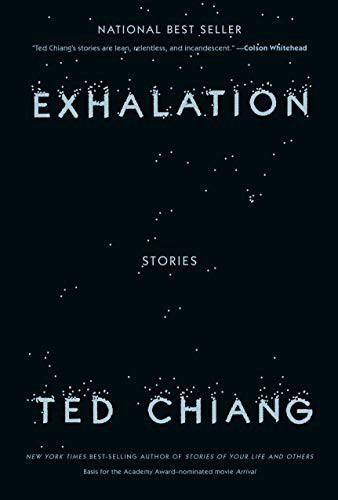
Talk to Exhalation: Stories like its author wrote you back.
Get the ideas that fit your life — not generic summaries.
- Chat with the book
- Audiobook-style main ideas
- Adapts to your life and goals
- Helps you take action
What it argues
Exhalation: Stories is Ted Chiang's second collection, containing nine stories written between 2005 and 2019. Each story takes a single speculative premise — a parrot trained on a century of human writing, a device that shows you your divergent life choices, a journal entry left for yourself across a time loop, air-powered mechanical beings who discover the nature of their universe — and follows it with rigorous, almost philosophical honesty to whatever conclusion the premise requires. Chiang does not use science fiction premises as window dressing; he uses them as thought experiments.
The collection's concerns are consistent across all nine stories: what free will means when you can see the future; whether personal identity survives radical memory alteration; what it would do to a parent-child relationship if you could replay footage of your child's past; how we should respond to the fact of our own impermanence. The title story, "Exhalation," is a meditation on entropy told from the perspective of a mechanical being who discovers that the universe is running down — and responds with curiosity rather than despair. It is one of the most quietly devastating things written in the genre.
What it gets right
- 1.
In 'Exhalation,' a mechanical being's discovery that his universe is running down becomes an argument for curiosity over despair — the response to inevitable entropy is to learn as much as possible before the end.
- 2.
'The Lifecycle of Software Objects' is the collection's longest and most emotionally demanding piece: a decade-long account of what it costs to care about a digital being, and what that care means about the nature of love.
- 3.
Chiang repeatedly uses time-travel or foreknowledge not as a plot device but as a philosophical test case: if you know the future, is the choice you make still a choice?
What it covers
Who wrote it
Ted Chiang is an American science fiction writer who works as a technical writer in the software industry. He has published fewer than twenty stories in total, but each has been received as a significant event in the genre. He has won four Nebula Awards, four Hugo Awards, and four Locus Awards, among others. His first collection, Stories of Your Life and Others (2002), contains "Story of Your Life," which became the basis for the 2016 film Arrival. Chiang publishes very slowly and has no social media presence, which makes each new story a notable occasion in the science fiction community.
