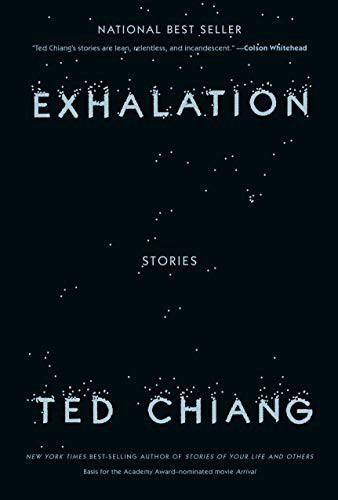
Exhalation: Stories by Ted Chiang is a 2019 short stories book about free will and determinism, memory and identity, technology and consciousness. In 'Exhalation,' a mechanical being's discovery that his universe is running down becomes an argument for curiosity over despair — the response to inevitable entropy is to learn as much as possible before the end.
Summary
Exhalation: Stories is Ted Chiang's second collection, containing nine stories written between 2005 and 2019. Each story takes a single speculative premise — a parrot trained on a century of human writing, a device that shows you your divergent life choices, a journal entry left for yourself across a time loop, air-powered mechanical beings who discover the nature of their universe — and follows it with rigorous, almost philosophical honesty to whatever conclusion the premise requires. Chiang does not use science fiction premises as window dressing; he uses them as thought experiments.
The collection's concerns are consistent across all nine stories: what free will means when you can see the future; whether personal identity survives radical memory alteration; what it would do to a parent-child relationship if you could replay footage of your child's past; how we should respond to the fact of our own impermanence. The title story, "Exhalation," is a meditation on entropy told from the perspective of a mechanical being who discovers that the universe is running down — and responds with curiosity rather than despair. It is one of the most quietly devastating things written in the genre.
Chiang writes in a clean, almost clinical prose that trusts the ideas to carry emotional weight. There is no atmospheric excess, no stylistic showing-off. The effect is that the moments of real feeling, when they arrive, hit unusually hard precisely because nothing has been done to manufacture them. He is also genuinely rigorous about his premises: the philosophical implications of a device that lets you observe alternate life paths are worked through with the care of an academic paper, not a thriller.
This is not a collection for readers who want plot momentum or genre comfort. Several stories are essentially dialogues, or thought experiments in narrative form. Readers who engage with ideas as a primary source of pleasure — who like their fiction to send them to Wikipedia or into extended argument with whoever is nearby — will find this collection inexhaustible. Those who want character arcs and emotional catharsis as the main event will find it cold, however precise.
Talk to Exhalation: Stories like its author wrote you back.
Get the ideas that fit your life — not generic summaries.
- Chat with the book
- Audiobook-style main ideas
- Adapts to your life and goals
- Helps you take action
Key takeaways
- 1.
In 'Exhalation,' a mechanical being's discovery that his universe is running down becomes an argument for curiosity over despair — the response to inevitable entropy is to learn as much as possible before the end.
- 2.
'The Lifecycle of Software Objects' is the collection's longest and most emotionally demanding piece: a decade-long account of what it costs to care about a digital being, and what that care means about the nature of love.
- 3.
Chiang repeatedly uses time-travel or foreknowledge not as a plot device but as a philosophical test case: if you know the future, is the choice you make still a choice?
- 4.
'Anxiety Is the Dizziness of Freedom' takes the multiverse seriously as an ethical problem: if every choice splits reality, does that change your moral responsibility for the choices you make in this branch?
- 5.
The prism story ('Omphalos') treats creationism as a lived epistemic crisis rather than a political position — the shock of discovering your foundational beliefs are false, and what it does to faith.
- 6.
Memory is treated throughout as identity-constituting, not just record-keeping: the question of who you are after your memories are altered is taken as seriously as any identity question gets.
- 7.
Chiang's stories consistently refuse comfort: resolutions are earned, not imposed, and several stories end without resolution because the premise genuinely has no comfortable resolution.
- 8.
The collection argues implicitly that science fiction's proper mode is philosophical inquiry — that the genre's speculative premises are most valuable when they force us to think, not just feel.
Discussion questions
Use these on your own, with a book club, or as chat starters in Superbook.
- 1.
'Exhalation' ends with a message to future beings who may inhabit a dead universe: 'Know that there was a universe that was passionate about understanding itself.' Is that a consolation, or does it make the ending sadder?
- 2.
In 'The Lifecycle of Software Objects,' the digients (digital beings) develop apparent personalities and preferences over years of interaction. At what point, if any, do you think they acquired moral status?
- 3.
'Anxiety Is the Dizziness of Freedom' argues that your choices in this branch matter even if another version of you chose differently. Does that argument actually work, or is it a psychological comfort rather than a philosophical one?
- 4.
In 'Omphalos,' a scientist's faith is shattered by the discovery that humans are not the center of creation. She decides to reframe her relationship with God. Is that reframing honest or a cope?
- 5.
Several stories involve characters who choose to accept painful knowledge rather than remain in comfortable ignorance. Is that always the right choice? Does Chiang think so?
- 6.
Chiang's prose is notably clean and impersonal. Does that coldness add to the emotional impact of the stories, or does it keep you at a distance from them?
- 7.
'Dacey's Patent Automatic Nanny' and 'The Great Silence' are the collection's shortest and strangest pieces. What do they add to the collection? Could it exist without them?
- 8.
The premise-to-conclusion rigor that Chiang is known for — following the logic wherever it leads — occasionally produces resolutions that feel more like proofs than endings. Did any story feel like that to you?
- 9.
Compared to his first collection (Stories of Your Life and Others), Exhalation seems less interested in grief and loss and more interested in ethics and free will. Does that feel true reading it? Which concerns resonate more?
- 10.
In 'The Truth of Fact, the Truth of Feeling,' perfect memory technology changes human relationships with the past. Would you want a perfect memory device? What would you lose?
- 11.
Several of Chiang's protagonists are working scientists or engineers. How does that professional background shape the stories' relationship to expertise and certainty?
- 12.
Which story in the collection did you find most challenging — intellectually, emotionally, or both — and why?
Themes
Frequently asked questions
-
Is Exhalation hard to read?
The prose itself is clear and accessible. The difficulty is conceptual — several stories require sustained philosophical engagement. Readers who engage with ideas will find it absorbing; those who read primarily for character and plot will find some stories frustrating. It rewards re-reading.
-
Do the stories need to be read in order?
No. Each story is completely standalone. Many readers have a favorite and start there. 'Exhalation' (the title story) and 'The Lifecycle of Software Objects' are good entry points for different reasons — the first for its scope, the second for its emotional depth.
-
How does this compare to Stories of Your Life and Others?
Both collections are excellent. Stories of Your Life is more concerned with grief and language; Exhalation is more focused on ethics, free will, and consciousness. The title story of each is arguably Chiang's best work — they represent different strengths. Many readers have a strong preference; it's worth reading both.
-
Is 'The Lifecycle of Software Objects' a novella?
It's the longest piece in the collection at roughly 30,000 words — long enough that some publishers classify it separately. It won the Hugo, Nebula, and Locus awards for Best Novella. If you find shorter stories too compressed, it's the place to start.
-
Who shouldn't read this collection?
Readers who want a novel's worth of character development, sustained narrative momentum, or genre thrills will be disappointed. This is a collection of ideas in narrative form. If the premise of a thought experiment doesn't itself create excitement for you, Chiang will feel airless.
Similar books
The Alchemist
Paulo Coelho
Sapiens: A Brief History of Humankind
Yuval Noah Harari
Other Minds: The Octopus, the Sea, and the Deep Origins of Consciousness
Peter Godfrey-Smith
