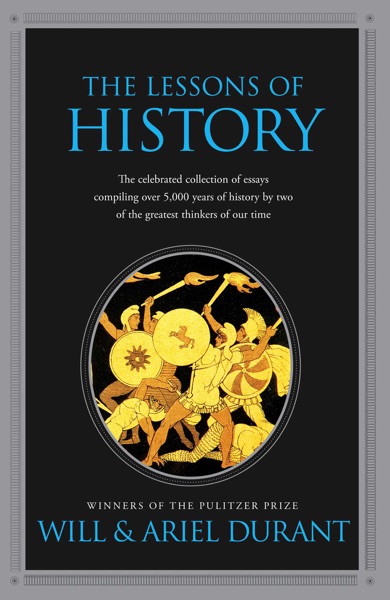
Talk to The Lessons of History like its author wrote you back.
Get the ideas that fit your life — not generic summaries.
- Chat with the book
- Audiobook-style main ideas
- Adapts to your life and goals
- Helps you take action
What it argues
The Lessons of History is the Durants' distillation of their eleven-volume The Story of Civilization — a project that consumed forty years — into a slim, hundred-page essay. The premise is audacious: extract what history actually teaches, stripped of nationalist sentiment and arranged by theme. The result is part meditation, part provocation, and part warning from two scholars who had seen enough of the twentieth century to know how confidently wrong confident people can be.
The book works through a series of short chapters, each one posing a question: What does history teach about biology? About morals? About religion? About economics? The Durants resist tidy answers. They note that inequality is natural and persistent — most redistributions of wealth last only a generation before concentrations re-form. They observe that the moral code loosens when civilizations feel secure and tightens when they feel threatened. They argue that religion has been indispensable as a social adhesive even for nonbelievers, because it provides the shared moral framework that law alone cannot sustain.
What it gets right
- 1.
History is largely the record of human behavior driven by biological imperatives — competition, cooperation, and the instinct for survival — that no ideology has permanently suppressed.
- 2.
Inequality of wealth and power is persistent; economic leveling happens through revolution or depression, but concentrations re-form within a generation.
- 3.
Moral codes change with the conditions of survival. Loose in secure eras, they tighten when a civilization feels threatened.
What it covers
Who wrote it
Will Durant (1885–1981) and Ariel Durant (1898–1981) were American historians who spent forty years writing The Story of Civilization, an eleven-volume history of human intellectual and cultural life from ancient Mesopotamia through Napoleon. Will won the Pulitzer Prize for General Non-Fiction in 1968 for Rousseau and Revolution, co-written with Ariel, and the Presidential Medal of Freedom in 1977. Ariel, who collaborated on the final six volumes and received equal credit from 1961 onward, shaped the project's scope and voice as much as her husband. They died within two weeks of each other in 1981.
