Talk to The Lies of Locke Lamora like its author wrote you back.
Get the ideas that fit your life — not generic summaries.
- Chat with the book
- Audiobook-style main ideas
- Adapts to your life and goals
- Helps you take action
The Lies of Locke Lamora, in detail
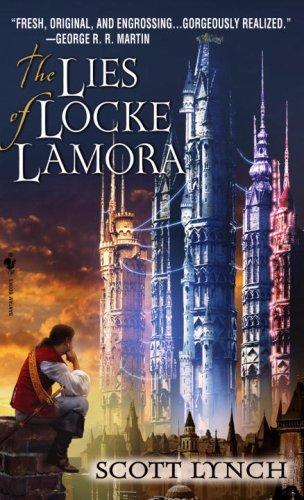
The Lies of Locke Lamora is set in Camorr, a fantastical city modeled roughly on Renaissance Venice, complete with canals, noble families, crime lords, and a complex social order that the protagonist has spent his life learning to exploit. Locke Lamora leads the Gentleman Bastards, a small band of con artists who specialize in robbing the nobility through elaborate theatrical schemes — while paying taxes to the Capa, the city's criminal overlord, on the pretense that they steal only from the poor. When a mysterious figure called the Gray King begins dismantling Camorr's criminal hierarchy, Locke's schemes and his people become collateral in a war he didn't start.
The book is, at its core, about what loyalty costs. The Gentleman Bastards are a found family — Locke and his closest companions were brought together as children, trained by a priest who taught them both theology and thievery, and have been inseparable since. Lynch makes you care about these relationships before he starts destroying them, which is the right order of operations. The elaborate cons are entertaining, but the weight of the book comes from what Locke is willing to do — and sacrifice — for the people he loves.
Lynch's world-building is dense without being a slog. Camorr has real texture: architecture, food, criminal customs, class anxieties, and a history of Eldren ruins that no one fully understands. The dual timeline structure — cutting between Locke's childhood and the present crisis — keeps the pace from bogging down in either the world-building or the heist mechanics. The prose is energetic, frequently funny, and occasionally very violent. Lynch writes action well, and he writes grief even better.
This is a long, ambitious debut novel that doesn't entirely stick every landing — the Gray King's plan has some structural wobbliness, and the ending is more emotionally devastating than narratively tidy. But it earned its reputation as one of the standout fantasy debuts of the 2000s. Readers who want moral complexity, propulsive plotting, and characters they'll miss when the book ends will find it here. Readers who need redemptive arcs and clean resolutions will be unhappy.
The big ideas
- 1.
The Gentleman Bastards work as a found family whose bonds are tested with genuine consequence. Lynch doesn't protect his characters because they're the protagonists.
- 2.
The dual timeline structure reveals character through contrast — who Locke was as a child and who he's become are not the same, and the gap between them is part of the story.
- 3.
Class is the novel's persistent subtext: the cons work because the nobility's vanity is predictable. Camorr's social order is a system Locke exploits but cannot escape.
