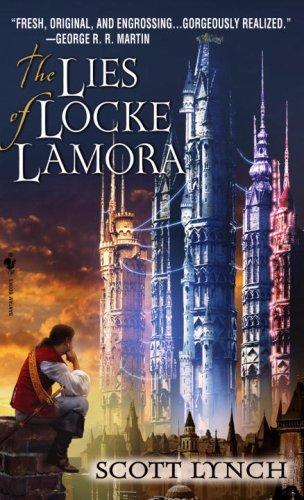
The Lies of Locke Lamora by Scott Lynch is a 2006 fantasy book about loyalty and brotherhood, class and deception, grief and revenge. The Gentleman Bastards work as a found family whose bonds are tested with genuine consequence. Lynch doesn't protect his characters because they're the protagonists.
Summary
The Lies of Locke Lamora is set in Camorr, a fantastical city modeled roughly on Renaissance Venice, complete with canals, noble families, crime lords, and a complex social order that the protagonist has spent his life learning to exploit. Locke Lamora leads the Gentleman Bastards, a small band of con artists who specialize in robbing the nobility through elaborate theatrical schemes — while paying taxes to the Capa, the city's criminal overlord, on the pretense that they steal only from the poor. When a mysterious figure called the Gray King begins dismantling Camorr's criminal hierarchy, Locke's schemes and his people become collateral in a war he didn't start.
The book is, at its core, about what loyalty costs. The Gentleman Bastards are a found family — Locke and his closest companions were brought together as children, trained by a priest who taught them both theology and thievery, and have been inseparable since. Lynch makes you care about these relationships before he starts destroying them, which is the right order of operations. The elaborate cons are entertaining, but the weight of the book comes from what Locke is willing to do — and sacrifice — for the people he loves.
Lynch's world-building is dense without being a slog. Camorr has real texture: architecture, food, criminal customs, class anxieties, and a history of Eldren ruins that no one fully understands. The dual timeline structure — cutting between Locke's childhood and the present crisis — keeps the pace from bogging down in either the world-building or the heist mechanics. The prose is energetic, frequently funny, and occasionally very violent. Lynch writes action well, and he writes grief even better.
This is a long, ambitious debut novel that doesn't entirely stick every landing — the Gray King's plan has some structural wobbliness, and the ending is more emotionally devastating than narratively tidy. But it earned its reputation as one of the standout fantasy debuts of the 2000s. Readers who want moral complexity, propulsive plotting, and characters they'll miss when the book ends will find it here. Readers who need redemptive arcs and clean resolutions will be unhappy.
Talk to The Lies of Locke Lamora like its author wrote you back.
Get the ideas that fit your life — not generic summaries.
- Chat with the book
- Audiobook-style main ideas
- Adapts to your life and goals
- Helps you take action
Key takeaways
- 1.
The Gentleman Bastards work as a found family whose bonds are tested with genuine consequence. Lynch doesn't protect his characters because they're the protagonists.
- 2.
The dual timeline structure reveals character through contrast — who Locke was as a child and who he's become are not the same, and the gap between them is part of the story.
- 3.
Class is the novel's persistent subtext: the cons work because the nobility's vanity is predictable. Camorr's social order is a system Locke exploits but cannot escape.
- 4.
The Gray King's scheme reframes the entire novel in retrospect. Lynch is writing a heist story about a man who is himself being conned, and the dramatic irony is carefully constructed.
- 5.
Loyalty in this book is absolute and costly. Locke's defining characteristic is not cleverness — it's that he will not leave people behind, even when leaving them would be rational.
- 6.
Camorr's criminal hierarchy is its own bureaucracy, with rules, tribute, and a political logic. Lynch takes the underworld seriously as a social structure.
- 7.
The novel is funnier than most fantasy. Lynch's banter is genuinely witty, and the humor makes the violence hit harder when it arrives.
- 8.
Grief and rage drive the second half of the book in ways the first half's comic heist structure doesn't prepare you for. The tonal shift is jarring and largely intentional.
Discussion questions
Use these on your own, with a book club, or as chat starters in Superbook. Book club version, ready to copy or print →
- 1.
Locke is described repeatedly as the best liar in a city of liars. By the end of the novel, what does he lie to himself about?
- 2.
The Gentleman Bastards steal from nobles but maintain a fiction to the Capa that they don't. Does that deception feel like a principled line or just another layer of pragmatism?
- 3.
Father Chains trained children to be thieves and gave them a moral code. Is he a villain, a mentor, or something the novel deliberately refuses to categorize?
- 4.
Lynch kills major characters. Did you find those deaths earned by the story's logic, or did they feel like authorial choices designed to manipulate the reader?
- 5.
The Gray King's plan depends on Locke behaving in predictable ways. Is Locke's predictability a flaw or a virtue, given what drives it?
- 6.
Camorr is a city where everyone is running a con on someone. Does that make the Gentleman Bastards morally equivalent to everyone else, or does their loyalty to each other distinguish them?
- 7.
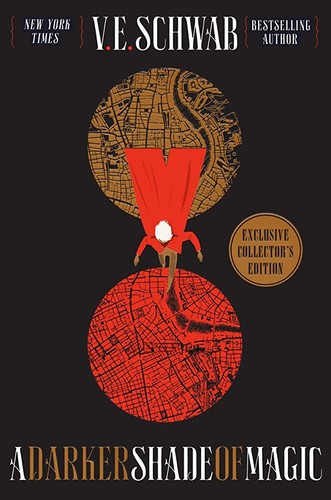
Compared to A Darker Shade of Magic, which is lighter and faster, The Lies of Locke Lamora is heavier and more emotionally demanding. Which kind of fantasy do you find more satisfying for a long read?
- 8.
The Eldren ruins are present throughout the novel but never explained. How does their mystery function in the story — does the unanswered question enrich or frustrate?
- 9.
Lynch is known for delays between sequels (the third book in this series took years to appear). How does the open-endedness of this first book's resolution sit with you?
- 10.
Locke's grief in the second half of the book drives him toward choices that are arguably self-destructive. Is that characterization consistent with who we understand him to be?
- 11.
The novel's Camorr is modeled on Renaissance Venice — class-stratified, canal-cut, with a ruling nobility and a teeming underworld. How does the fantasy setting change what Lynch can say about those social structures versus a historical novel set in the real Venice?
- 12.
If you continued to the sequels (Red Seas Under Red Skies, The Republic of Thieves), how does this first book read differently knowing where the characters end up?
Themes
Frequently asked questions
-
Is The Lies of Locke Lamora worth reading?
Yes, especially if you enjoy heist stories, found-family dynamics, and morally complex fantasy. It's long and the second half is significantly darker than the first, but it earns its reputation as one of the best fantasy debuts of the 2000s.
-
Is The Lies of Locke Lamora part of a series?
Yes, it's the first book in the Gentleman Bastards sequence. The series continues with Red Seas Under Red Skies and The Republic of Thieves. A fourth book has been announced but had not been published as of 2024. This first book has a complete emotional arc.
-
How long is The Lies of Locke Lamora?
Long — around 500 pages in most editions, approximately 500,000 words across the trilogy so far. This first book takes most readers 10-15 hours. The pacing is fast enough that the length doesn't feel punishing.
-
Who shouldn't read The Lies of Locke Lamora?
Readers who want happy endings, clear moral heroes, or fantasy without graphic violence and dark turns. The book is genuinely funny for the first half and genuinely devastating for the second. If you can't handle both in the same novel, this won't work for you.
-
Is there an adaptation?
A film adaptation has been in development for years but has not been produced as of 2024. The theatrical, caper-driven structure of the novel would translate well to screen.