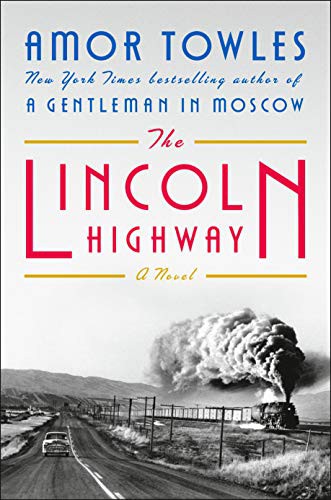
Talk to The Lincoln Highway like its author wrote you back.
Get the ideas that fit your life — not generic summaries.
- Chat with the book
- Audiobook-style main ideas
- Adapts to your life and goals
- Helps you take action
The Lincoln Highway, in detail
The Lincoln Highway unfolds over ten days in June 1954. Emmett Watson, eighteen, has just been released from a Nebraska work camp after serving time for an accidental death. He intends to collect his younger brother Billy, sell the family farm, drive to California, and start over. What happens instead is that two fellow inmates have stowed away in the warden's car, derailing the plan almost immediately. One of them, Woolly, is sweet and directionless; the other, Duchess, is charismatic, impulsive, and impossible to stop. Rather than heading west, the group ends up heading east — toward New York — while Billy, armed with a guidebook to historic American landmarks, keeps pointing toward the horizon his brother promised him.
The novel is Amor Towles doing something different from A Gentleman in Moscow: instead of one man confined to a single elegant space, this is four young men careening across postwar America, and the energy is kinetic rather than contemplative. Towles rotates the narration among multiple voices — Emmett, Billy, Duchess, and several other characters who intersect with them — each with a distinct cadence. Duchess in particular is one of the novel's pleasures: a self-dramatizing schemer whose moral logic is just coherent enough to be convincing while being entirely wrong.
The Lincoln Highway (the real road, built in the 1910s as America's first transcontinental automobile route) is used as both a literal setting and an organizing metaphor for the direction of American ambition. Towles is uninterested in realism and very interested in archetypes — the novel's debt to Huckleberry Finn, Don Quixote, and the picaresque tradition is worn openly. Billy's guidebook chapters, in which he narrates historical legends with the solemn authority of a nine-year-old who has memorized everything, are genuinely funny and give the novel a fable-like texture.
At 576 pages, the book asks for patience with its detours, and not all of them feel equally earned. Readers who loved A Gentleman in Moscow for its control and compression may find this one looser than they'd like. But for those willing to follow Towles wherever Duchess leads, The Lincoln Highway is an enormously enjoyable road not taken.
The big ideas
- 1.
Duchess is the novel's most complicated creation — a character who genuinely believes his destructive choices serve some higher principle of fairness, and who is consequently both compelling and infuriating.
- 2.
Billy, the nine-year-old narrator, is used to give the fable its moral center: his literalism and trust serve as a counterweight to every adult's self-serving rationalization.
- 3.
Towles uses the picaresque form deliberately — episodic, digressive, character-driven — which means the novel rewards those who enjoy the individual chapters more than those focused on the destination.
