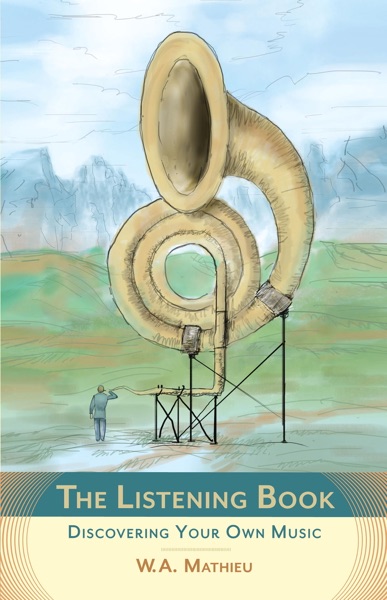
Talk to The Listening Book like its author wrote you back.
Get the ideas that fit your life — not generic summaries.
- Chat with the book
- Audiobook-style main ideas
- Adapts to your life and goals
- Helps you take action
What it argues
The Listening Book is W.A. Mathieu's invitation to hear the world differently — not through theory or technique, but through a series of short essays and exercises that ask the reader to pay unusual attention to ordinary sound. Mathieu was a composer and music teacher, and the book grew from his years of work with students who needed not to learn more music theory but to actually listen to what was already around them.
The book is organized as a series of brief chapters, none longer than a few pages, each focused on a specific aspect of listening: to a single note sustained until it reveals its overtones, to the sound of a room before anyone begins to play, to the noise of traffic as accidental composition, to silence as the condition that makes sound meaningful. Mathieu is not interested in music as a specialized activity. He is interested in listening as a way of being present — a practice that is eroded by the background noise of modern life and recoverable with attention.
What it gets right
- 1.
Listening is a skill that can be developed, not just a passive condition; most people hear but do not actually listen to what is around them.
- 2.
Every room has an acoustic character — a texture of resonance, absorption, and reflection — that musicians and attentive listeners can learn to read before playing a note.
- 3.
Silence is not the absence of sound but the frame that gives sound meaning; learning to listen to silence is prerequisite to hearing music deeply.
What it covers
Who wrote it
W.A. Mathieu is an American composer, pianist, and music teacher whose work spans jazz, classical, and world music traditions. He studied with Charles Mingus and spent years as a composer and musical director with the San Francisco Mime Troupe. He is also the author of Harmonic Experience, a widely used text on the physics and perception of musical harmony. His teaching has focused on ear training and direct listening as the foundation of musical understanding. The Listening Book, published in 1991, has become a quiet classic among musicians, music teachers, and people interested in auditory perception more broadly.
