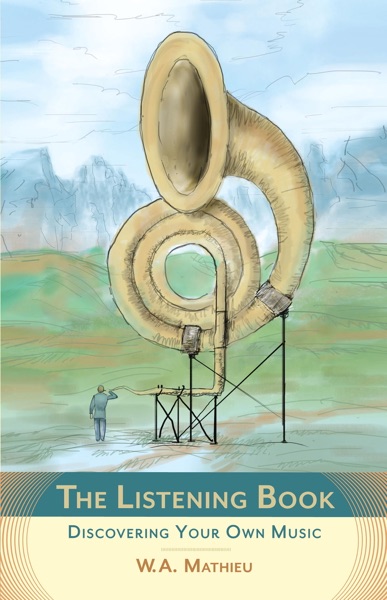
The Listening Book by W.A. Mathieu is a 1991 philosophy book about music, listening, attention. Listening is a skill that can be developed, not just a passive condition; most people hear but do not actually listen to what is around them.
Summary
The Listening Book is W.A. Mathieu's invitation to hear the world differently — not through theory or technique, but through a series of short essays and exercises that ask the reader to pay unusual attention to ordinary sound. Mathieu was a composer and music teacher, and the book grew from his years of work with students who needed not to learn more music theory but to actually listen to what was already around them.
The book is organized as a series of brief chapters, none longer than a few pages, each focused on a specific aspect of listening: to a single note sustained until it reveals its overtones, to the sound of a room before anyone begins to play, to the noise of traffic as accidental composition, to silence as the condition that makes sound meaningful. Mathieu is not interested in music as a specialized activity. He is interested in listening as a way of being present — a practice that is eroded by the background noise of modern life and recoverable with attention.
The writing is intimate and precise in the way that only comes from someone who has spent decades noticing things most people filter out. Mathieu describes how the first sounds you make in a new room are a kind of conversation with that room's acoustics, how musicians often play over each other rather than with each other because they haven't learned to wait, how a child learning to sing is doing something closer to philosophy than to performance. The book does not separate the auditory from the emotional — sound, in Mathieu's account, is one of the primary ways we register and communicate inner states.
The practical exercises are simple and repeatable: listen to a common household sound until you notice something new in it; sit in silence and count the layers of sound; sing a single note and follow where it leads. They are not therapy exercises, not mindfulness techniques in the clinical sense — they are invitations to a fuller kind of attention. The book is thin enough to read in an afternoon and substantial enough to change what you hear for years.
Talk to The Listening Book like its author wrote you back.
Get the ideas that fit your life — not generic summaries.
- Chat with the book
- Audiobook-style main ideas
- Adapts to your life and goals
- Helps you take action
Key takeaways
- 1.
Listening is a skill that can be developed, not just a passive condition; most people hear but do not actually listen to what is around them.
- 2.
Every room has an acoustic character — a texture of resonance, absorption, and reflection — that musicians and attentive listeners can learn to read before playing a note.
- 3.
Silence is not the absence of sound but the frame that gives sound meaning; learning to listen to silence is prerequisite to hearing music deeply.
- 4.
Harmony begins with listening to another person rather than waiting for your own turn; ensemble playing is a model for all collaborative attention.
- 5.
The overtone series — the harmonics present in any sustained tone — is audible to anyone who learns to listen for it, and it is the physical basis of musical consonance.
- 6.
Children learning to sing are engaged in something philosophically significant: matching an inner image of pitch to an outer sound, which requires unusual self-awareness.
- 7.
Music notation and theory are tools for transmitting music, but they can also screen the ear from direct experience of sound if learned before listening is developed.
- 8.
The practice of deep listening transfers beyond music: it improves how you hear language, how you register emotional tone in conversation, and how you attend to your own interior states.
Discussion questions
Use these on your own, with a book club, or as chat starters in Superbook. Book club version, ready to copy or print →
- 1.
Mathieu suggests that most people hear without truly listening. When was the last time you genuinely stopped and listened to something — not music, just the ambient sound around you?
- 2.
He describes every room as having an acoustic character. Have you ever entered a space and felt its sound quality before any music was played? What did you notice?
- 3.
The book treats silence as a positive substance rather than an absence. Does that distinction make sense to you experientially, or is it a philosophical nicety?
- 4.
Mathieu argues that ensemble music is really an exercise in listening to others rather than producing sound yourself. How does that reframe collaboration in non-musical contexts?
- 5.
He writes for readers with no formal music training. Did you find yourself going to a piano or humming while reading, or did the text work without sound?
- 6.
The book is full of very short exercises. Did you try any of them? Which one shifted something in how you perceived sound?
- 7.
Mathieu suggests that music theory learned before listening is developed can actually impair hearing. Is there an equivalent in any field you know — where technical training precedes direct experience and costs something?
- 8.
He describes children's singing as philosophically significant because it requires matching an inner image to an outer sound. What other activities have that quality of inside-outside alignment?
- 9.
The book is thirty years old and says almost nothing about recorded music, headphones, or digital sound. Does the absence of that context date it, or is it a useful constraint?
- 10.
Mathieu writes about listening to traffic or machine noise as accidental composition. Have you ever found unintended beauty in industrial or urban sound?
- 11.
The chapters are very short — some only a paragraph. Does that form match the content, or does it feel fragmentary?
- 12.
If listening is a practice that improves with attention, what would a serious practice of listening look like in your daily life?
Themes
Frequently asked questions
-
Do you need to be a musician to benefit from The Listening Book?
No. Mathieu explicitly wrote it for anyone who wants to hear more carefully — musicians, non-musicians, and people who don't particularly think of themselves as interested in music. The exercises require no instruments or prior training.
-
How long is The Listening Book?
About 160 pages, organized into very short chapters. Most readers finish in two to three hours. Because each chapter is a discrete observation or exercise, it works well to read a few pages, try the suggested practice, and return.
-
What is the main idea of The Listening Book?
That hearing more deeply is possible for anyone, that it requires deliberate practice rather than talent, and that cultivating this kind of attention changes how you experience not just music but the full range of sound in daily life.
-
Is this a practical how-to book or more of an essay collection?
Both. The chapters are essayistic but most include an implicit or explicit practice — something to do with your ears. It reads like a philosophy of listening that is also a practical workbook, though a very gentle one.
-
Who should read this book?
Musicians who want to reconnect with direct auditory experience before theory, and anyone who has noticed that they spend most of the day not really listening to anything. It is particularly useful for people who work with sound, language, or other people.
Similar books
This Is Your Brain on Music: The Science of a Human Obsession
Daniel J. Levitin

Daily Rituals: How Artists Work
Mason Currey
The Creative Habit
Twyla Tharp
Flow: The Psychology of Optimal Experience
Mihaly Csikszentmihalyi
