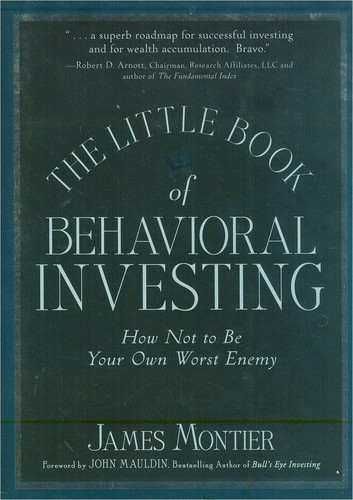
Talk to The Little Book of Behavioral Investing like its author wrote you back.
Get the ideas that fit your life — not generic summaries.
- Chat with the book
- Audiobook-style main ideas
- Adapts to your life and goals
- Helps you take action
The Little Book of Behavioral Investing, in detail
The Little Book of Behavioral Investing is James Montier's tour through the cognitive traps that cause intelligent, well-intentioned investors to consistently underperform. Montier, a quantitative strategist with extensive experience at major investment banks, writes with unusual candor: the biases he describes are not just problems for retail investors. They affect professionals too, and the data he cites makes that uncomfortable point repeatedly.
The book is organized around specific biases rather than a single unifying framework. Montier covers overconfidence and the illusion of knowledge, where having more information generates false confidence without improving outcomes. He addresses inattentional blindness, where investors focus so hard on specific data that they miss obvious disconfirming evidence. He dissects the influence of emotion on decision-making — fear and greed at market extremes — and shows how social pressure leads investors to hold consensus positions long past the point where the evidence supports them.
The anchoring problem receives particular attention. Investors routinely treat arbitrary reference points — the price they paid, a stock's 52-week high, an analyst's price target — as meaningful inputs to their current decision. Montier shows how these anchors distort valuation judgment in ways that are hard to see in real time. The hindsight bias chapter is similarly sharp: investors systematically remember their past decisions as more rational than they were, which prevents them from learning from mistakes.
Montier's proposed solution is process over intuition. He recommends pre-mortems before major investment decisions, simple checklists that force attention to ignored evidence, and explicit constraints on how much weight to give recent events. The book is brief and blunt. Montier doesn't claim these tools are easy to use under pressure — he acknowledges that knowing about a bias and not acting on it is the normal human condition. What he offers is a framework for designing decision processes that fight bias structurally, rather than relying on discipline that tends to fail when it's needed most.
The big ideas
- 1.
More information does not produce better investment decisions. Past a certain point it increases confidence without improving accuracy — a dangerous combination.
- 2.
Overconfidence is the most pervasive and costly bias in investing. Most investors, including professionals, believe their analysis is better than it typically is.
- 3.
Anchoring to reference prices — purchase price, 52-week high, analyst targets — corrupts valuation judgment in ways investors rarely notice.
