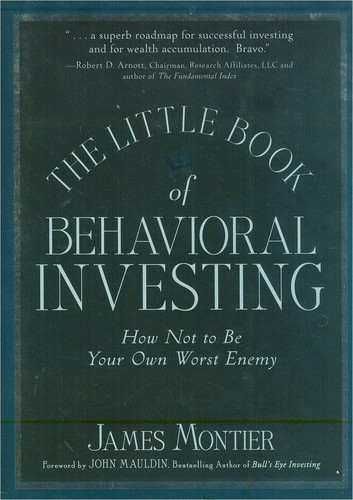
The Little Book of Behavioral Investing by James Montier is a 2010 economics book about behavioral finance, cognitive biases, investment psychology. More information does not produce better investment decisions. Past a certain point it increases confidence without improving accuracy — a dangerous combination.
Summary
The Little Book of Behavioral Investing is James Montier's tour through the cognitive traps that cause intelligent, well-intentioned investors to consistently underperform. Montier, a quantitative strategist with extensive experience at major investment banks, writes with unusual candor: the biases he describes are not just problems for retail investors. They affect professionals too, and the data he cites makes that uncomfortable point repeatedly.
The book is organized around specific biases rather than a single unifying framework. Montier covers overconfidence and the illusion of knowledge, where having more information generates false confidence without improving outcomes. He addresses inattentional blindness, where investors focus so hard on specific data that they miss obvious disconfirming evidence. He dissects the influence of emotion on decision-making — fear and greed at market extremes — and shows how social pressure leads investors to hold consensus positions long past the point where the evidence supports them.
The anchoring problem receives particular attention. Investors routinely treat arbitrary reference points — the price they paid, a stock's 52-week high, an analyst's price target — as meaningful inputs to their current decision. Montier shows how these anchors distort valuation judgment in ways that are hard to see in real time. The hindsight bias chapter is similarly sharp: investors systematically remember their past decisions as more rational than they were, which prevents them from learning from mistakes.
Montier's proposed solution is process over intuition. He recommends pre-mortems before major investment decisions, simple checklists that force attention to ignored evidence, and explicit constraints on how much weight to give recent events. The book is brief and blunt. Montier doesn't claim these tools are easy to use under pressure — he acknowledges that knowing about a bias and not acting on it is the normal human condition. What he offers is a framework for designing decision processes that fight bias structurally, rather than relying on discipline that tends to fail when it's needed most.
Talk to The Little Book of Behavioral Investing like its author wrote you back.
Get the ideas that fit your life — not generic summaries.
- Chat with the book
- Audiobook-style main ideas
- Adapts to your life and goals
- Helps you take action
Key takeaways
- 1.
More information does not produce better investment decisions. Past a certain point it increases confidence without improving accuracy — a dangerous combination.
- 2.
Overconfidence is the most pervasive and costly bias in investing. Most investors, including professionals, believe their analysis is better than it typically is.
- 3.
Anchoring to reference prices — purchase price, 52-week high, analyst targets — corrupts valuation judgment in ways investors rarely notice.
- 4.
Hindsight bias makes past decisions look more rational than they were. This prevents genuine learning from mistakes and inflates perceived skill.
- 5.
Social proof and herding amplify mistakes at market extremes. Being contrarian requires both analytical conviction and psychological independence.
- 6.
Inattentional blindness causes investors to miss obvious evidence that doesn't fit their existing thesis. Seeking disconfirmation should be a deliberate process.
- 7.
Pre-mortems — imagining a decision has failed and asking why — surface risks that forward-looking analysis misses. They should be standard practice.
- 8.
Simple rules and checklists outperform expert judgment in many domains, including investment analysis. Process constraints that fight bias beat discipline alone.
Discussion questions
Use these on your own, with a book club, or as chat starters in Superbook. Book club version, ready to copy or print →
- 1.
Montier argues that more information can make decisions worse, not better. Where in your own life have you seen that pattern?
- 2.
What reference point anchors your thinking about a major financial decision you've made or are considering? How much does that anchor actually matter?
- 3.
Can you recall an investment or financial decision that looked obviously right in retrospect that wasn't actually obvious at the time? How has hindsight shaped how you remember it?
- 4.
Montier argues that even professional investors are systematically overconfident. How would you test whether you're overconfident in an area of expertise you care about?
- 5.
The book describes herding as rational at the individual level but destructive at the group level. Have you made a financial or professional decision primarily because it was the consensus view?
- 6.
Montier recommends pre-mortems before major decisions. Would you actually be willing to do one, and what would make you resist it?
- 7.
Which bias do you think affects your financial decisions most — overconfidence, anchoring, loss aversion, or herding? What evidence supports your answer?
- 8.
The book argues that process constraints work better than discipline. What's an area of your decision-making where you've successfully designed a process to fight a tendency you know you have?
- 9.
How do you distinguish between a conviction that is genuinely contrarian and one that is simply contrarian for its own sake?
- 10.
Montier notes that knowing about a bias doesn't prevent you from falling for it. What do you think is actually required to change a deep decision-making habit?
- 11.
The book treats emotion in investing primarily as a liability. Are there cases where emotional signals carry useful information?
- 12.
Which of Montier's proposed solutions — checklists, pre-mortems, explicit process rules — do you think would be most useful in your own financial decision-making?
Themes
Frequently asked questions
-
Is The Little Book of Behavioral Investing worth reading?
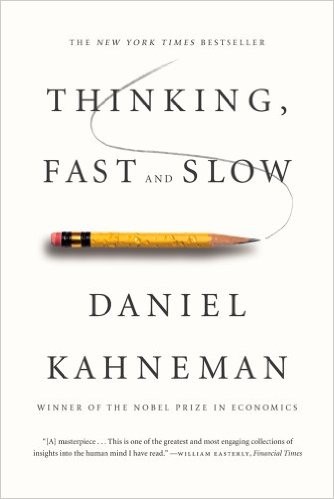
Yes, especially if you've read Thinking, Fast and Slow and want a shorter, more investment-specific application of the same ideas. Montier writes for practitioners and keeps the focus on actionable implications rather than academic theory.
-
How is this different from Thinking, Fast and Slow?
Kahneman's book is a comprehensive account of cognitive psychology. Montier's is a short, applied guide to how specific biases play out in investment decisions. Both are worth reading, but they serve different purposes.
-
Who should read this book?
Anyone who manages their own investments, evaluates them regularly, or makes significant financial decisions under uncertainty. It's also useful for analysts and portfolio managers who want a structured framework for challenging their own thinking.
-
How long is it?
Around 200 pages. Most readers finish it in a few sittings. The chapters are short and structured around single ideas, which makes it easy to revisit specific sections.
-
What's the most actionable advice in the book?
The pre-mortem technique: before finalizing a major investment decision, assume it has failed in two years and work backward to identify what went wrong. This forces you to surface risks your forward-looking analysis tends to ignore.
Similar books
Thinking, Fast and Slow
Daniel Kahneman
The Intelligent Investor
Benjamin Graham
Thinking in Bets: Making Smarter Decisions When You Don't Have All the Facts
Annie Duke
The Art of Thinking Clearly
Rolf Dobelli
