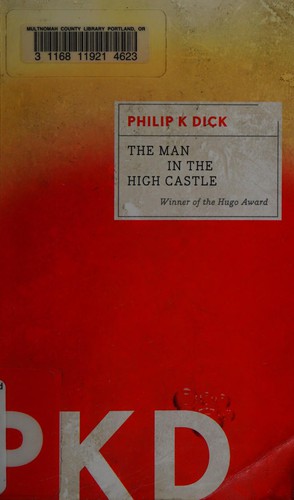
Talk to The Man in the High Castle like its author wrote you back.
Get the ideas that fit your life — not generic summaries.
- Chat with the book
- Audiobook-style main ideas
- Adapts to your life and goals
- Helps you take action
What it argues
It is 1962, fifteen years after the Axis won World War II. The eastern United States is controlled by Nazi Germany, the western Pacific States by Imperial Japan. Dick follows several characters through this occupied America: Robert Childan, an antiques dealer in San Francisco who sells Americana to Japanese collectors; Frank Frink, a Jewish craftsman hiding his identity while trying to make a living; Juliana Frink, his ex-wife who falls in with a mysterious man in Colorado; and Nobusuke Tagomi, a Japanese trade official whose moral universe is quietly disintegrating. A novel called The Grasshopper Lies Heavy circulates underground — it depicts a world where the Allies won. But this imagined alternate reality isn't quite our own history either.
The book is about authenticity in every sense. What makes an American antique genuine? What makes a person's identity real under an occupying power? What makes a historical narrative true? Dick uses the I Ching — which several characters consult throughout — to foreground the idea that reality may be less fixed than it appears. The nested fiction, a novel within a novel about a different counterfactual, introduces an unsettling recursion: we are reading an alternate history that contains its own alternate history, and neither one is our world.
What it gets right
- 1.
Authenticity is the novel's central obsession — Childan's forgery subplot and the I Ching's role both ask whether anything is what it claims to be.
- 2.
The nested fiction, The Grasshopper Lies Heavy, introduces a counterfactual within a counterfactual, suggesting that 'what really happened' may be an unstable category.
- 3.
Tagomi's moral crisis — acting against his own self-interest to protect others — is the novel's emotional and ethical core, presented quietly and without resolution.
What it covers
Who wrote it
Philip K. Dick (1928–1982) was an American science fiction writer whose work obsessively examined the nature of reality, identity, and the relationship between humans and technology. He published over 40 novels and 120 short stories, with Do Androids Dream of Electric Sheep?, Ubik, A Scanner Darkly, and VALIS among his most celebrated. He won the Hugo Award for The Man in the High Castle in 1963. His novels have been the source material for Blade Runner, Total Recall, Minority Report, and many other films. He spent most of his life in California in financial difficulty.
