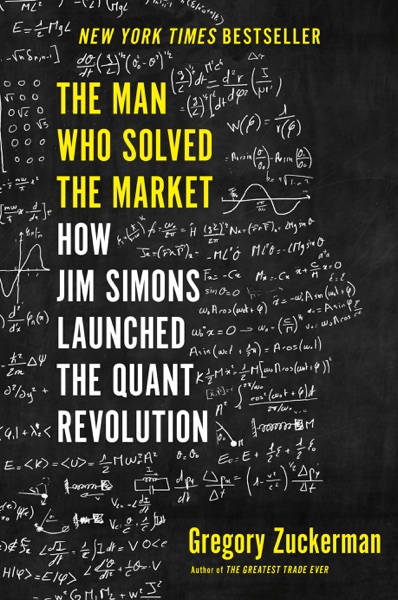
Talk to The Man Who Solved the Market like its author wrote you back.
Get the ideas that fit your life — not generic summaries.
- Chat with the book
- Audiobook-style main ideas
- Adapts to your life and goals
- Helps you take action
The Man Who Solved the Market, in detail
The Man Who Solved the Market is Gregory Zuckerman's account of Jim Simons, the mathematician who founded Renaissance Technologies and built the most successful investment firm in history. Simons was a world-class mathematician who cracked Soviet codes for the NSA and made foundational contributions to geometry before turning his attention to financial markets in his forties. The Medallion Fund, Renaissance's flagship, has returned roughly 66 percent annually before fees for more than three decades — a performance so far above any competitor that the finance world has largely stopped trying to explain it.
Zuckerman, a Wall Street Journal reporter, spent years conducting interviews for the book. The result is the most detailed account yet available of how Renaissance was built: the recruitment of mathematicians, physicists, and computer scientists rather than finance professionals; the development of statistical models that could identify non-random patterns in price data; the fierce internal debates between the "fundamental" camp that wanted to incorporate traditional financial reasoning and the "systematic" camp that wanted pure mathematical signal; and the repeated crises that threatened to destroy the firm.
The central intellectual claim is that financial markets contain persistent patterns detectable by statistical methods, and that Renaissance found them first because it hired scientists trained to find patterns in noisy data rather than economists trained to explain prices through theory. Simons and his colleagues never claimed to understand why a pattern existed — only that it did, and reliably enough to trade.
The second half of the book turns darker. Simons' former partner Robert Mercer used his Renaissance wealth to become one of the primary financial backers of Steve Bannon, Cambridge Analytica, and the Trump presidential campaign. Zuckerman traces this trajectory carefully, noting the tension between Simons' own liberal politics and the political use made of money generated within the same firm. The book raises questions it doesn't fully answer about the relationship between mathematical genius, vast wealth, and political consequence.
The big ideas
- 1.
Renaissance Technologies' Medallion Fund has produced roughly 66 percent annual returns before fees for over thirty years — the greatest track record in the history of investment management.
- 2.
Simons built Renaissance by hiring mathematicians and scientists rather than finance professionals. The firm explicitly did not want people who thought like economists.
- 3.
The systematic approach treats financial markets as data problems: find persistent statistical patterns in price data, trade them mechanically, and never deviate based on intuition or explanation.
