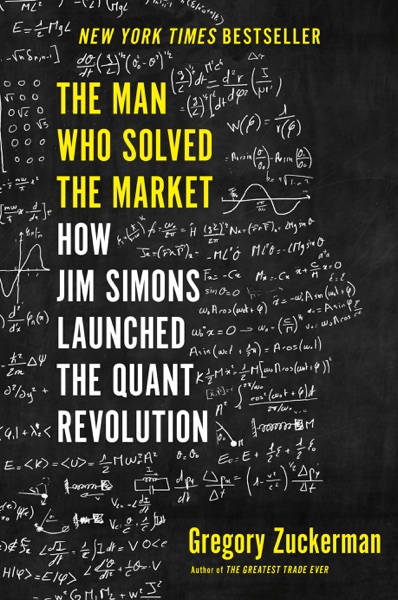
The Man Who Solved the Market by Gregory Zuckerman is a 2019 biography book about quantitative finance, financial markets, mathematics and science. Renaissance Technologies' Medallion Fund has produced roughly 66 percent annual returns before fees for over thirty years — the greatest track record in the history of investment management.
Summary
The Man Who Solved the Market is Gregory Zuckerman's account of Jim Simons, the mathematician who founded Renaissance Technologies and built the most successful investment firm in history. Simons was a world-class mathematician who cracked Soviet codes for the NSA and made foundational contributions to geometry before turning his attention to financial markets in his forties. The Medallion Fund, Renaissance's flagship, has returned roughly 66 percent annually before fees for more than three decades — a performance so far above any competitor that the finance world has largely stopped trying to explain it.
Zuckerman, a Wall Street Journal reporter, spent years conducting interviews for the book. The result is the most detailed account yet available of how Renaissance was built: the recruitment of mathematicians, physicists, and computer scientists rather than finance professionals; the development of statistical models that could identify non-random patterns in price data; the fierce internal debates between the "fundamental" camp that wanted to incorporate traditional financial reasoning and the "systematic" camp that wanted pure mathematical signal; and the repeated crises that threatened to destroy the firm.
The central intellectual claim is that financial markets contain persistent patterns detectable by statistical methods, and that Renaissance found them first because it hired scientists trained to find patterns in noisy data rather than economists trained to explain prices through theory. Simons and his colleagues never claimed to understand why a pattern existed — only that it did, and reliably enough to trade.
The second half of the book turns darker. Simons' former partner Robert Mercer used his Renaissance wealth to become one of the primary financial backers of Steve Bannon, Cambridge Analytica, and the Trump presidential campaign. Zuckerman traces this trajectory carefully, noting the tension between Simons' own liberal politics and the political use made of money generated within the same firm. The book raises questions it doesn't fully answer about the relationship between mathematical genius, vast wealth, and political consequence.
Talk to The Man Who Solved the Market like its author wrote you back.
Get the ideas that fit your life — not generic summaries.
- Chat with the book
- Audiobook-style main ideas
- Adapts to your life and goals
- Helps you take action
Key takeaways
- 1.
Renaissance Technologies' Medallion Fund has produced roughly 66 percent annual returns before fees for over thirty years — the greatest track record in the history of investment management.
- 2.
Simons built Renaissance by hiring mathematicians and scientists rather than finance professionals. The firm explicitly did not want people who thought like economists.
- 3.
The systematic approach treats financial markets as data problems: find persistent statistical patterns in price data, trade them mechanically, and never deviate based on intuition or explanation.
- 4.
Renaissance's models don't require understanding why a pattern exists — only that it exists with sufficient consistency to trade profitably. This is philosophically distinct from fundamental investing.
- 5.
The internal culture at Renaissance was intensely secretive. Employees signed agreements that prevented them from discussing the firm's methods even after leaving.
- 6.
The debate between 'fundamental' camp members who wanted explanatory models and 'systematic' members who wanted pure statistical models was resolved decisively in favor of the systematists.
- 7.
Simons' former partner Robert Mercer used Renaissance-derived wealth to fund Steve Bannon, Cambridge Analytica, and the Trump campaign — a political consequence nobody at the firm anticipated.
- 8.
Simons himself is a paradox: a brilliant scientist and generous philanthropist whose methods remain largely opaque even to sophisticated observers of financial markets.
Discussion questions
Use these on your own, with a book club, or as chat starters in Superbook. Book club version, ready to copy or print →
- 1.
Renaissance's models find patterns without requiring explanations for why they exist. What does that tell us about the nature of financial markets, and what are the limits of that approach?
- 2.
Simons hired scientists specifically because they didn't think like economists. In what other fields might importing outsiders with different training produce similar advantages?
- 3.
The Medallion Fund's returns are so far above any competitor that they are hard to explain even within Renaissance. What does persistent outperformance at this level suggest about market efficiency?
- 4.
Zuckerman traces how Mercer's wealth flowed into political causes that Simons opposed. Does accumulating wealth through a mathematical process carry any moral responsibility for what the wealth funds?
- 5.
Renaissance employees signed remarkably restrictive NDAs and the firm maintained extraordinary secrecy. Is that secrecy legitimate intellectual property protection or something that crosses a line?
- 6.
The book chronicles recurring internal conflicts between systematic and fundamental approaches. Where in your own work do you see analogous debates between data-driven and intuition-driven decision-making?
- 7.
The Medallion Fund is closed to outside investors and only available to Renaissance employees. If you accept the fund's returns as real, is that arrangement defensible?
- 8.
Simons moved from mathematics to codebreaking to business before finding finance. What does his career suggest about the relationship between deep expertise in one domain and the ability to generate new insights in another?
- 9.
Zuckerman got remarkable access for a book about one of the most secretive firms in the world. How do you assess the reliability of a business biography built largely on retrospective interviews with insiders?
- 10.
The book ends with questions about political consequence but doesn't fully resolve them. What do you think the obligations of major political donors are when their money goes to causes that harm others?
- 11.
Renaissance employees made enormous sums but lived under severe restrictions on what they could do professionally after leaving. Is that a reasonable trade?
- 12.
If you were designing a quantitative trading firm today, which of Simons' organizational choices would you replicate and which would you change?
Themes
Frequently asked questions
-
What is The Man Who Solved the Market about?
It's the story of Jim Simons and the founding of Renaissance Technologies, the most successful quantitative hedge fund in history. The book covers how Simons recruited scientists to find statistical patterns in market data, and how Renaissance's wealth was later used to fund major political campaigns.
-
Is The Man Who Solved the Market worth reading?
Yes. It's the best reported account of Renaissance Technologies available, and the story of Simons himself — mathematician, codebreaker, then investor — is genuinely compelling. The second half, on Mercer and political consequence, raises important questions beyond pure finance.
-
Does the book explain how Renaissance's models actually work?
No, and that's honest — the models remain proprietary and nobody outside the firm fully understands them. The book explains the philosophy and the organizational culture without revealing the specific methods.
-
Do I need a finance background to read this?
No. Zuckerman writes for a general audience. The quantitative concepts are explained plainly enough that readers without finance knowledge will follow the argument. Finance professionals will find the big-picture framing familiar but the specific details about Renaissance genuinely new.
-
What's the most surprising thing in the book?
Probably the political section — the detailed account of how Robert Mercer's Renaissance-generated wealth flowed into Cambridge Analytica, Steve Bannon's operations, and the Trump campaign. It's a stark illustration of how financial returns can have consequences nobody at the generating institution intended or wanted.