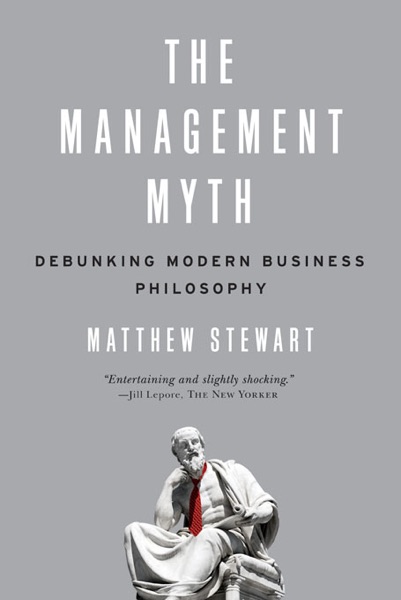
Talk to The Management Myth like its author wrote you back.
Get the ideas that fit your life — not generic summaries.
- Chat with the book
- Audiobook-style main ideas
- Adapts to your life and goals
- Helps you take action
What it argues
Matthew Stewart spent several years as a management consultant at a prestigious firm before concluding that much of what he was selling was not knowledge but the performance of knowledge. The Management Myth is his account of that realization, a history of management theory from Frederick Winslow Taylor's scientific management through the twentieth century, and an argument that the discipline's claim to be a science is largely unfounded.
The central target is the business school's promise that management can be reduced to teachable principles that produce predictable results. Stewart traces this promise back to Taylor, whose time-and-motion studies in steel mills produced a system that claimed to be the one best way of doing any task. Taylor's influence on how management thinks about work is enormous and largely invisible: the idea that tasks can be broken down, optimized, and controlled by technical experts is embedded in most modern organizations. Stewart argues that Taylor's actual studies were fraudulent — the numbers were invented — and that the edifice built on them reflects this shaky foundation.
What it gets right
- 1.
Frederick Winslow Taylor's scientific management, the founding discipline of modern management theory, was built on fraudulent data — the time-and-motion studies were invented, not measured.
- 2.
Management consulting sells the appearance of rigor and expertise more consistently than it delivers actual knowledge. Clients buy confidence as much as content.
- 3.
The academic discipline of management studies has not produced testable, replicable knowledge the way chemistry or engineering has. Its frameworks are better described as rhetoric than science.
What it covers
Who wrote it
Matthew Stewart studied philosophy at Princeton and Oxford, receiving a doctorate in philosophy, and then spent several years as a management consultant at a major strategy consulting firm before leaving to write full-time. He has written several books, including The Courtier and the Heretic, on Leibniz and Spinoza, and Nature's God, on deism and the American founding. The Management Myth, published in 2009, draws directly on his experience inside the consulting industry and his background in the history of ideas. He has also written widely on inequality and class in America.
