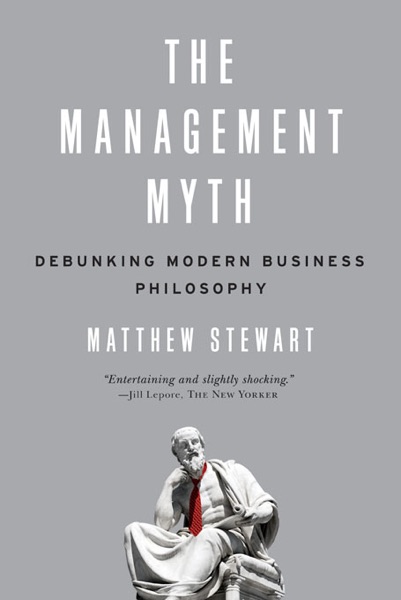
The Management Myth by Matthew Stewart is a 2009 business book about management, consulting, organizational theory. Frederick Winslow Taylor's scientific management, the founding discipline of modern management theory, was built on fraudulent data — the time-and-motion studies were invented, not measured.
Summary
Matthew Stewart spent several years as a management consultant at a prestigious firm before concluding that much of what he was selling was not knowledge but the performance of knowledge. The Management Myth is his account of that realization, a history of management theory from Frederick Winslow Taylor's scientific management through the twentieth century, and an argument that the discipline's claim to be a science is largely unfounded.
The central target is the business school's promise that management can be reduced to teachable principles that produce predictable results. Stewart traces this promise back to Taylor, whose time-and-motion studies in steel mills produced a system that claimed to be the one best way of doing any task. Taylor's influence on how management thinks about work is enormous and largely invisible: the idea that tasks can be broken down, optimized, and controlled by technical experts is embedded in most modern organizations. Stewart argues that Taylor's actual studies were fraudulent — the numbers were invented — and that the edifice built on them reflects this shaky foundation.
The book moves through the major schools of management thought: human relations theory (Elton Mayo), systems theory, strategy (Porter), and more recent frameworks. In each case Stewart identifies the gap between the claims made and the evidence supporting them. He is not arguing that management is unimportant — organizations require coordination and direction — but that the academic discipline of management studies has consistently overclaimed its knowledge and under-delivered on its results. The consulting industry, which sells this knowledge as expertise, has benefited enormously from the pretense.
Stewart's own background as a philosophy PhD who stumbled into consulting gives the book its particular tone: the account of what it felt like to charge enormous fees for advice derived from frameworks he'd constructed the previous week, the recognition of Taylor's ghost in every project management methodology, and the conclusion that the humanities offer better preparation for management than the MBA. It is a provocative book, occasionally polemical, but grounded in real history and entertaining throughout.
Talk to The Management Myth like its author wrote you back.
Get the ideas that fit your life — not generic summaries.
- Chat with the book
- Audiobook-style main ideas
- Adapts to your life and goals
- Helps you take action
Key takeaways
- 1.
Frederick Winslow Taylor's scientific management, the founding discipline of modern management theory, was built on fraudulent data — the time-and-motion studies were invented, not measured.
- 2.
Management consulting sells the appearance of rigor and expertise more consistently than it delivers actual knowledge. Clients buy confidence as much as content.
- 3.
The academic discipline of management studies has not produced testable, replicable knowledge the way chemistry or engineering has. Its frameworks are better described as rhetoric than science.
- 4.
The best managers Stewart encountered operated through relationship, judgment, and contextual knowledge — capabilities that business schools are poorly positioned to teach.
- 5.
Philosophy, history, and literature may prepare people for leadership better than MBA programs because they develop the kind of judgment that doesn't reduce to frameworks.
- 6.
Organizations built on Taylor's principles — divided, measured, optimized — often create exactly the alienated workers and fragile systems that make real performance impossible.
- 7.
The gap between what management theory claims and what it delivers has persisted for over a century precisely because it is very hard to measure management's contribution to organizational outcomes.
Discussion questions
Use these on your own, with a book club, or as chat starters in Superbook. Book club version, ready to copy or print →
- 1.
Stewart argues that Taylor's foundational studies were fraudulent. If that's true, how much of modern management practice should be reconsidered from scratch?
- 2.
He describes selling management advice he'd constructed that week as legitimate expertise. Where in your own professional life have you seen similar performances of knowledge?
- 3.
The book claims philosophy prepares people better for management than MBAs. Do you believe that? What would it actually take to test the claim?
- 4.
Taylor's model separates the people who think about work from the people who do it. Where in your organization is that separation present, and what does it cost?
- 5.
Stewart is hard on consulting firms but acknowledges they fill a real need. What legitimate value does management consulting provide, and what is theater?
- 6.
He traces a direct line from Taylor's scientific management to modern process optimization. What is the most Taylorist practice you encounter regularly in your own organization?
- 7.
The book argues that management is best understood as a craft learned through practice, not a discipline of transferable knowledge. What implications does that have for how you'd train managers?
- 8.
Stewart left consulting to write philosophy. What would it take for you to leave your current career for something that felt more honest?
- 9.
He notes that organizations consistently prefer the appearance of rational management to the reality of messy judgment. Why do organizations so badly want to believe that management is a science?
- 10.
The most effective leaders Stewart encountered operated through personal presence and relationship rather than frameworks. Can that kind of leadership be developed deliberately?
- 11.
Management theory has been remarkably resilient to empirical challenge. Why do frameworks persist after the evidence turns against them?
- 12.
If you were designing a management education program from scratch, knowing what Stewart describes, what would it include and what would you cut?
Themes
Frequently asked questions
-
Is The Management Myth just a polemic, or is there real argument here?
Both. Stewart has genuine historical claims about Taylor's fraudulent data and the thin empirical basis of management theory, and those claims are well-documented. The book is also clearly the work of someone with a grievance against the consulting industry. The strongest sections are the historical ones; the prescriptive parts are more impressionistic.
-
Who should read this book?
People working in or with consulting firms, MBAs who want to think critically about their education, managers who have noticed that the frameworks don't always work, and anyone interested in the history of how organizations came to be run the way they are.
-
Does Stewart think management is useless?
No. He thinks organizations need good management and that some people are very good at it. His argument is that management education and consulting can't reliably produce or transmit that goodness, because the actual skills involved — judgment, relationship, contextual knowledge — don't reduce to teachable frameworks.
-
How does this book compare to Good Strategy Bad Strategy?
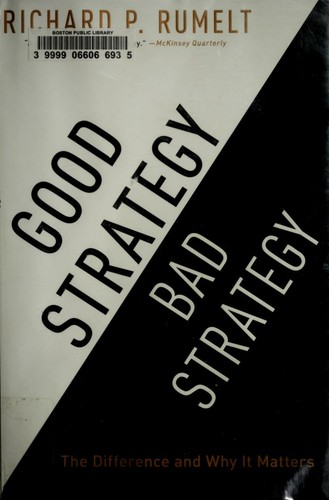
Rumelt's book accepts the management project and tries to do it better; Stewart's book questions whether the project is coherent. They make good companion reading: Rumelt on what actually works, Stewart on why so much of what claims to work doesn't.
-
What is the book's biggest weakness?
Stewart's alternative — humanistic education as management training — is more asserted than demonstrated. He shows what doesn't work but is less clear about what does, and his own career as a consultant who left is more evidence of dissatisfaction than of a better path.