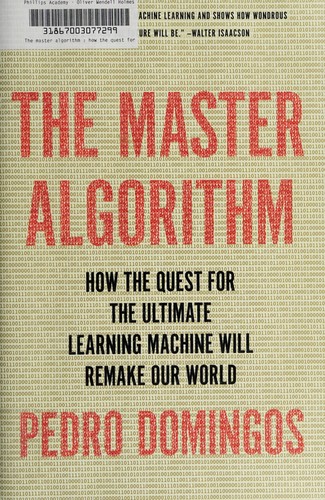
The Master Algorithm by Pedro Domingos is a 2015 science book about machine learning, artificial intelligence, algorithms. Machine learning is the programming paradigm that creates algorithms which improve their performance through experience rather than being explicitly programmed to solve specific problems.
Summary
The Master Algorithm is Pedro Domingos's survey of machine learning — the field of computer science that creates algorithms capable of learning from data — organized around a central speculative thesis: that there exists, or may be found, a single master algorithm from which all learning can be derived. Domingos argues that the major schools of machine learning are each working on different facets of the same underlying problem, and that a unified learner that combines their strengths would be capable of deriving any knowledge from data.
The five tribes of machine learning that Domingos describes each embody a different metaphor for learning. Symbolists derive rules from examples using inverse deduction, following in the tradition of logic and formal systems. Connectionists build systems inspired by neural structure, most powerfully expressed in modern deep learning. Evolutionists use simulated evolution — genetic algorithms — to discover solutions by survival of the fittest. Bayesians reason probabilistically under uncertainty, updating beliefs as evidence accumulates. Analogizers generalize from similar examples, expressed most powerfully in support vector machines and k-nearest-neighbor approaches.
The second half of the book traces the applications of machine learning in search engines, recommendation systems, medical diagnosis, personalized advertising, and scientific discovery. Domingos is enthusiastic about the field's potential to solve problems in biology, physics, and economics that are too complex for human mathematical analysis but tractable for pattern recognition at scale.
The master algorithm idea itself — that all learning can be unified — is speculative and has not been achieved. Critics point out that different learning problems genuinely require different approaches and that the unified-learner vision may be an overreach. The book's greatest value is its accessible survey of the five major approaches and their applications, not its grand unified theory.
Talk to The Master Algorithm like its author wrote you back.
Get the ideas that fit your life — not generic summaries.
- Chat with the book
- Audiobook-style main ideas
- Adapts to your life and goals
- Helps you take action
Key takeaways
- 1.
Machine learning is the programming paradigm that creates algorithms which improve their performance through experience rather than being explicitly programmed to solve specific problems.
- 2.
Five major schools of machine learning — symbolists, connectionists, evolutionists, Bayesians, and analogizers — represent different approaches to the same fundamental problem of learning from data.
- 3.
Deep learning, the most powerful current form of connectionist learning, builds hierarchical representations of data through many layers of artificial neurons, and has achieved human-level or superhuman performance on vision and language tasks.
- 4.
Bayesian reasoning — updating beliefs systematically in response to evidence according to Bayes' theorem — is both a description of rational reasoning and the foundation of a powerful class of learning algorithms.
- 5.
Machine learning systems learn what they are rewarded for, not necessarily what we intend. This alignment problem is fundamental: the difficulty of specifying what you actually want is as hard as the engineering problem.
- 6.
Recommendation algorithms learn your preferences from your behavior and project that behavior into the future — which creates filter bubbles and echo chambers, reinforcing existing preferences rather than expanding them.
- 7.
The master algorithm thesis holds that a single learning algorithm capable of learning from any data could, given sufficient data, derive all knowledge — including the algorithms that currently exist as separate tools.
- 8.
Machine learning is already the dominant paradigm for personalized medicine, protein folding, climate modeling, and drug discovery, where the patterns in data are too complex for explicit mathematical formulation.
Discussion questions
Use these on your own, with a book club, or as chat starters in Superbook. Book club version, ready to copy or print →
- 1.
Domingos identifies five tribes of machine learning. Which school's approach to learning seems most analogous to how human learning actually works?
- 2.
The master algorithm idea — a single learner for all problems — has not been achieved. Do you think it is a useful research target or a misleading framing?
- 3.
Recommendation algorithms learn what you like and give you more of it. Is that a service or a problem?
- 4.
Machine learning systems optimize for the target they are given, not for what we intended. Can you give an example from the book or from your experience where this distinction caused problems?
- 5.
Deep learning achieves superhuman performance on specific tasks but has no general understanding. Is that a limitation that matters, or is performance what counts?
- 6.
The book argues that machine learning will transform science by finding patterns in data that humans cannot discover analytically. Which scientific domain do you think it will most transform?
- 7.
Bayesian reasoning is presented as both normatively correct (how you should reason) and computationally powerful. Do humans reason Bayesianly by nature, or is it a learned skill?
- 8.
Domingos is enthusiastic about machine learning's potential. Does that enthusiasm color the book's treatment of risks and downsides?
- 9.
The filter bubble concern — that recommendations amplify existing preferences — is now widely discussed. Has anything been done to address it?
- 10.
How does the five-tribes framework help you understand the current AI landscape, including deep learning systems like GPT?
- 11.
If a master algorithm were achieved, what would you want it to learn first?
Themes
Frequently asked questions
-
Is The Master Algorithm technical?
It is accessible but not shallow. Domingos explains all concepts in plain language and avoids mathematics, but the ideas are genuinely complex and require attention. Readers with no prior machine learning background will find it challenging in places but manageable.
-
What is the master algorithm?
Domingos's speculative concept: a single learning algorithm capable of deriving any knowledge from data. It does not currently exist. The book surveys the candidate algorithms from different schools of machine learning and argues they are all approximations of the same underlying thing.
-
How has the field changed since the book was published in 2015?
Dramatically. The deep learning revolution that had just begun in 2015 has since produced transformers, large language models, diffusion models, and protein folding solutions. Connectionists (Domingos's neural tribe) have dominated the field in a way the book does not fully anticipate.
-
What is the most important idea in the book?
Probably the explanation of how different types of machine learning work and what their strengths and limitations are. The five-tribes taxonomy gives non-specialists a framework for understanding what the field is and why it has multiple competing approaches.
-
Who should read it?
Anyone who uses AI tools and wants to understand what they are doing, or who is considering working in data science. The book is more conceptual than technical and serves as a foundation for understanding current AI development.
Similar books
The Second Machine Age
Erik Brynjolfsson and Andrew McAfee
Human Compatible: Artificial Intelligence and the Problem of Control
Stuart Russell
Weapons of Math Destruction
Cathy O'Neil
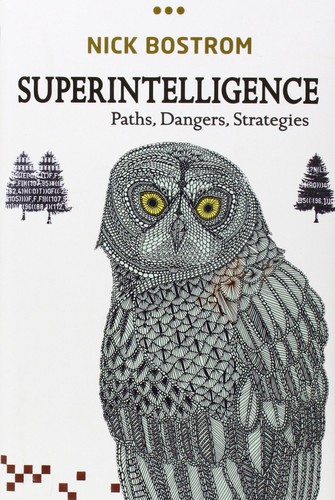
Superintelligence: Paths, Dangers, Strategies
Nick Bostrom
