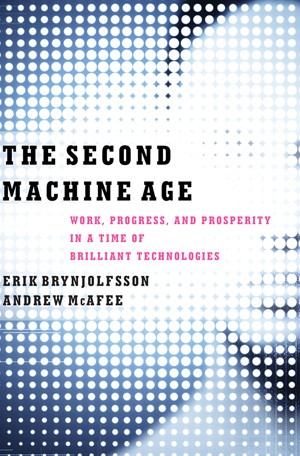
The Second Machine Age by Erik Brynjolfsson and Andrew McAfee is a 2014 economics book about automation, artificial intelligence, economics. Digital technology has entered a qualitatively new phase in which cognitive work is being automated alongside physical work — the second machine age, analogous to the first machine age of industrialization.
Summary
The Second Machine Age is Erik Brynjolfsson and Andrew McAfee's argument that digital technology has entered a qualitatively new phase — one in which machines can perform cognitive tasks previously reserved for humans, creating economic disruption and opportunity simultaneously. The first machine age was the Industrial Revolution, which automated physical labor. The second machine age automates mental work.
The book's starting framework is exponential growth. Brynjolfsson and McAfee use the famous parable of the inventor who asked for one grain of rice on the first square of a chessboard, two on the second, four on the third, and so on — producing a number larger than all the rice ever grown. They argue that digital technology has reached the second half of the chessboard, where the doublings start producing truly enormous numbers. Computing power, storage, bandwidth, and the capabilities built on them are now in this phase.
The economic argument is more cautious than the typical techno-optimism. The book distinguishes bounty — the growth in total output and the declining costs of digitally delivered goods and services — from spread — the growing inequality in how that bounty is distributed. Automation tends to raise productivity and lower costs for consumers while simultaneously concentrating gains among owners of capital and highly skilled workers who complement automation, while displacing workers in routinizable middle-skill jobs. This polarization of the labor market — strong demand at the top and bottom but declining demand in the middle — is documented with labor market data.
The policy recommendations include reforming education to emphasize creativity and interpersonal skills that are hard to automate, negative income taxes or earned income tax credits to support workers displaced by automation, investment in infrastructure and basic research, and rethinking immigration policy to attract skilled workers. The book is analytically stronger than it is prescriptively specific: the policy recommendations are sensible but familiar.
Talk to The Second Machine Age like its author wrote you back.
Get the ideas that fit your life — not generic summaries.
- Chat with the book
- Audiobook-style main ideas
- Adapts to your life and goals
- Helps you take action
Key takeaways
- 1.
Digital technology has entered a qualitatively new phase in which cognitive work is being automated alongside physical work — the second machine age, analogous to the first machine age of industrialization.
- 2.
Exponential growth in computing creates nonlinear effects: capabilities that seem modest double after double eventually become transformative, and many organizations are in the second half of the chessboard.
- 3.
Automation creates bounty — greater output, lower prices, more variety — and spread — growing inequality between workers who complement technology and workers who compete with it.
- 4.
The labor market is polarizing: demand for highly skilled cognitive work and low-skill service work is growing, while demand for middle-skill routinizable jobs — accounting, clerical work, certain manufacturing — is declining.
- 5.
General-purpose technologies like the steam engine and electricity took decades to show up in productivity statistics because complementary institutional and organizational changes are required to realize their value. Digital technology may follow the same pattern.
- 6.
Race with the machines, not against them: the workers and firms that thrive will be those who use automation to augment their capabilities rather than treating it as a direct competitor.
- 7.
Education systems designed for the industrial economy are poorly aligned with the second machine age; creativity, judgment, interpersonal skills, and learning agility matter more than routine knowledge acquisition.
- 8.
Winner-take-all dynamics in digital markets mean that small differences in capability can produce enormous differences in outcome, which concentrates market power and income among a small number of leading firms and individuals.
Discussion questions
Use these on your own, with a book club, or as chat starters in Superbook. Book club version, ready to copy or print →
- 1.
The book argues the US is in the 'second half of the chessboard' for digital technology. Do current AI developments since 2014 confirm or contradict that framing?
- 2.
Brynjolfsson and McAfee distinguish bounty from spread. If average living standards rise but inequality grows, how should we evaluate that as an outcome?
- 3.
Which jobs do you think are most vulnerable to automation in the next decade, and which are most protected?
- 4.
They argue workers should 'race with machines' rather than against them. Is that advice universally applicable or only to workers with certain kinds of skills and resources?
- 5.
The policy recommendations — negative income tax, education reform, infrastructure investment — are familiar. Why do you think these measures are so hard to implement?
- 6.
Winner-take-all dynamics mean a few companies dominate markets that might otherwise support many. Is that a problem that policy should address, and how?
- 7.
The first machine age created enormous disruption and eventually much greater prosperity. Does that historical pattern make you more or less optimistic about the second?
- 8.
The book was written in 2014, before large language models demonstrated the breadth of cognitive work that could be automated. How does that development affect the book's argument?
- 9.
Brynjolfsson and McAfee are economists. Does that disciplinary lens shape what they see and what they miss about technological change?
- 10.
They argue that digital goods — music, software, information — are non-rival: my use doesn't reduce your access. What does widespread non-rival production imply for economic models based on scarcity?
- 11.
Which specific sector's disruption from automation do you find most uncertain, and why?
- 12.
Is the framing of a 'second machine age' the right historical analogy, or does digital technology differ from the industrial revolution in ways that make the analogy misleading?
Themes
Frequently asked questions
-
Is The Second Machine Age optimistic or pessimistic about technology?
Optimistic about technology's potential and cautionary about its distributional effects. The book celebrates what technology can produce while being explicit that the gains will not be automatically shared. It is neither technophobic nor naively techno-optimistic.
-
How has the argument held up since 2014?
The broad trends — automation, labor market polarization, winner-take-all dynamics — have continued. The specific AI capabilities available have dramatically exceeded what the book implies. The policy recommendations remain largely unimplemented.
-
What is the difference between this book and Race Against the Machine?
Race Against the Machine (2012) is a short e-book making the core argument. The Second Machine Age is the full-length elaboration with more evidence, more economic analysis, and policy recommendations.
-
Is it too technical for non-economists?
No. The economics is explained accessibly. Some charts and statistics appear, but the narrative carries the argument without requiring technical economic knowledge.
-
What is their main policy recommendation?
A bundle: education reform emphasizing judgment and creativity; a negative income tax or earned income tax credit to support displaced workers; investment in infrastructure and basic research; immigration reform to attract skilled workers. They acknowledge these are not novel ideas and that political implementation is the real challenge.
Similar books
The Innovators: How a Group of Hackers, Geniuses, and Geeks Created the Digital Revolution
Walter Isaacson
The Singularity Is Near
Ray Kurzweil
Weapons of Math Destruction
Cathy O'Neil
Life 3.0: Being Human in the Age of Artificial Intelligence
Max Tegmark
