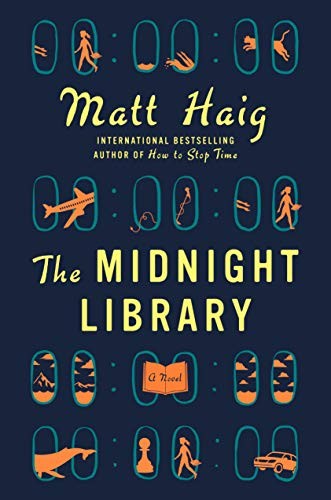
Talk to The Midnight Library like its author wrote you back.
Get the ideas that fit your life — not generic summaries.
- Chat with the book
- Audiobook-style main ideas
- Adapts to your life and goals
- Helps you take action
The Midnight Library, in detail
Nora Seed is thirty-five and done. She has lost her job, her cat, her best friend through her own choices, and she no longer sees a reason to continue. On the night she decides to end her life, she finds herself in a vast library between life and death, staffed by Mrs. Elm — her childhood librarian — and stocked with infinite books representing the infinite lives Nora could have lived had she made different choices. She can enter any of them. The question is whether any life she could have lived is worth wanting.
Matt Haig is writing about depression in the architecture of a high-concept philosophical fable. The Midnight Library allows him to explore the texture of regret — what it actually is, as opposed to what we imagine it to be — by making the thought experiment literal. Nora enters the lives she gave up: the Olympic swimmer, the glaciologist, the rock star's wife, the woman who married the man she jilted. Each life is real and complete and has its own griefs. The novel's argument, delivered through accumulation rather than lecture, is that the regrets we use to condemn our lives are usually not what we imagine they would have resolved.
Haig writes accessibly, at the edge of airport fiction and literary fable — this is not a difficult novel. The philosophy is real (Thoreau, Neoplatonism, quantum many-worlds theory make appearances) but worn lightly. The emotional payoff is structured to be genuine rather than cheap, though readers with a higher tolerance for sentimentality will find it more fully satisfying than those who don't. The prose is clear and the pacing is well-managed; this is a novel you can read in a day.
The Midnight Library became one of the bestselling literary novels of the pandemic years, which seems right: a book about the value of a life that exists, right now, however imperfect, found its audience at a particular historical moment of collective reassessment. Readers who have experienced depression, who have made choices they grieve, or who have simply wondered about the paths not taken will find it speaks directly. Readers looking for narrative complexity, ambiguity, or demanding prose will find it under-equipped.
The big ideas
- 1.
The novel's central argument is that regret is almost always a misreading of causation: the life you imagine you would have had if you'd made a different choice is not the life you would have actually had.
- 2.
Depression is depicted here not as sadness but as a failure of the imagination — the inability to conceive of a future worth wanting or a present worth inhabiting.
- 3.
Each parallel life Nora inhabits is fully real and has its own losses. The fantasy of the other life is always better than the reality of it.
