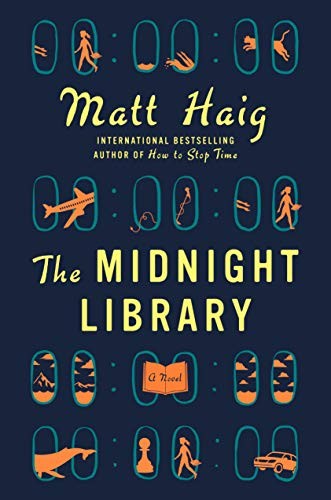
The Midnight Library by Matt Haig is a 2020 contemporary fiction book about regret and possibility, depression and the will to live, identity and choice. The novel's central argument is that regret is almost always a misreading of causation: the life you imagine you would have had if you'd made a different choice is not the life you would have actually had.
Summary
Nora Seed is thirty-five and done. She has lost her job, her cat, her best friend through her own choices, and she no longer sees a reason to continue. On the night she decides to end her life, she finds herself in a vast library between life and death, staffed by Mrs. Elm — her childhood librarian — and stocked with infinite books representing the infinite lives Nora could have lived had she made different choices. She can enter any of them. The question is whether any life she could have lived is worth wanting.
Matt Haig is writing about depression in the architecture of a high-concept philosophical fable. The Midnight Library allows him to explore the texture of regret — what it actually is, as opposed to what we imagine it to be — by making the thought experiment literal. Nora enters the lives she gave up: the Olympic swimmer, the glaciologist, the rock star's wife, the woman who married the man she jilted. Each life is real and complete and has its own griefs. The novel's argument, delivered through accumulation rather than lecture, is that the regrets we use to condemn our lives are usually not what we imagine they would have resolved.
Haig writes accessibly, at the edge of airport fiction and literary fable — this is not a difficult novel. The philosophy is real (Thoreau, Neoplatonism, quantum many-worlds theory make appearances) but worn lightly. The emotional payoff is structured to be genuine rather than cheap, though readers with a higher tolerance for sentimentality will find it more fully satisfying than those who don't. The prose is clear and the pacing is well-managed; this is a novel you can read in a day.
The Midnight Library became one of the bestselling literary novels of the pandemic years, which seems right: a book about the value of a life that exists, right now, however imperfect, found its audience at a particular historical moment of collective reassessment. Readers who have experienced depression, who have made choices they grieve, or who have simply wondered about the paths not taken will find it speaks directly. Readers looking for narrative complexity, ambiguity, or demanding prose will find it under-equipped.
Talk to The Midnight Library like its author wrote you back.
Get the ideas that fit your life — not generic summaries.
- Chat with the book
- Audiobook-style main ideas
- Adapts to your life and goals
- Helps you take action
Key takeaways
- 1.
The novel's central argument is that regret is almost always a misreading of causation: the life you imagine you would have had if you'd made a different choice is not the life you would have actually had.
- 2.
Depression is depicted here not as sadness but as a failure of the imagination — the inability to conceive of a future worth wanting or a present worth inhabiting.
- 3.
Each parallel life Nora inhabits is fully real and has its own losses. The fantasy of the other life is always better than the reality of it.
- 4.
The Midnight Library uses the thought experiment format to make concrete what is usually abstract: the question of what you actually value, as revealed by what you miss when you have everything else.
- 5.
Mrs. Elm as the librarian/guide figure embodies an idealized form of being witnessed — the person who sees what you might become rather than cataloging what you've failed to be.
- 6.
The novel is skeptical of achievement as a substitute for presence: the successful versions of Nora are not happier than the unsuccessful ones; they are differently unhappy.
- 7.
Haig's treatment of suicidal crisis is deliberately non-clinical and non-dramatic: it's rendered as a logical conclusion to a particular way of thinking, rather than an aberration or emergency.
- 8.
The ending is deliberately optimistic in a way that will feel earned or saccharine depending on what you bring to the novel. Haig is not interested in ambiguity; he has an argument and makes it.
Discussion questions
Use these on your own, with a book club, or as chat starters in Superbook. Book club version, ready to copy or print →
- 1.
Nora's regrets are specific — the Olympic swimming career, the fiancé she left, her brother's band. Looking at them one by one, do you think the novel is right that she was wrong to regret them?
- 2.
The Midnight Library posits that we can never know whether our unlived lives would have been better. Is that a comforting argument or a deflating one, depending on who you are?
- 3.
Haig was public about writing this novel in the context of his own experience with depression. Does knowing that change how you read it?
- 4.
The philosophy in the novel — Thoreau on living deliberately, quantum many-worlds, Neoplatonism — is worn lightly. Did you feel it enriched the story or was it decorative?
- 5.
Every parallel life Nora enters has its own form of loss. Is the novel making an argument that all lives are equally good, or a more specific argument that Nora's particular life was good?
- 6.
Mrs. Elm is more symbol than character. Does that function suit her role in the story, or did you find her thinness a problem?
- 7.
The novel ends with a clear resolution. Is that resolution earned by the journey Nora takes, or does it feel like the book offering comfort rather than truth?
- 8.
Which of Nora's unlived lives did you find most compelling, and what does that tell you about your own regrets?
- 9.
The Midnight Library was enormously successful during the pandemic. What do you think it gave readers in that specific moment that other books didn't?
- 10.
Haig's prose is accessible rather than literary. Is that a choice suited to the material, or does it limit what the novel can do?
- 11.
The book has been compared to It's a Wonderful Life. Is that a useful comparison? What does the novel do differently, and does the difference matter?
- 12.
If you've experienced depression, does the novel's depiction feel accurate to you? If not, does the inaccuracy matter for whether it works as fiction?
Themes
Frequently asked questions
-
Is The Midnight Library worth reading?
Yes, for the right reader. If you're drawn to fiction that directly addresses depression, regret, and the value of an ordinary life, it's one of the most direct and accessible treatments available. If you want literary ambiguity or challenging prose, it's not that book.
-
Is The Midnight Library depressing to read?
It engages seriously with suicidal thinking and depression, but it is not a depressing book — it is ultimately an argument for life, rendered with optimism that some will find moving and others will find slightly too tidy.
-
What is The Midnight Library about, in one line?
A woman who wants to die is placed in a library of all her possible lives and must decide whether any of them — including her own — is worth living.
-
Who shouldn't read The Midnight Library?
Readers who find high-concept narrative structures contrived, readers who prefer ambiguous endings, and readers for whom accessible prose without literary density is frustrating. The book is emotionally earnest in a way not everyone wants from fiction.
-
Is there an adaptation?
A Netflix film adaptation was in development as of late 2024, with no confirmed release date.