Talk to The Mind's I like its author wrote you back.
Get the ideas that fit your life — not generic summaries.
- Chat with the book
- Audiobook-style main ideas
- Adapts to your life and goals
- Helps you take action
What it argues
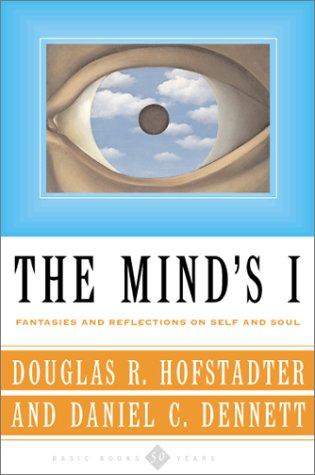
The Mind's I is a collaborative anthology edited by Douglas Hofstadter and Daniel Dennett, two of the most influential thinkers on consciousness and mind of the late twentieth century. Published in 1981, it collects fiction, philosophy, thought experiments, and scientific essays — from Jorge Luis Borges to Alan Turing to Richard Dawkins to John Searle — and pairs each piece with a reflective commentary from one or both editors. The result is not a textbook but an intellectual tour: a guided exploration of what the mind is, whether machines can have minds, what the self consists of, and whether personal identity can survive radical change.
The organizing questions are large and genuinely hard. What is it to be a mind? Can a brain transplanted into a new body retain its identity? What would it mean for a computer simulation to be conscious? If you uploaded your mental patterns to a machine, would the result be you? Hofstadter and Dennett don't resolve these questions — they use them as lenses. Each reading opens a new angle on the same set of puzzles, and the editors' commentaries explicitly connect pieces that might otherwise seem unrelated.
What it gets right
- 1.
The self is not a unified thing sitting behind the eyes — it is an emergent pattern, a story we tell about a collection of processes. This is uncomfortable but well-supported by both philosophy and neuroscience.
- 2.
Hofstadter and Dennett use fiction alongside philosophy deliberately. Some truths about consciousness are better approached through stories and thought experiments than through argument alone.
- 3.
Searle's Chinese Room argues that syntactic manipulation of symbols (what computers do) cannot, by itself, produce semantic understanding. The counterarguments Hofstadter develops are at least as important as the original challenge.
What it covers
Who wrote it
Douglas Hofstadter is a cognitive scientist and American Pulitzer Prize-winning author best known for Gödel, Escher, Bach: An Eternal Golden Braid (1979). He has held positions at Indiana University, where he directs the Fluid Analogies Research Group, and has written extensively on creativity, translation, and analogy as core cognitive processes. Daniel Dennett was a philosopher at Tufts University and one of the foremost defenders of a materialist account of mind. His books include Consciousness Explained and Darwin's Dangerous Idea. Both thinkers have been central to debates about artificial intelligence and the philosophy of mind for over four decades.
