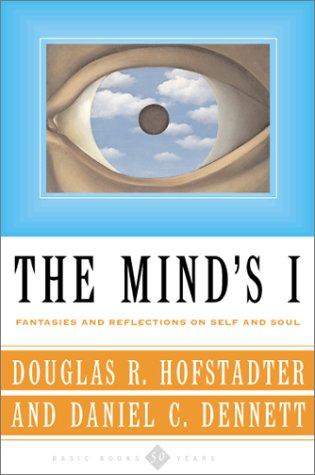
The Mind's I by Douglas Hofstadter & Daniel Dennett is a 1981 philosophy book about consciousness, identity, artificial intelligence. The self is not a unified thing sitting behind the eyes — it is an emergent pattern, a story we tell about a collection of processes. This is uncomfortable but well-supported by both philosophy and neuroscience.
Summary
The Mind's I is a collaborative anthology edited by Douglas Hofstadter and Daniel Dennett, two of the most influential thinkers on consciousness and mind of the late twentieth century. Published in 1981, it collects fiction, philosophy, thought experiments, and scientific essays — from Jorge Luis Borges to Alan Turing to Richard Dawkins to John Searle — and pairs each piece with a reflective commentary from one or both editors. The result is not a textbook but an intellectual tour: a guided exploration of what the mind is, whether machines can have minds, what the self consists of, and whether personal identity can survive radical change.
The organizing questions are large and genuinely hard. What is it to be a mind? Can a brain transplanted into a new body retain its identity? What would it mean for a computer simulation to be conscious? If you uploaded your mental patterns to a machine, would the result be you? Hofstadter and Dennett don't resolve these questions — they use them as lenses. Each reading opens a new angle on the same set of puzzles, and the editors' commentaries explicitly connect pieces that might otherwise seem unrelated.
The tone varies considerably across contributions. Borges's short fiction is literary and deliberately unsettling. Searle's "Chinese Room" thought experiment (included here in an early form) is rigorous analytic philosophy. Thomas Nagel's "What Is It Like to Be a Bat?" probes the hard problem of subjective experience. The computer science contributions from Turing and others engage the question of machine intelligence from a technical direction. The breadth is intentional: Hofstadter and Dennett believe that philosophy of mind requires an unusual range of tools, and the book models that belief.
The Mind's I rewards readers who are willing to sit with confusion and follow arguments wherever they lead. It is not a light read, but it is rarely dull — the editors have a talent for selecting material that is genuinely provocative rather than merely academic. For anyone seriously interested in consciousness, artificial intelligence, personal identity, or the nature of the self, this book remains one of the richest entry points in the literature. Its age shows in some of the AI discussions, but the philosophical questions it raises have only become more pressing as machine intelligence has advanced.
Talk to The Mind's I like its author wrote you back.
Get the ideas that fit your life — not generic summaries.
- Chat with the book
- Audiobook-style main ideas
- Adapts to your life and goals
- Helps you take action
Key takeaways
- 1.
The self is not a unified thing sitting behind the eyes — it is an emergent pattern, a story we tell about a collection of processes. This is uncomfortable but well-supported by both philosophy and neuroscience.
- 2.
Hofstadter and Dennett use fiction alongside philosophy deliberately. Some truths about consciousness are better approached through stories and thought experiments than through argument alone.
- 3.
Searle's Chinese Room argues that syntactic manipulation of symbols (what computers do) cannot, by itself, produce semantic understanding. The counterarguments Hofstadter develops are at least as important as the original challenge.
- 4.
Turing's imitation game reframes the unanswerable question 'can machines think?' into the tractable one 'can a machine behave indistinguishably from a thinker?' — but whether that reframing actually solves the problem is itself contested.
- 5.
Personal identity over time is philosophically fragile. The thought experiments in the book — brain transplants, teleportation, copying — reveal that our intuitions about what makes us 'the same person' are surprisingly unstable.
- 6.
The hard problem of consciousness — why there is subjective experience at all, why it feels like something to see red — remains genuinely unsolved. The book is honest about this in a way that more confident treatments are not.
- 7.
Richard Dawkins's contribution on the extended phenotype and the selfish gene context of selfhood deepens the biological grounding of what seems to be purely a philosophical question.
- 8.
Reading philosophy about consciousness changes how you experience your own consciousness — at least temporarily. The editors see this recursive effect as a feature, not a distraction.
Discussion questions
Use these on your own, with a book club, or as chat starters in Superbook. Book club version, ready to copy or print →
- 1.
Hofstadter argues that the self is an emergent pattern, not a unitary thing. Does that view change anything about how you think about your own decisions or moral responsibility?
- 2.
Searle's Chinese Room claims a computer can pass any behavior test while still not understanding. Hofstadter's counter-argues the system as a whole can understand even if no part does. Which position do you find more compelling, and why?
- 3.
Several thought experiments in the book involve copying or duplicating a person. If an exact copy of you woke up tomorrow, would it be you? What hangs on the answer?
- 4.
Nagel asks what it is like to be a bat — and answers that we can't know from outside. Does the same argument apply to other humans? To very different cultures or minds?
- 5.
The book includes fiction alongside analytic philosophy. Do you think the fictional pieces carry philosophical weight, or are they illustrations rather than arguments?
- 6.
As AI has advanced since 1981, which thought experiments in the book feel more relevant than ever, and which feel dated or resolved?
- 7.
Hofstadter and Dennett seem to think the self is an illusion in some technical sense, while also acting as if it matters morally and practically. Is that coherent?
- 8.
The book treats AI and consciousness as deeply connected questions. How does that framing hold up now that large language models exist and behave in ways that were not anticipated in 1981?
- 9.
Borges's fiction is included because it captures something philosophy struggles to express directly. What does literature give you that argument cannot?
- 10.
If you could ask Hofstadter one question about consciousness that this book doesn't answer, what would it be?
- 11.
The editors argue that philosophy of mind requires breadth — science, fiction, thought experiments, formal argument. Is that argument about method convincing, or does it risk diluting rigor?
- 12.
Personal identity and continuity of self across time is one of the book's central puzzles. How does your own experience of memory and change relate to the philosophical accounts offered here?
Themes
Frequently asked questions
-
Is The Mind's I suitable for readers without a philosophy background?
Largely yes. The editors chose pieces for accessibility as well as depth, and the commentaries explain technical ideas in plain terms. Some analytic philosophy pieces are challenging, but the fiction and thought experiments require no prior training. A curious reader willing to sit with difficult questions will get a great deal from it.
-
How does The Mind's I relate to Hofstadter's Gödel, Escher, Bach?
GEB is Hofstadter's original sustained work exploring strange loops, self-reference, and consciousness through Gödel, Escher, and Bach. The Mind's I is a companion anthology that broadens the conversation to include other thinkers. Reading GEB first helps but isn't required — The Mind's I stands on its own.
-
What is the Chinese Room thought experiment?
Searle imagines a person in a room following rules to manipulate Chinese symbols they don't understand. The room passes a Chinese language test perfectly, but the person inside understands nothing. Searle uses this to argue that computers, which manipulate symbols by rules, cannot genuinely understand language or be conscious.
-
Is this book still relevant given advances in AI?
More relevant than ever. The philosophical questions about understanding, consciousness, and identity that Hofstadter and Dennett raise in 1981 have become urgent practical questions as large language models and other AI systems blur the lines the book is examining.
-
Who should read The Mind's I?
Anyone seriously interested in consciousness, artificial intelligence, the nature of the self, or the philosophy of mind. Also worth reading for people in AI or cognitive science who want deeper philosophical grounding for the questions their work raises.
Similar books
Consciousness Explained
Daniel C. Dennett
The Emperor's New Mind
Roger Penrose
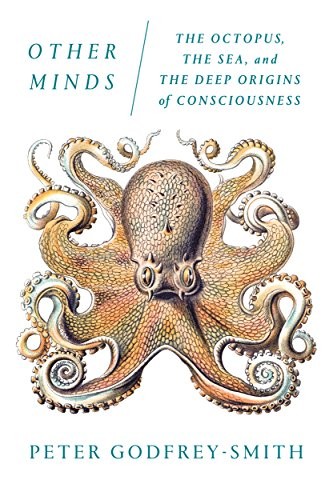
Other Minds: The Octopus, the Sea, and the Deep Origins of Consciousness
Peter Godfrey-Smith
Being and Nothingness
Jean-Paul Sartre
