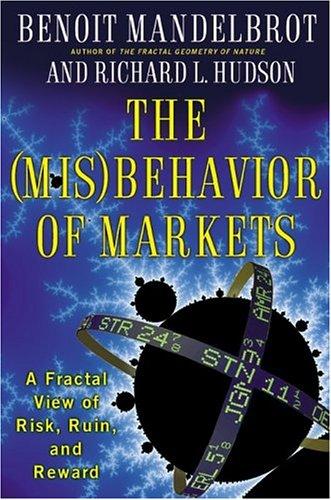
Talk to The Misbehavior of Markets like its author wrote you back.
Get the ideas that fit your life — not generic summaries.
- Chat with the book
- Audiobook-style main ideas
- Adapts to your life and goals
- Helps you take action
The Misbehavior of Markets, in detail
Benoit Mandelbrot, the mathematician who discovered fractal geometry, spent decades arguing that standard financial theory systematically underestimates the riskiness of markets. The Misbehavior of Markets, co-authored with science writer Richard Hudson and published in 2004, is his accessible case for that argument. The book arrived four years before the financial crisis of 2008, which Mandelbrot's framework had essentially predicted — not in timing, but in the claim that events of that magnitude are far more likely than conventional models allow.
The book's central target is the efficient market hypothesis and its mathematical foundations in Brownian motion and the normal distribution. Standard financial models — Black-Scholes for options pricing, Value at Risk for risk management — assume that price changes follow a bell curve: small moves are common, large moves are rare, and catastrophic moves are essentially impossible. Mandelbrot shows this is wrong. Actual market data follows a fat-tailed distribution, where extreme events occur orders of magnitude more frequently than the bell curve predicts. The 1987 stock market crash, by standard models, was an event so improbable it should not have occurred in the entire history of the universe.
Mandelbrot proposes that markets are better described by fractal geometry — the mathematics he developed over his career. Fractals exhibit self-similarity across scales and produce fat-tailed distributions naturally. Price charts at different time scales — intraday, daily, yearly — look statistically similar. Risk concentrates in ways that simple diversification cannot fully address. The book presents this framework accessibly, with charts and historical examples rather than formal mathematics.
The book has a polemical edge. Mandelbrot is genuinely contemptuous of the financial academy's attachment to models he believes are demonstrably wrong. Co-author Hudson assists with the readability and provides useful contextual material, but the voice is clearly Mandelbrot's. The practical implications are sobering: conventional risk models are not slightly wrong, they are wrong in a way that consistently underestimates tail events, and the financial industry has reasons not to correct this because the corrected version would require holding much more capital.
The big ideas
- 1.
Standard financial models assume price changes follow a normal (bell-curve) distribution. Real market data does not. Extreme events — crashes, booms — occur far more frequently than the normal distribution predicts.
- 2.
Markets have memory. Standard theory assumes each day's price change is independent of previous days. In reality, periods of high volatility cluster together, and so do periods of calm.
- 3.
Fractal geometry describes market price behavior more accurately than Brownian motion. Price charts exhibit self-similarity across time scales, which is a signature of fractal structure.
