The Misbehavior of Markets by Benoit Mandelbrot is a 2004 economics book about risk, financial markets, fractal geometry. Standard financial models assume price changes follow a normal (bell-curve) distribution. Real market data does not. Extreme events — crashes, booms — occur far more frequently than the normal distribution predicts.
Summary
Benoit Mandelbrot, the mathematician who discovered fractal geometry, spent decades arguing that standard financial theory systematically underestimates the riskiness of markets. The Misbehavior of Markets, co-authored with science writer Richard Hudson and published in 2004, is his accessible case for that argument. The book arrived four years before the financial crisis of 2008, which Mandelbrot's framework had essentially predicted — not in timing, but in the claim that events of that magnitude are far more likely than conventional models allow.
The book's central target is the efficient market hypothesis and its mathematical foundations in Brownian motion and the normal distribution. Standard financial models — Black-Scholes for options pricing, Value at Risk for risk management — assume that price changes follow a bell curve: small moves are common, large moves are rare, and catastrophic moves are essentially impossible. Mandelbrot shows this is wrong. Actual market data follows a fat-tailed distribution, where extreme events occur orders of magnitude more frequently than the bell curve predicts. The 1987 stock market crash, by standard models, was an event so improbable it should not have occurred in the entire history of the universe.
Mandelbrot proposes that markets are better described by fractal geometry — the mathematics he developed over his career. Fractals exhibit self-similarity across scales and produce fat-tailed distributions naturally. Price charts at different time scales — intraday, daily, yearly — look statistically similar. Risk concentrates in ways that simple diversification cannot fully address. The book presents this framework accessibly, with charts and historical examples rather than formal mathematics.
The book has a polemical edge. Mandelbrot is genuinely contemptuous of the financial academy's attachment to models he believes are demonstrably wrong. Co-author Hudson assists with the readability and provides useful contextual material, but the voice is clearly Mandelbrot's. The practical implications are sobering: conventional risk models are not slightly wrong, they are wrong in a way that consistently underestimates tail events, and the financial industry has reasons not to correct this because the corrected version would require holding much more capital.
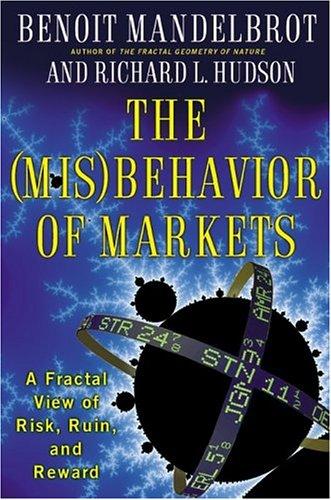
Talk to The Misbehavior of Markets like its author wrote you back.
Get the ideas that fit your life — not generic summaries.
- Chat with the book
- Audiobook-style main ideas
- Adapts to your life and goals
- Helps you take action
Key takeaways
- 1.
Standard financial models assume price changes follow a normal (bell-curve) distribution. Real market data does not. Extreme events — crashes, booms — occur far more frequently than the normal distribution predicts.
- 2.
Markets have memory. Standard theory assumes each day's price change is independent of previous days. In reality, periods of high volatility cluster together, and so do periods of calm.
- 3.
Fractal geometry describes market price behavior more accurately than Brownian motion. Price charts exhibit self-similarity across time scales, which is a signature of fractal structure.
- 4.
Value at Risk and similar risk management tools give firms false confidence. They are calibrated to the wrong distribution and will consistently fail to warn of the events that actually destroy institutions.
- 5.
Diversification helps with mild risk but not with wild risk. When correlations spike during a crisis — as they did in 2008 — diversified portfolios can still fall together.
- 6.
The Black-Scholes model for options pricing contains assumptions about market behavior that are known to be false. The model is widely used anyway because it is tractable and because alternatives are not as easy to sell.
- 7.
There is a difference between mild randomness (cloth textures, height distributions) and wild randomness (wealth distributions, market returns). Applying mild-randomness tools to wild-randomness problems is a category error.
- 8.
Financial crises are not rare black swans. Under a fat-tailed distribution, they are statistically expected at much higher frequencies than standard models predict — more like gray swans.
Discussion questions
Use these on your own, with a book club, or as chat starters in Superbook. Book club version, ready to copy or print →
- 1.
Mandelbrot argues that standard risk models are not just imprecise but fundamentally miscalibrated. If financial professionals know this, why do they continue using them?
- 2.
The 1987 crash was, under standard models, a near-impossibility. Does the existence of such events change how you personally think about the risk in your own financial decisions?
- 3.
Mandelbrot says markets have memory — volatility clusters. Have you observed this pattern in your own experience following markets, and how does it change what risk management should look like?
- 4.
The book distinguishes mild randomness from wild randomness. Which domains in your professional or personal life involve wild randomness that is often treated as mild?
- 5.
If fractal models are more accurate than bell-curve models, why hasn't the financial industry adopted them? Mandelbrot's answer is essentially institutional inertia and self-interest — does that seem like the full story?
- 6.
Diversification is one of the most widely recommended investment strategies. Mandelbrot qualifies it significantly. How much does his argument change your view of a diversified portfolio?
- 7.
The book predates the 2008 financial crisis. How much of what happened in 2008 do you think Mandelbrot's framework explains that standard models missed?
- 8.
Black-Scholes is used even though its assumptions are known to be false. What other widely used models or frameworks in your field are you using despite knowing their assumptions are wrong?
- 9.
Mandelbrot is contemptuous of the financial academy. Does his outsider position strengthen or weaken his argument for you?
- 10.
The practical implication of Mandelbrot's framework is that financial institutions should hold much more capital as a buffer. What would markets look like if they did?
- 11.
What does the concept of wild randomness suggest about the predictability of your own career or financial trajectory over a ten-year horizon?
Themes
Frequently asked questions
-
Is The Misbehavior of Markets worth reading?
Yes, especially for anyone who manages investments or wants to understand why financial crises happen more often than models predict. It is more readable than Mandelbrot's technical work and Nassim Taleb's books cover related terrain with more narrative flair, but this version has the mathematical authority of the original source.
-
Do I need to understand mathematics to read this book?
No. The book is written for general readers and uses charts and historical examples instead of equations. Basic familiarity with concepts like normal distributions helps but is not required.
-
What is the main argument of The Misbehavior of Markets?
That standard financial theory uses the wrong mathematical model for market risk — the normal distribution — and that fractal geometry provides a more accurate description of how markets actually behave, including far more frequent extreme events.
-
How does this book relate to Nassim Taleb's work?
Taleb explicitly credits Mandelbrot as a major influence on his thinking about fat tails and Black Swan events. The two books are complementary: Mandelbrot provides the mathematical framework and the historical evidence; Taleb explores the philosophical and practical implications more extensively.
-
Who should read this book?
Investors, risk managers, finance professionals, and anyone interested in why financial models failed in 2008. Also suitable for general readers interested in the limits of quantitative models in complex systems.
Similar books
The Black Swan: The Impact of the Highly Improbable
Nassim Nicholas Taleb
Fooled by Randomness
Nassim Nicholas Taleb
Against the Gods: The Remarkable Story of Risk
Peter L. Bernstein
Misbehaving: The Making of Behavioral Economics
Richard H. Thaler
