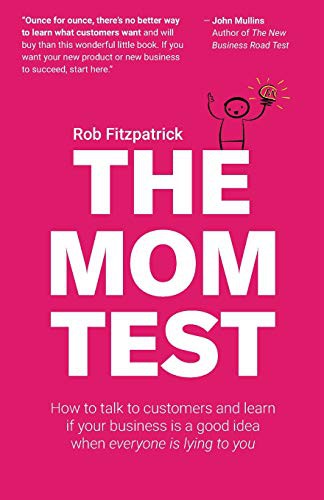
Talk to The Mom Test like its author wrote you back.
Get the ideas that fit your life — not generic summaries.
- Chat with the book
- Audiobook-style main ideas
- Adapts to your life and goals
- Helps you take action
The Mom Test, in detail
The Mom Test is Rob Fitzpatrick's short guide to customer development interviews — the conversations founders and product teams have with potential customers before building something. The central problem it addresses is that most of these conversations are useless, and the people having them usually don't realize it. The issue isn't dishonesty. It's politeness. People don't want to hurt your feelings. They'll say your idea sounds interesting, that they'd probably buy it, that they'd definitely recommend it to a friend. None of that means anything. Fitzpatrick's fix is a simple rule set for asking questions that customers can't lie about even if they want to, because the questions aren't about your idea at all.
The book's title comes from a test case: could your mom give you a useful interview if she loved you too much to criticize you? The answer is yes, if you ask the right questions. Good questions are about their life, not your idea. They ask about concrete past behavior rather than hypothetical future intentions. "How do you currently handle this problem?" is a good question. "Would you use something like this?" is not. "How much did that cost you last time it happened?" is good. "Do you think that's a common problem in your industry?" is not. The distinction sounds obvious stated plainly, but Fitzpatrick shows with repeated examples how consistently founders violate it — usually because they're unconsciously fishing for validation rather than information. The chapter walking through bad question after bad question is the most useful part of the book, because the examples are uncomfortably recognizable.
Fitzpatrick distinguishes three types of useful information: facts about the customer's current situation, emotions that reveal how much they care about the problem, and commitments that signal what they'll actually do. Compliments and opinions are noise. The only signal worth treating as real is commitment — someone willing to pay money, give up time, make an introduction, or sign a letter of intent. He also addresses the structural failures that corrupt interviews before they start: running a demo instead of listening, explaining your idea when you should be asking questions, and interviewing people who are already friendly to you rather than representative customers. The chapter on when to stop interviewing is useful: not when you feel confident, but when you start hearing the same problems and workarounds repeated across unrelated conversations with strangers.
At roughly 130 pages, the book is short enough to read in a single sitting and specific enough that re-reading the question examples before a real interview is genuinely worth doing. The main limitation is scope. Fitzpatrick focuses almost entirely on the single conversation — how to structure it, what to ask, how to handle deflection. He says little about synthesizing data across dozens of interviews, navigating enterprise sales cycles with multiple stakeholders, or deciding what to build once you have real signal. For anyone doing early-stage discovery work on a new product, business, or feature, it remains the clearest and most practical guide to the problem.
The big ideas
- 1.
Talk about their life, not your idea. The moment you pitch during a customer interview, you stop learning and start selling.
- 2.
Hypothetical questions get hypothetical answers. Ask about past behavior and current habits, not what someone would do in a future scenario.
- 3.
Compliments are worthless data. "That sounds really interesting" is not a signal. Money, time, and introductions are signals.
