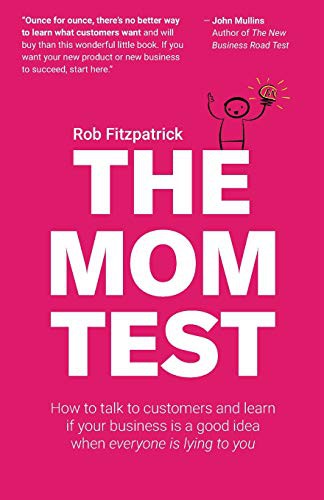
The Mom Test by Rob Fitzpatrick is a 2013 business book about customer interviews, startup validation, product development. Talk about their life, not your idea. The moment you pitch during a customer interview, you stop learning and start selling.
Summary
The Mom Test is Rob Fitzpatrick's short guide to customer development interviews — the conversations founders and product teams have with potential customers before building something. The central problem it addresses is that most of these conversations are useless, and the people having them usually don't realize it. The issue isn't dishonesty. It's politeness. People don't want to hurt your feelings. They'll say your idea sounds interesting, that they'd probably buy it, that they'd definitely recommend it to a friend. None of that means anything. Fitzpatrick's fix is a simple rule set for asking questions that customers can't lie about even if they want to, because the questions aren't about your idea at all.
The book's title comes from a test case: could your mom give you a useful interview if she loved you too much to criticize you? The answer is yes, if you ask the right questions. Good questions are about their life, not your idea. They ask about concrete past behavior rather than hypothetical future intentions. "How do you currently handle this problem?" is a good question. "Would you use something like this?" is not. "How much did that cost you last time it happened?" is good. "Do you think that's a common problem in your industry?" is not. The distinction sounds obvious stated plainly, but Fitzpatrick shows with repeated examples how consistently founders violate it — usually because they're unconsciously fishing for validation rather than information. The chapter walking through bad question after bad question is the most useful part of the book, because the examples are uncomfortably recognizable.
Fitzpatrick distinguishes three types of useful information: facts about the customer's current situation, emotions that reveal how much they care about the problem, and commitments that signal what they'll actually do. Compliments and opinions are noise. The only signal worth treating as real is commitment — someone willing to pay money, give up time, make an introduction, or sign a letter of intent. He also addresses the structural failures that corrupt interviews before they start: running a demo instead of listening, explaining your idea when you should be asking questions, and interviewing people who are already friendly to you rather than representative customers. The chapter on when to stop interviewing is useful: not when you feel confident, but when you start hearing the same problems and workarounds repeated across unrelated conversations with strangers.
At roughly 130 pages, the book is short enough to read in a single sitting and specific enough that re-reading the question examples before a real interview is genuinely worth doing. The main limitation is scope. Fitzpatrick focuses almost entirely on the single conversation — how to structure it, what to ask, how to handle deflection. He says little about synthesizing data across dozens of interviews, navigating enterprise sales cycles with multiple stakeholders, or deciding what to build once you have real signal. For anyone doing early-stage discovery work on a new product, business, or feature, it remains the clearest and most practical guide to the problem.
Talk to The Mom Test like its author wrote you back.
Get the ideas that fit your life — not generic summaries.
- Chat with the book
- Audiobook-style main ideas
- Adapts to your life and goals
- Helps you take action
Key takeaways
- 1.
Talk about their life, not your idea. The moment you pitch during a customer interview, you stop learning and start selling.
- 2.
Hypothetical questions get hypothetical answers. Ask about past behavior and current habits, not what someone would do in a future scenario.
- 3.
Compliments are worthless data. "That sounds really interesting" is not a signal. Money, time, and introductions are signals.
- 4.
The three useful types of information are facts, emotions, and commitments. Opinions and compliments fall outside all three.
- 5.
Confirmation bias kills customer interviews before they start. Most founders hear what they want to hear rather than what customers are actually saying.
- 6.
You should come away from each interview with specific facts: how they currently solve the problem, what tools they use, how much it costs them, how often it happens.
- 7.
Stop interviewing when you start hearing the same problems repeated by different strangers, not when you feel confident about your idea.
- 8.
Commitment is the test. If a customer won't pay, give time, or make an introduction, their positive feedback is not real signal.
Discussion questions
Use these on your own, with a book club, or as chat starters in Superbook. Book club version, ready to copy or print →
- 1.
Fitzpatrick argues that most customer conversations are worthless because founders ask the wrong questions. Which questions have you asked in the past that now seem like they were fishing for validation?
- 2.
The book says compliments are the enemy of real learning. What's the most encouraging thing a potential customer has said to you that, in retrospect, meant nothing?
- 3.
Good questions are about past behavior, not hypothetical futures. What would change about how you talk to customers if you committed to only asking about what they've actually done?
- 4.
Fitzpatrick says the only real signal is commitment — money, time, introductions. Have you ever mistaken enthusiasm for commitment? What happened next?
- 5.
The Mom Test suggests that most people are too polite to tell you your idea is bad. In which areas of your life do you rely on polite feedback instead of honest data?
- 6.
Fitzpatrick recommends stopping interviews when you start hearing repeated patterns from strangers. How would you know when you've reached that point in a real research project?
- 7.
The book covers how to handle someone who is too helpful — giving you what you want to hear. Who in your professional or personal life fills this role for your ideas?
- 8.
Fitzpatrick argues that running a demo before understanding the problem is a mistake most founders make. When have you rushed to show something before you understood what the other person actually needed?
- 9.
The distinction between facts, emotions, and commitments shapes what's worth writing down after a conversation. How do you currently document what you hear from customers or users? What's missing?
- 10.
Bad questions telegraph the answer you want. "Don't you find X frustrating?" "Wouldn't something like this help?" Write down three questions you've recently asked that have this problem.
- 11.
Fitzpatrick says you should be uncomfortable running a great customer interview because you're not pitching. How comfortable are you with silence and with questions that don't point anywhere?
- 12.
The book is short enough that its advice is specific and hard to misapply. What part of it do you think you would ignore in practice, and why?
Themes
Frequently asked questions
-
What is The Mom Test about?
It's a guide to customer interviews for founders and product teams. The core argument is that most early-stage conversations with potential customers produce misleading information because people are too polite to say what they really think, and that asking questions about past behavior instead of hypothetical futures fixes the problem.
-
Is The Mom Test worth reading?
Yes, especially for anyone who has ever walked away from a customer conversation feeling encouraged but then built something nobody wanted. The advice is specific, the examples are clear, and the book is short enough that the ideas stay concrete rather than dissolving into abstraction.
-
How long is The Mom Test?
About 130 pages, which takes most readers one to two hours. It's short enough to read in a single sitting and specific enough that re-reading the examples before an actual interview is worth the time.
-
Who should read The Mom Test?
Founders doing early product validation, product managers running user research, designers planning discovery interviews, and anyone who has received enthusiastic customer feedback and then been surprised when the product didn't sell. Less useful for teams that have moved past discovery into iterating on a product with existing users.
-
What is the main difference between a good and a bad customer interview question?
Good questions ask about what someone has actually done in the past — their current tools, their workarounds, the last time the problem cost them something. Bad questions ask about hypothetical future behavior or fish for the answer you want. "Would you pay for this?" is almost always a bad question.
-
What does The Mom Test title mean?
It refers to whether your questions are good enough that even your mom — who loves you and would never criticize your idea — could give you useful data. If your questions are about her actual behavior and not about your idea, she can't tell you what you want to hear even if she tries.
Similar books
The Lean Startup
Eric Ries
Zero to One: Notes on Startups, or How to Build the Future
Peter Thiel
Start with Why
Simon Sinek
Influence: The Psychology of Persuasion
Robert B. Cialdini
