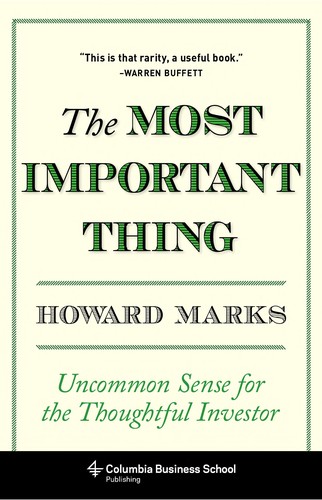
Talk to The Most Important Thing like its author wrote you back.
Get the ideas that fit your life — not generic summaries.
- Chat with the book
- Audiobook-style main ideas
- Adapts to your life and goals
- Helps you take action
What it argues
The Most Important Thing is Howard Marks's collection of investment insights drawn from his decades of memos to Oaktree Capital clients — memos that became famous in investment circles for their clarity, depth, and willingness to address the psychological dimensions of investing that most practitioners avoid. Marks is the co-founder of Oaktree Capital Management, a firm specializing in distressed debt, and has spent his career in parts of the market that most investors avoid. The book distills what he learned into a framework for thinking about risk, market cycles, and the psychology that makes investing difficult.
The organizing concept is "second-level thinking." First-level thinking is the obvious inference: this company looks good, so buy the stock. Second-level thinking asks what everyone else thinks, how the current price already reflects that consensus, and what would have to be different from the consensus for the investment to work out. Marks argues that superior investment returns require seeing something the market doesn't see — and that requires a level of critical analysis that goes beyond the immediately apparent.
What it gets right
- 1.
Second-level thinking goes beyond the obvious inference to ask what the consensus thinks, how it's already reflected in price, and what needs to be different for the investment to work.
- 2.
Risk is not volatility. The real risk is permanent loss of capital. Assets that look safe because prices are stable can represent enormous risk if they are overvalued.
- 3.
Risk is invisible in good times. When markets are rising, high-risk assets look safe because they are performing. This is precisely when risk is being accumulated, not avoided.
What it covers
Who wrote it
Howard Marks is the co-founder and co-chairman of Oaktree Capital Management, one of the world's largest alternative investment managers with a specialization in distressed securities. He joined Citibank after business school, moved through a series of investment roles, and founded Oaktree in 1995. Since 1990, Marks has written investment memos to clients that have been widely circulated in financial circles for their analytical depth and clarity. Warren Buffett has said that when he sees a new Marks memo, it is the first thing he reads. In addition to The Most Important Thing, Marks wrote Mastering the Market Cycle (2018). He holds degrees from the Wharton School and the…
