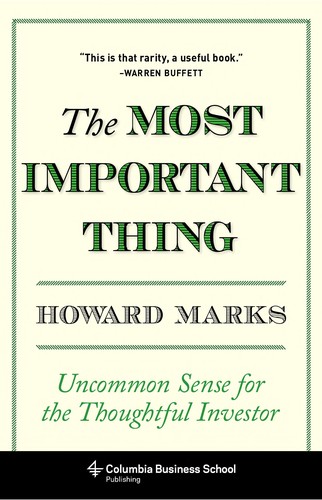
Talk to The Most Important Thing like its author wrote you back.
Get the ideas that fit your life — not generic summaries.
- Chat with the book
- Audiobook-style main ideas
- Adapts to your life and goals
- Helps you take action
The Most Important Thing, in detail
The Most Important Thing is Howard Marks's collection of investment insights drawn from his decades of memos to Oaktree Capital clients — memos that became famous in investment circles for their clarity, depth, and willingness to address the psychological dimensions of investing that most practitioners avoid. Marks is the co-founder of Oaktree Capital Management, a firm specializing in distressed debt, and has spent his career in parts of the market that most investors avoid. The book distills what he learned into a framework for thinking about risk, market cycles, and the psychology that makes investing difficult.
The organizing concept is "second-level thinking." First-level thinking is the obvious inference: this company looks good, so buy the stock. Second-level thinking asks what everyone else thinks, how the current price already reflects that consensus, and what would have to be different from the consensus for the investment to work out. Marks argues that superior investment returns require seeing something the market doesn't see — and that requires a level of critical analysis that goes beyond the immediately apparent.
The risk framework is the book's most useful contribution. Marks distinguishes between risk and volatility, arguing that permanent loss of capital is the real risk — not short-term price movement. He discusses how risk is invisible in good times (high-risk assets look safe when everything is going up), how the safest-seeming investments at peaks can be the most dangerous, and how genuine risk management requires understanding the full distribution of outcomes, not just the expected outcome. The central insight is that investors who ignore the downside scenarios and focus only on expected returns are not managing risk — they are ignoring it.
The book also addresses market cycles, investor psychology, contrarianism, and the virtues of defensive investing. Marks is unusually direct about what he doesn't know — he explicitly rejects the idea that anyone can reliably predict market direction — and frames successful investing as being roughly right about relative value and risk rather than being precisely correct about future prices. The "Uncommented" and "Illuminated" editions include annotations from prominent investors including Warren Buffett, Joel Greenblatt, Paul Johnson, and Seth Klarman.
The big ideas
- 1.
Second-level thinking goes beyond the obvious inference to ask what the consensus thinks, how it's already reflected in price, and what needs to be different for the investment to work.
- 2.
Risk is not volatility. The real risk is permanent loss of capital. Assets that look safe because prices are stable can represent enormous risk if they are overvalued.
- 3.
Risk is invisible in good times. When markets are rising, high-risk assets look safe because they are performing. This is precisely when risk is being accumulated, not avoided.
