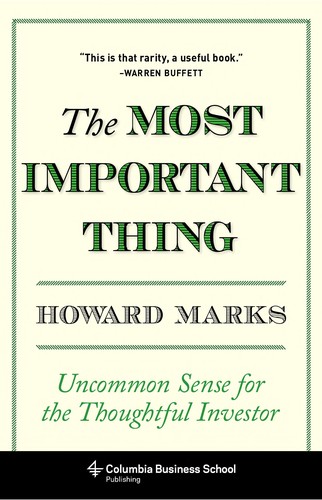
The Most Important Thing by Howard Marks is a 2011 economics book about value investing, risk management, market cycles. Second-level thinking goes beyond the obvious inference to ask what the consensus thinks, how it's already reflected in price, and what needs to be different for the investment to work.
Summary
The Most Important Thing is Howard Marks's collection of investment insights drawn from his decades of memos to Oaktree Capital clients — memos that became famous in investment circles for their clarity, depth, and willingness to address the psychological dimensions of investing that most practitioners avoid. Marks is the co-founder of Oaktree Capital Management, a firm specializing in distressed debt, and has spent his career in parts of the market that most investors avoid. The book distills what he learned into a framework for thinking about risk, market cycles, and the psychology that makes investing difficult.
The organizing concept is "second-level thinking." First-level thinking is the obvious inference: this company looks good, so buy the stock. Second-level thinking asks what everyone else thinks, how the current price already reflects that consensus, and what would have to be different from the consensus for the investment to work out. Marks argues that superior investment returns require seeing something the market doesn't see — and that requires a level of critical analysis that goes beyond the immediately apparent.
The risk framework is the book's most useful contribution. Marks distinguishes between risk and volatility, arguing that permanent loss of capital is the real risk — not short-term price movement. He discusses how risk is invisible in good times (high-risk assets look safe when everything is going up), how the safest-seeming investments at peaks can be the most dangerous, and how genuine risk management requires understanding the full distribution of outcomes, not just the expected outcome. The central insight is that investors who ignore the downside scenarios and focus only on expected returns are not managing risk — they are ignoring it.
The book also addresses market cycles, investor psychology, contrarianism, and the virtues of defensive investing. Marks is unusually direct about what he doesn't know — he explicitly rejects the idea that anyone can reliably predict market direction — and frames successful investing as being roughly right about relative value and risk rather than being precisely correct about future prices. The "Uncommented" and "Illuminated" editions include annotations from prominent investors including Warren Buffett, Joel Greenblatt, Paul Johnson, and Seth Klarman.
Talk to The Most Important Thing like its author wrote you back.
Get the ideas that fit your life — not generic summaries.
- Chat with the book
- Audiobook-style main ideas
- Adapts to your life and goals
- Helps you take action
Key takeaways
- 1.
Second-level thinking goes beyond the obvious inference to ask what the consensus thinks, how it's already reflected in price, and what needs to be different for the investment to work.
- 2.
Risk is not volatility. The real risk is permanent loss of capital. Assets that look safe because prices are stable can represent enormous risk if they are overvalued.
- 3.
Risk is invisible in good times. When markets are rising, high-risk assets look safe because they are performing. This is precisely when risk is being accumulated, not avoided.
- 4.
The full distribution of outcomes matters as much as the expected outcome. An investment with a 70% chance of a good outcome still loses 30% of the time. Understanding the bad scenarios is part of evaluating the investment.
- 5.
Market cycles are driven by psychology more than by fundamentals. The pendulum of investor sentiment swings between fear and greed, and the experienced investor positions for that swing.
- 6.
Contrarianism is not automatically correct. The consensus is often right. The contrarian investor must identify where the consensus is specifically and significantly wrong.
- 7.
Defensive investing — avoiding the big loss — produces better long-run results than aggressive investing that periodically loses everything. Not losing is more powerful than most people realize.
- 8.
Luck plays a larger role in investment outcomes than most successful investors acknowledge. Evaluating decisions by process, not just by outcome, is the only way to distinguish skill from luck.
Discussion questions
Use these on your own, with a book club, or as chat starters in Superbook. Book club version, ready to copy or print →
- 1.
Marks's 'second-level thinking' concept requires knowing what the consensus believes before you can identify where it might be wrong. For any investment you currently hold, what do you think the consensus view is?
- 2.
Marks distinguishes between risk and volatility. Does your own emotional and practical behavior during market declines suggest you experience them as the same thing?
- 3.
The risk-invisibility concept — that risk builds during good times — is counterintuitive enough that investors repeatedly fail to act on it. What conditions today suggest that risk is being accumulated somewhere in markets?
- 4.
Marks is explicit about what he doesn't know: he says reliable market direction prediction is impossible. Which financial commentators or analysts you follow are equally honest about the limits of their knowledge?
- 5.
The full-distribution-of-outcomes framework asks you to think about the scenarios in which an investment fails, not just the expected outcome. For a current holding, what does the failure scenario look like?
- 6.
The pendulum metaphor describes cycles driven by investor psychology. Where would you place investor psychology on the fear-greed pendulum in the current market environment?
- 7.
Marks argues that contrarianism requires identifying where the consensus is specifically wrong. Simply doing the opposite of what everyone else does is not a strategy. In which markets or asset classes do you currently see a consensus view that seems specifically wrong?
- 8.
Defensive investing — avoiding loss over maximizing gains — appeals to some investors and feels too conservative to others. Which approach matches your actual temperament, not your stated preference?
- 9.
The book includes annotations from Buffett, Klarman, and Greenblatt. Does the endorsement from other prominent investors make you more or less critical about the ideas, or does it not affect your evaluation?
- 10.
Marks spends considerable time on the role of luck in investment outcomes. How do you distinguish between skill and luck in your own investment track record?
- 11.
Oaktree specializes in distressed debt — buying the obligations of companies that are in financial difficulty. How does the specialized context of Marks's career shape which of his principles translate to equity investing by individuals?
- 12.
Marks's memos became widely read in investment circles before they were compiled into this book. What does it say about investment education that the best material was distributed informally rather than through conventional channels?
Themes
Frequently asked questions
-
Is The Most Important Thing a practical guide or a philosophical framework?
Both, but more philosophical. Marks provides mental models for thinking about risk, market cycles, and investment decisions rather than specific techniques for finding investments. The second-level thinking and risk frameworks are genuinely actionable, but they improve judgment rather than replace it with a formula.
-
What edition should I read?
The 'Illuminated' edition (2013) includes annotations from Buffett, Klarman, Greenblatt, and Joel Greenblatt that add significant value by showing how other sophisticated investors respond to Marks's ideas. If you can access it, read that version.
-
Who should read The Most Important Thing?
Investors who already understand the basics and want to develop their judgment about risk, market cycles, and investment process. It is not a beginner's book — Marks assumes familiarity with financial statements, valuation concepts, and market history. For readers who already have that foundation, it is one of the most useful books available on investment thinking.
-
How does this book differ from Marks's second book, Mastering the Market Cycle?
The Most Important Thing covers a range of investment principles. Mastering the Market Cycle is specifically about understanding and positioning for the cycles that recur in financial markets. They are companion volumes; both are worth reading.
-
Is second-level thinking achievable for most individual investors?
Marks is not optimistic. He argues that most investors — including many professionals — are stuck at first-level thinking. Second-level thinking requires doing more analysis than the consensus, being willing to hold unconventional positions, and having the patience to be wrong for extended periods before being right. These are rare qualities regardless of education level.
Similar books
The Intelligent Investor
Benjamin Graham
The Snowball: Warren Buffett and the Business of Life
Alice Schroeder
The Essays of Warren Buffett
Warren Buffett
Security Analysis
Benjamin Graham
